%202.png)
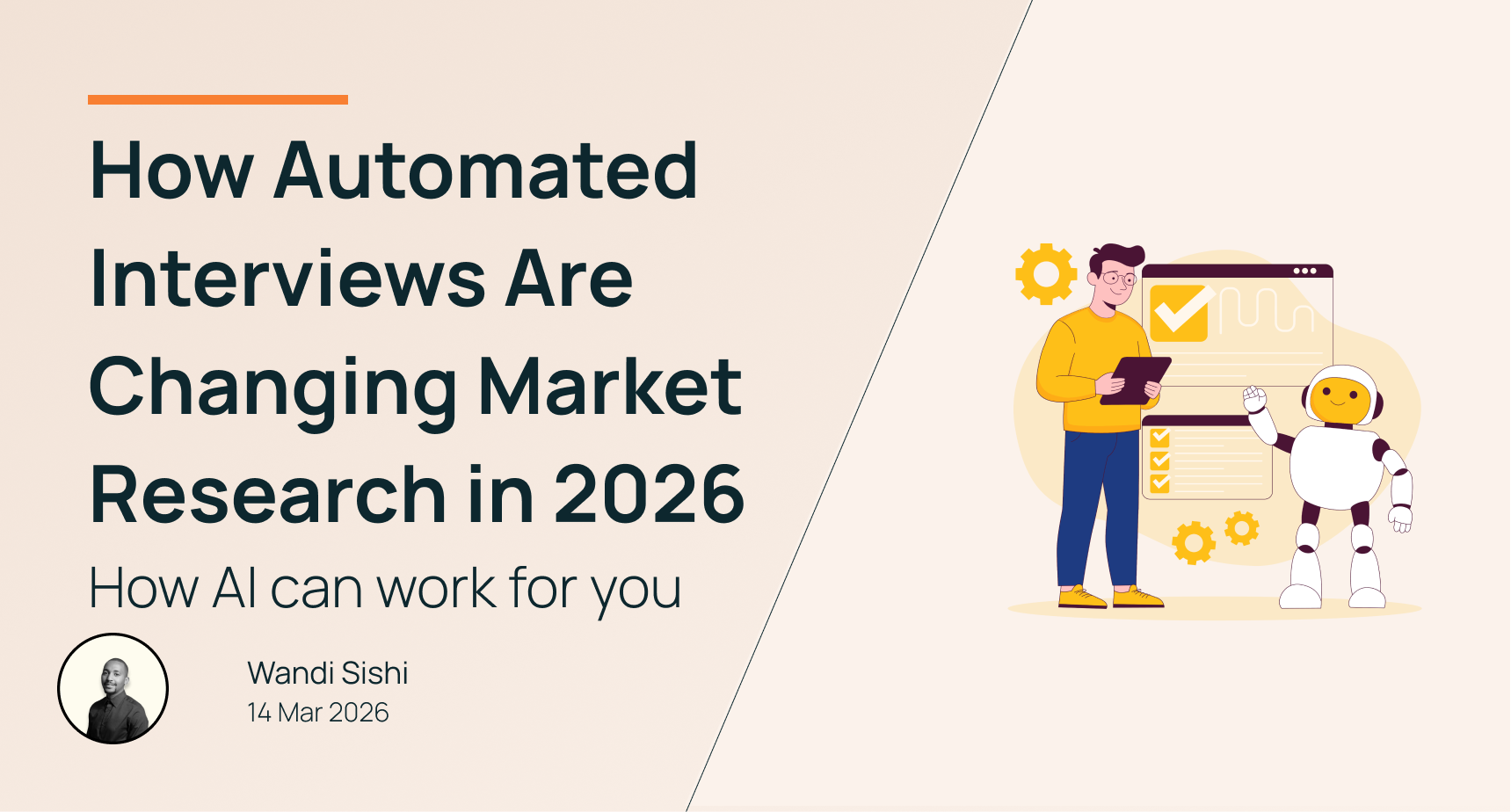
The world of research is changing fast, and the automated interview is at the forefront of this evolution. Imagine being able to conduct hundreds of in depth qualitative interviews overnight, without scheduling a single call. That’s the power of using AI to engage with participants. An automated interview is a conversation conducted by a computer system, using artificial intelligence to ask questions, understand responses, and probe for deeper insights, all without a live human moderator.
This technology combines the scale and efficiency of a survey with the conversational depth of a one on one chat. For market researchers and CX teams, and anyone needing rich qualitative data, it’s a game changer. Let’s dive into how it all works.
How Does an Automated Interview Work? The Tech Behind the Talk
At its core, an automated interview uses sophisticated technology to mimic a human interviewer. It’s not just a simple chatbot running through a script; it’s a dynamic conversational partner designed to gather valuable information. See how Yazi works.
The AI Interviewer Mechanism
The “brain” of an automated interview is typically a large language model (LLM) like OpenAI’s GPT. Here’s a simplified breakdown of the process:
Input: A participant provides an answer via text, voice note, or a live call.
Understanding: The system uses natural language processing (NLP) to interpret the meaning, context, and even sentiment of the response.
Decision: Based on the researcher’s predefined guide and the participant’s answer, the AI decides on the most relevant follow up question.
Output: The AI delivers the next question in a conversational tone, continuing the dialogue.
Throughout this process, researchers maintain control. They set up the interview guide, define the key topics, and establish guardrails to ensure the conversation stays on track and appropriate.
Adaptive Questioning for Deeper Insights
One of the most powerful features of a modern automated interview is adaptive question routing. Instead of a rigid, fixed questionnaire, the AI dynamically changes its questions based on what the participant says. If a user mentions a specific frustration with a product, the AI can intelligently probe deeper into that exact issue.
This dynamic approach yields far richer data. One study found that AI driven follow ups led to a 3.5× increase in the total words participants shared compared to their initial answers. By listening and reacting, the AI interviewer can uncover nuances that a static survey would miss entirely.
The Brains of the Operation: OpenAI and Twilio
Most platforms don’t build their AI from scratch. They leverage powerful, specialized services through API integrations.
OpenAI Real Time API Integration: Platforms like Yazi can integrate with OpenAI’s models to power their AI interviewers. With over a million customers using OpenAI technology, these models provide world class language understanding. This allows the AI to conduct fluent, context aware conversations in real time, making the experience feel natural for participants.
Twilio Voice Integration: For voice based interviews, services like Twilio are the backbone. Twilio handles the complex world of telephony, allowing an AI to make and receive phone calls globally. With about 35% of the market share in its category, Twilio provides the reliable infrastructure needed to record calls, convert speech to text, and deliver the AI’s voice using text to speech technology.
The Participant Experience: Talking to a Bot
Technology is only half the story. The real test of an automated interview is how participants feel about the experience. The results are surprisingly positive.
Convenience is King: The Self Paced Interview
Unlike traditional interviews that require scheduling gymnastics, an automated interview is typically self paced. Participants receive a link and can start, pause, and complete the conversation whenever it’s convenient for them, 24/7. This flexibility is a huge benefit, as it reaches people who wouldn’t commit to a scheduled call, such as busy professionals or parents. Data collection that used to take weeks can now be completed in a matter of days.
Do People Actually Prefer AI Interviewers?
While it might seem counterintuitive, many people are very comfortable talking to an AI. Research shows that over 90% of participants felt comfortable and were open and honest when answering an AI’s questions. Some even forgot they were talking to a machine.
There are a few reasons for this high level of comfort:
Less Judgment: Participants often feel less social pressure and fear of judgment when talking to an AI, leading to more candid answers on sensitive topics.
Consistency: Every participant gets the same unbiased experience, which some perceive as fairer than interacting with a human interviewer who might have an off day.
Engagement: A conversational format is often seen as more engaging and less tedious than filling out a traditional survey form.
Social Presence and Feeling Heard
Social presence is the feeling of connection with another person in a conversation. An automated interview has a lower social presence, which is a double edged sword. The lack of a human can reduce inhibitions and social desirability bias, leading to more honest data.
However, some participants miss the empathetic feedback of a human, like a nod or a reassuring “I understand”. Well designed AI can mitigate this by using a friendly tone and asking relevant follow ups that make the participant feel listened to, even without a human on the other end.
Automated Interview vs. Traditional Methods: A Head to Head Comparison
So, how does an automated interview stack up against a traditional, human moderated one? Each has its strengths and is suited for different research needs.
Feature | Automated Interview | Traditional Interview |
|---|---|---|
Scale | High (hundreds or thousands) | Low (tens) |
Speed | Very Fast (days) | Slow (weeks or months) |
Cost | Low (around $5 to $20 per session) | High (around $150 to $300 per session) |
Consistency | Perfect | Variable (interviewer bias) |
Empathy | Limited (simulated) | High (genuine) |
Flexibility | Moderate (within guardrails) | Very High (can improvise) |
Achieving Qualitative Research at Scale
The biggest advantage of the automated interview is its ability to scale qualitative data collection. You can get the “why” behind the numbers from a much larger and more representative sample. It’s now possible to conduct 100 AI led interviews in just 48 hours, a feat that would be impossible for a small research team. See our case studies. This allows you to segment findings by user type or market and still have a robust sample size for each group, leading to more confident decisions.
Understanding the Limitations on Depth and Flexibility
While powerful, AI interviewers have limitations. They struggle to read subtle emotional cues like hesitation or a quiver in the voice. For deeply sensitive or complex topics like personal trauma or major life decisions, the empathy and judgment of a skilled human moderator remain irreplaceable. An AI follows its programming and can’t easily pivot to explore a completely unexpected but fascinating tangent the way a person can.
The Researcher’s Playbook: From Setup to Analysis
Running a successful automated interview study involves a clear workflow, from choosing the right use case to analyzing the final results.
Choosing Your Moment: Use Case Selection
Deciding when to use an automated interview is key. It excels in scenarios like:
Large scale validation of insights from smaller studies.
Global research projects that span multiple time zones and languages.
Voice of the Customer (VoC) programs requiring continuous feedback.
Diary studies where an AI can check in with participants periodically.
Concept testing for new products, ads, or features.
For exploratory research that requires deep empathy and flexibility, a hybrid approach often works best. A team might conduct a few human led interviews to identify key themes, then deploy an AI interviewer to validate those findings with hundreds of people.
Getting the Word Out: Interview Link Distribution
Once your study is designed, you need to invite participants. While email is an option, channels with higher open rates are more effective. Messaging apps are a fantastic choice, as text messages have an open rate of around 98%.
Platforms like WhatsApp, which has over 3 billion monthly users, are perfect for distribution. A platform like Yazi’s WhatsApp AI interviewer integrates directly, allowing you to send interview invites that participants can start right within the app they use every day. This convenience dramatically boosts response rates.
The Analysis Workflow: Transcripts, Sentiment, and Insights
After the fieldwork is done, the real work begins. An automated platform streamlines the result analysis workflow.
Interview Recording and Transcription: Voice responses are automatically recorded (with consent) and transcribed into text with high accuracy. This saves countless hours of manual work.
Sentiment Analysis: The platform’s AI can analyze the transcripts to automatically classify responses as positive, negative, or neutral. This provides a quick overview of participant attitudes and helps identify trends.
Data Storage and Export: All data, including transcripts and recordings, is stored securely. Researchers can typically export this data as CSV or Excel files for further analysis in other tools.
Staying in Control: Researcher Agency and Data Privacy
Despite the automation, the researcher is always in control. You design the questions, set the conversational flow, and interpret the final data. Human oversight is a critical part of the process.
Furthermore, data privacy is paramount. Any reputable platform must comply with regulations like GDPR and POPIA. This involves:
Obtaining explicit consent from participants.
Storing data securely with encryption.
Anonymizing personal information where possible.
Having clear data retention and deletion policies.
Platforms built with privacy in mind, like Yazi’s data security and compliance, allow you to conduct research ethically and lawfully, maintaining participant trust.
A Closer Look: The Voice Based Automated Interview
While many automated interviews are text based, a voice based AI interview setup offers unique advantages. Participants can simply speak their answers, which is often faster and more natural than typing. The average person speaks at 200 to 250 words per minute, far faster than the average typing speed of 40 to 50 wpm.
This means you can capture more detailed, narrative responses in a shorter amount of time. A voice based automated interview is perfect for gathering rich stories and can be more accessible for participants who are less comfortable with typing. This can be done through a direct phone call (powered by a service like Twilio) or via voice notes on an app like WhatsApp.
Frequently Asked Questions about the Automated Interview
1. What is an automated interview?
An automated interview is a research method where an AI system, rather than a human, conducts an interview. It uses natural language processing to ask questions, understand answers, and ask relevant follow ups in a conversational way.
2. Are automated interviews effective?
Yes, for the right use cases. They are extremely effective for gathering in depth qualitative data at scale, offering incredible speed, cost efficiency, and consistency. They are particularly good for validation studies, concept tests, and continuous feedback programs.
3. Can AI replace human interviewers?
Not entirely. While an automated interview excels at scalable and structured conversations, skilled human interviewers are still essential for topics requiring deep empathy, complex emotional understanding, and the ability to improvise. Many researchers use a hybrid approach, combining the strengths of both.
4. What are the main benefits of an automated interview?
The primary benefits are scale (conducting hundreds of interviews simultaneously), speed (collecting data in days, not weeks), cost savings, and consistency (no interviewer bias). They also offer great convenience for participants.
5. How do you ensure data privacy in an automated interview?
Data privacy is ensured through compliance with regulations like GDPR. This includes getting informed consent, using secure and encrypted data storage, anonymizing data, and having clear policies for data deletion. Choosing a compliant platform is crucial.
6. What kind of research is best for an automated interview?
It is ideal for research where you need qualitative depth from a large number of people. This includes customer experience (CX) studies, UX research, concept testing, diary studies, and any project where you need to validate findings across a broad audience quickly.
Ready to see how an automated interview can transform your research process? Request an AI interviewer demo to start gathering deeper insights at scale today.