%202.png)
Run multi-day tracking studies that capture life as it happens - photos, voice notes, and real moments - without asking your participants to download a single thing.


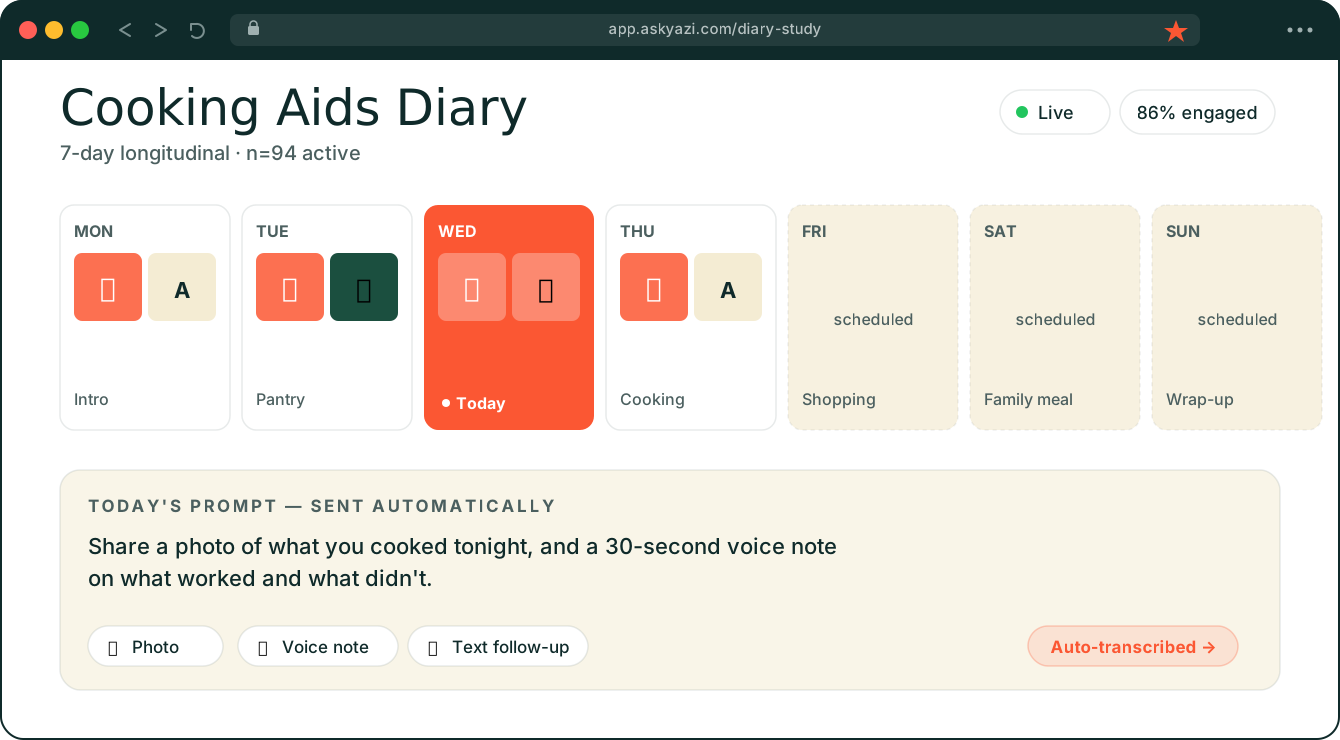
Define the days, prompts, media types and reminders. Visual journey editor - no spreadsheets.
Send a single WhatsApp message. Participants opt in with one tap - no app, no email.
Yazi handles reminders, follow-ups and missed days. Participants stay engaged, you don’t chase.
Photos, voice and text auto-themed by day. Watch patterns emerge before the study ends.

Diary tools that demand an app install lose 40–60% of recruits before day one. WhatsApp lives in the same place as messages from family, so participation feels like a habit, not a chore whilst you can track daily progress and changes.
No download, no login. The chat thread feels like a friend checking in. Median engagement of 86% by day three across studies.
Participants share in the format that feels most natural. Voice notes get transcribed in 100+ languages automatically.
Smart-time reminders, missed-day follow-ups, and graceful “almost there” nudges - all configurable, all in the same thread.
Themes update as participants respond. Spot the unmet need on day three — not after a six-week debrief.
Capture decision-making at the shelf, not from memory two days later.
Send a sample, capture first-use, day-three, and day-seven reactions with voice and video.
100 day-in-the-life diaries in the time it used to take to run 8 home visits.
15 minutes to scope. Same week to field. We’ll run a pilot with you.
Discover why leading agencies and researchers trust Yazi for their data collection needs. Hear directly from our satisfied clients who've experienced the transformative power of our platform.
.png)
"Yazi has quickly become a key research partner, replacing older and more established research houses who have higher fixed costs and who struggle to create and maintain a business-to-business relationship. Extremely happy. I highly recommend Yazi Research."

"The established techniques we had been in field for about three weeks and with Yazi, we were able to create our questionnaire launch and get feedback within a 24-hour cycle... Here you're able to get a very good sense very quickly about what works or what doesn't work or what types of things may need further investigation."

"Yazi really simplified data collection for us, increased our engagement, increased our response rate, and gave us an overall better platform to collect quality data for our clients. Through using the tool, we can see Yazi being leveraged in other research activities such as price collection through OCR, customer satisfaction, customer experience, and mystery shopping."

"The results Yazi delivered were outstanding. Their platform allowed us to engage with Gen Z on their preferred platform, WhatsApp, and the AI interviewer provided deep insights that we hadn't captured with traditional methods. The real-time feedback and rich qualitative data from voice notes gave us the edge we needed to understand our future customers better. We’re excited to apply these insights to the retailer's marketing strategies."

"Yazi was a game-changer for us! It helped us connect with a typically hard-to-reach audience via WhatsApp, opening up a whole new segment for our research. It was quick, cost-effective, and highly personalised. We received our results in less than 24 hours! Yazi saved us loads of time and empowered us with valuable insights to make informed product development decisions based on a deeper understanding of our audience."
.png)
"With AI voice surveys we've generally gotten response rates of under 5%, so we didn't know what to expect. You mentioned 22% is average for you, and these two pilots are very close to that. I'm pleasantly surprised."

"I know our global team wants to do ticketing through WhatsApp, and they saw what we did, and they loved it."

"Overall it was a very good piece of work… from a marketing standpoint [they have] a clear direction on what [they] need to do, and it's backed up by the voice of the customer."

We have gathered the answers to common queries about how Yazi facilitates revolutionary market research through WhatsApp, alongside a host of other insightful information.
A WhatsApp diary study is a longitudinal research method where participants document their daily behaviors, experiences, or product usage directly through WhatsApp chat over a period of time. Instead of logging into a separate app or website, participants communicate with researchers (or automated systems) through the messaging app they already use, significantly lowering barriers to participation in qualitative research.
Traditional diary studies often rely on physical journals, email logs, or dedicated research apps that feel like "homework." WhatsApp diary studies feel like natural conversations. They capture data "in the moment" rather than relying on end-of-day recall, resulting in more authentic, immediate, and detailed insights. The familiar WhatsApp interface also reduces participant training time and technical barriers.
Traditional mobile ethnography requires participants to download specific apps and create new accounts, creating significant drop-off. WhatsApp diary studies eliminate this friction entirely since participants already use WhatsApp daily. Additionally, researchers typically ask participants to pin the diary chat to the top of their WhatsApp, keeping it visible and top-of-mind throughout the study period. This results in substantially higher completion rates compared to the 40-55% typical of dedicated research apps.
Yes. WhatsApp diary study platforms can schedule automated "nudges" and triggers that fire at specific times of day or based on participant behavior (e.g., "Don't forget to log your lunch"). Because these appear as standard WhatsApp notifications, they are seen almost immediately, maintaining high compliance throughout multi-day studies.
Participants can submit text, voice notes, photos, and videos directly through WhatsApp. This is ideal for tasks like "show us your pantry," "record your unboxing experience," or "tell us how you feel right now." All media uploads instantly to research dashboards, and voice notes are typically auto-transcribed for analysis.
There is no technical limit to WhatsApp diary study duration. Studies can range from a few days to several weeks or months. For longer studies, platforms typically support engagement strategies like chat pinning and automated incentive tracking to maintain participant motivation throughout extended research periods.
Yes. While diary studies can be fully automated, most WhatsApp research platforms offer "agent takeover" functionality. This allows human researchers to step into the chat, view incoming responses in real-time, and ask follow-up questions or clarify instructions manually when needed.
WhatsApp is designed for stability in low-bandwidth areas. If participants are offline, their diary entries (including photos and videos) are stored locally and uploaded automatically once they reconnect. This makes WhatsApp diary studies ideal for research in areas with spotty internet coverage.
WhatsApp diary study platforms typically provide real-time dashboards that aggregate all participant data. This includes automated transcription of voice/video content, thematic analysis of text responses, and demographic filtering capabilities. Most platforms allow data export to Excel/CSV or can generate presentation-ready summaries automatically.


