%202.png)
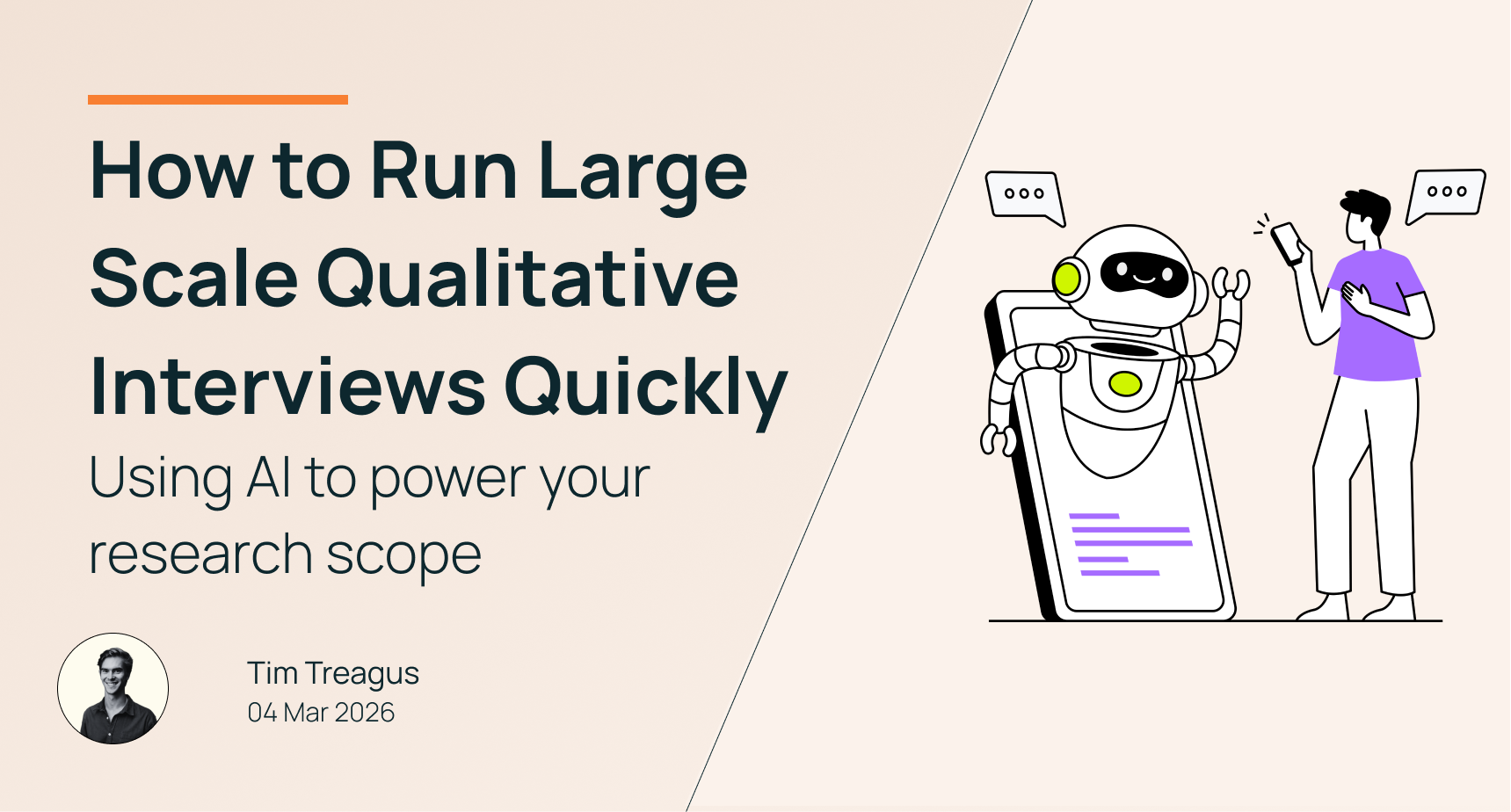
Qualitative research offers incredible depth, uncovering the “why” behind user actions. But let’s be honest, traditional methods can be painfully slow. Scheduling, conducting, transcribing, and analyzing one on one interviews takes a huge amount of time and resources. So, how do you get rich, human insights without the logistical nightmare? The answer lies in technology.
This guide explores modern techniques and tools that show you exactly how to run large scale qualitative interviews quickly, turning a process that once took weeks into something you can accomplish in days, or even hours.
The Foundation: AI Interviewers and Automated Phone Calls
The core of modern, rapid qualitative research is automation. Instead of a human asking every question, specialized AI systems can now handle the conversation, allowing you to scale your efforts massively.
AI Interviewer Setup with Twilio Voice and OpenAI
An AI interviewer is an automated system that conducts spoken interviews over the phone. Using a combination of a telephony API like Twilio Voice and a real time AI language model like OpenAI’s GPT 4, these systems can hold surprisingly natural conversations.
The technology streams call audio to the AI, which generates dynamic questions and even spoken replies, making the experience feel like talking to a real person. This isn’t just a futuristic concept; Twilio reports that over 300,000 customers now have the ability to build these compelling voice experiences. These AI interviewers can manage conversation pacing and handle interruptions to sound more human. For example, the hiring platform Indeed, built on Twilio, hosted over 200,000 virtual interviews in 2020 alone to speed up its hiring process.
The Power of the Phone Based Automated Interview
A phone based automated interview is simply an interview where a computer, not a person, asks the questions. This method allows you to reach a massive audience quickly and consistently. Every participant hears the exact same question, which removes interviewer bias.
This approach is incredibly effective for reaching people who may not be online, a crucial factor in many emerging markets. For a deeper dive into why WhatsApp is particularly effective for market research in Africa, see this guide. With mobile phone ownership soaring (there were over 440 million mobile subscribers in sub Saharan Africa by 2017), automated calls are a viable research tool. In the world of hiring, automated calls solve a major pain point: scheduling. A staggering 42% of candidates drop out when interview scheduling takes too long. Automated systems let candidates respond on their own time, transforming a process that took weeks into one that takes hours.
Distribution and Data Collection at Scale
Once you have an automated interviewer, the next challenge is getting it in front of people efficiently and ethically.
Asynchronous Link Based AI Interview Distribution
Asynchronous link based distribution means sending participants a link they can click to start an AI driven interview on their own schedule. This simple shift eliminates the single biggest bottleneck: coordinating calendars.
Instead of endless back and forth, you can send hundreds or thousands of interview links via SMS, email, or WhatsApp. This on demand approach dramatically shortens research timelines. The adoption of asynchronous methods has skyrocketed; what was used by only 10% of top companies in 2012 is now standard practice for about 70% of recruiters. For many researchers, learning how to run large scale qualitative interviews quickly starts right here.
A quick tip: delivering these interviews on a platform your audience already uses and trusts is key. For instance, platforms like Yazi conduct interviews natively within WhatsApp, removing extra steps and boosting completion rates, especially in mobile first regions.
Local Call Recording for Privacy Compliance
When you’re recording interviews, privacy is paramount. Local call recording means storing audio files within the same country or region where the call originated. This is essential for complying with data protection laws like Europe’s GDPR and South Africa’s POPIA.
Many regulations have strict rules about transferring personal data across borders. For example, GDPR fines for violations can be as high as €20 million or 4% of a company’s global annual turnover. Storing data locally is the simplest way to ensure compliance. This involves more than just storage location; you must also get explicit consent to record, state your purpose, and secure the data.
Prompt Configuration for Dynamic Follow Up Questions
The magic of a great qualitative interview is in the follow up questions. A well configured AI can replicate this. Prompt configuration is the process of giving the AI instructions on how to ask relevant, on the fly follow ups based on a participant’s answers.
You’re essentially briefing the AI, telling it things like, “If a participant mentions an emotion, ask them why they feel that way.” This transforms a static script into a dynamic conversation. Well crafted follow up questions consistently yield deeper insights than a simple questionnaire. It’s how you bridge the gap between a survey’s scale and an interview’s depth.
In Product Micro Surveys for Real Time Feedback
An in product micro survey is a very short, one to three question survey embedded directly within an app or website. It’s a fantastic way to capture qualitative feedback at the exact moment a user is experiencing something. Because these surveys are short and contextually relevant, they often achieve response rates of 10% to 30% or even higher, far surpassing traditional email surveys. By including an open ended question, you can gather thousands of snippets of qualitative feedback that reveal the “why” behind user behavior. If you need inspiration on what to ask, explore this survey question bank.
Processing the Data: Turning Conversations into Insights
Collecting hundreds of interviews is one thing; making sense of them is another. This is where AI powered analysis provides another massive speed advantage.
Automated Transcription and Translation
The first step in analysis is getting a written record of the conversation. Automated transcription services use AI to convert speech to text in minutes, eliminating the need to wait days or weeks for a human transcriber.
Modern AI models have become incredibly accurate. OpenAI’s Whisper model, for instance, was found to match or even exceed human accuracy in transcribing English. These systems can also handle translation. Services like Google Translate now support hundreds of languages, with Google adding 110 new languages in 2024 alone. This means you can conduct an interview in one language and get an accurate English transcript almost instantly, making global research more feasible than ever.
For researchers working across Africa’s diverse linguistic landscape, tools like Yazi can be a game changer. It can auto transcribe voice notes and instantly translate responses from over 100 languages into a consolidated English report.
Automated Text Analysis for Rapid Theme Extraction
Once you have your transcripts, automated text analysis uses AI to quickly identify common themes, patterns, and sentiments. Instead of a human team spending weeks manually reading and coding responses, algorithms can categorize and summarize vast amounts of text in minutes. This is a crucial skill for anyone who wants to know how to run large scale qualitative interviews quickly. Large language models (LLMs) can sift through volumes of text that would be impossible for a human team, grouping responses into themes like “price concerns” or “customer service issues.”
Ensuring Quality and Rigor in AI Assisted Analysis
Speed is great, but not at the expense of quality. A robust workflow combines the power of AI with the critical thinking of a human researcher.
Codebook Driven LLM Coding of Transcripts
This hybrid approach combines human expertise with AI speed. A researcher first creates a codebook, which is a set of predefined themes or categories. Then, you feed this codebook to a large language model and ask it to code the interview transcripts accordingly. The AI does the initial, heavy lifting of tagging the data, and the researcher validates the output. This process preserves the interpretive depth of human analysis while massively scaling the volume of data you can process.
Transcript Chunking for Scalable Coding
AI models have limits on how much text they can process at once (this is called a context window). Transcript chunking involves breaking long transcripts into smaller, manageable segments. This ensures the AI can process the entire interview without losing context or accuracy. Research shows that an LLM’s coding accuracy can drop on longer documents, making chunking an essential best practice for reliable results.
Exporting Coded Data to NVivo or MAXQDA
Many researchers rely on specialized qualitative data analysis (QDA) software like NVivo or MAXQDA. The good news is that you don’t have to abandon your favorite tools. You can use an AI platform to do the initial coding and then export the coded data (often as a CSV or Excel file) directly into NVivo or MAXQDA for deeper, more nuanced analysis. This bridges the gap between AI powered speed and traditional academic rigor.
The Importance of Human in the Loop Review
No matter how advanced the AI, human oversight is critical. A human in the loop review means a researcher oversees, checks, and corrects the AI’s work. The AI does a first pass, and a human refines the output, catching nuances, sarcasm, or context the machine might have missed. Studies have found that relying solely on LLMs for coding can lead to low accuracy. AI should augment the researcher, not replace them.
Inter Coder Reliability Monitoring
To ensure your analysis is consistent and not just one person’s subjective interpretation, you need to monitor inter coder reliability. This involves having two or more coders (who could be humans or an AI and a human) independently code a subset of the data. You then measure their level of agreement using statistics like Cohen’s Kappa. A high level of agreement gives you confidence that the coding is reliable.
Building a System for Continuous Insight
The ultimate goal isn’t just to run one study quickly. It’s to create an ongoing conversation with your users.
A continuous qualitative research workflow means you are constantly collecting and analyzing feedback, rather than doing sporadic, one off studies. This agile approach allows you to catch emerging trends early and make more informed decisions in real time. The COVID 19 pandemic accelerated this shift, with one survey finding that 81% of professionals believe virtual interviews are here to stay.
With tools that automate outreach, analysis, and reporting, a small team can maintain an “always on” research program. One case study in South Africa saw a research effort that traditionally took three weeks get compressed into just 24 hours using an AI moderated WhatsApp study, a 90% reduction in time. This is the power of learning how to run large scale qualitative interviews quickly.
If you’re ready to embrace these modern methods and get closer to your customers, book a demo to see how Yazi can help you scale your qualitative research today.
Frequently Asked Questions
1. What is the fastest way to conduct a large number of qualitative interviews?
The fastest method combines several technologies. Using an AI interviewer distributed through asynchronous links (like via WhatsApp or email) allows you to run hundreds of interviews simultaneously without scheduling conflicts. Automating the transcription, translation, and initial thematic analysis further accelerates the process from weeks to days.
2. How can AI help me run large scale qualitative interviews quickly?
AI can automate nearly every step. AI interviewers conduct the conversations, AI transcription and translation tools process the audio, and AI text analysis models extract key themes and sentiments from the transcripts. This removes the most time consuming manual labor from the workflow.
3. Are automated interviews as good as human interviews?
While they lack the nuanced empathy of a skilled human, AI interviewers are incredibly effective for many research goals. They are consistent, unbiased, and can ask intelligent, dynamic follow up questions. For large scale projects, the benefits of speed and scale often outweigh the limitations, providing deep qualitative insights that would otherwise be unattainable.
4. How do you analyze data from hundreds of interviews quickly?
The key is AI powered text analysis. After your interviews are automatically transcribed, you can use large language models to perform thematic analysis. These tools can read through all the transcripts, identify recurring topics, and even analyze sentiment, presenting you with a summary of key findings in a fraction of the time it would take a human team.
5. Is it possible to do qualitative research in multiple languages at scale?
Yes, absolutely. Modern platforms can automate both transcription and translation. You can interview participants in their native language (over 100 are often supported), and the system will provide you with an English transcript and consolidated report. This makes global qualitative research faster and more affordable than ever.
6. How do I ensure data quality with automated methods?
Quality control is crucial. Best practices include using a “human in the loop” approach to review and validate the AI’s coding, monitoring inter coder reliability between the AI and a human analyst, and carefully designing your AI’s prompts to ensure it asks relevant and probing questions.
7. What tools do you recommend to run large scale qualitative interviews quickly?
Platforms that integrate multiple functions are most efficient. Look for tools that offer AI moderated interviews, support for channels like WhatsApp where your users are active, and have built in automated transcription and analysis. Solutions like Yazi are purpose built for this kind of work in emerging markets, combining these features into a single workflow.
8. How does this approach save money?
It saves money by drastically reducing the hours of human labor required. You save on the costs of interviewers, transcribers, translators, and manual data coders. The ability to complete research projects in a fraction of the time also leads to faster decision making and a quicker return on your research investment. For plan details, see our pricing.