%202.png)

AI Moderation Tools for Qualitative Research & Interviews
A practical comparison of eight platforms for scaling in-depth interviews, updated for 2026
AI-moderated interviews (AIMIs) have moved from experiment to everyday method. Instead of scheduling one-on-one sessions with human moderators, these platforms use large language models to run adaptive conversations with hundreds of participants at the same time. The promise is qualitative depth at quantitative scale, delivered in days rather than weeks.
The category has also grown up fast. Platforms differ a lot in approach. Most send participants a link to a web page where they answer by video, voice or text, and one runs the whole study inside WhatsApp. Some are built for a single interview, while others can run diaries, surveys and interviews together over days or weeks. And not every platform is built for the same research context.
This guide compares eight AI moderation platforms to help you choose the right tool for your next study. We look at interview format, language support, analysis, recruitment and integrations, and which research scenarios each one suits best.
What's Changed in 2026
A year ago most of these companies were early-stage startups. In 2026 the market looks different:
• Big money has arrived. Listen Labs raised a $69M Series B in January 2026, Outset raised a $30M Series B at the end of 2025, and Conveo announced a $50M Series A in September 2026.
• Consolidation has started. In September 2026 Salesforce signed a definitive agreement to acquire Listen Labs, in a deal reported at around $2 billion. It is the clearest sign yet that AI interviews are becoming part of the enterprise customer data stack.
• From projects to always-on. Outset has launched an AI-native customer experience platform, Conveo now runs recurring interview programmes, and Verso builds consumer personas that update with every study. The direction of travel is continuous listening rather than one-off projects.
• New entrants keep coming. Verso, a Paris-based platform that raised a $6M seed round in October 2026, joins this year's list.
What Are AI-Moderated Interviews?
AI-moderated interviews use conversational AI to run semi-structured interviews asynchronously. Unlike static surveys, the AI adapts its follow-up questions to what each participant says, probing for clarity, asking for examples and exploring how people feel.
Research from Glaut's comparative study found that AI-moderated interviews delivered 129% more words per response than traditional surveys, with 66% of transcripts rated higher quality. Completion rates were 61% for AI interviews versus 39% for static surveys when adjusted for meaningful interactions. The 'gibberish' rate (low-quality or nonsensical responses) was 26% for AIMIs compared to 56% for traditional surveys.
These platforms typically handle three core functions:
1. Interview design: Researchers create discussion guides or upload briefs, and the AI generates adaptive question flows.
2. Data collection: Participants respond by text, voice or video at a time that suits them. The AI moderates in real time, asking follow-ups based on their answers.
3. Analysis: Automated transcription, thematic coding, sentiment analysis and report generation.
Platform Comparison at a Glance
The table below summarises the key differences across the eight platforms reviewed. Most vendors price on a custom quote, so we've left pricing out and focused on how each platform works.

Detailed Platform Reviews
Yazi: Interviews, Diaries and Surveys Inside WhatsApp
Every other platform in this list sends participants to a web link. Yazi is the only one that runs the whole study inside WhatsApp, the app people already open dozens of times a day. There's nothing to download and no browser tab to keep open, and participants answer the way they'd reply to a friend: a quick text, a voice note on the way home, a photo of what's in the fridge. Yazi has seen response rates six to seven times higher than traditional survey channels as a result.
More than a single interview: Yazi runs AI-moderated interviews, surveys, diary studies and moderated WhatsApp group discussions from one platform. That means a study doesn't have to be one conversation. Researchers can screen with a short survey, follow up with an AI interview, then keep participants engaged for days or weeks.
Diary and multi-activity studies: Studies can be built as a sequence of activities (AI interviews, surveys, photo and video tasks, in-the-moment check-ins) scheduled and unlocked over time. Participants can also send an entry whenever something happens, and the AI can probe on it. It suits usage diaries, path-to-purchase work, product trials and pre-tasks before a group.
AI and human moderation in the same study: The AI moderator follows the discussion guide, probes and adapts in real time, but a researcher can step in and take over any conversation live, then hand it back. Group discussions can be run by a human moderator or the AI. You get the scale of AI with a human in the room when it matters.
Reporting: Responses are coded into themes as they arrive, with an AI-written executive summary you can edit and export to PDF or PowerPoint, cross-tabs, searchable transcripts that read like the original WhatsApp chat, and video highlight reels cut from participants' own voice notes and videos.
Language and reach: Natively moderates in English, isiZulu, isiXhosa, Afrikaans, Setswana, Sesotho, Swahili, French, Portuguese and others, with AI translation covering 100+ languages. Recruit from Yazi's own panel across 15+ countries, through its panel partners, or from your own customer list.
Quality and compliance: Automated quality checks flag inconsistent answers and responses that look AI-generated. Yazi is POPIA, GDPR and CCPA compliant, with research data hosted in the UK.
Where it fits less well: Screen-share prototype testing, which the browser-based platforms below handle better.
Best suited for: Diary and multi-activity studies; research that mixes quant and qual in one study; teams who want AI scale with human control; mobile-first audiences in Africa, Latin America, Asia, the Middle East and anywhere WhatsApp is the default way people talk.

Outset: Enterprise Video Interviews and Always-On CX
Outset has raised $51 million in total, including a $30M Series B in December 2025 led by Radical Ventures with participation from M12, Microsoft's venture fund. Backed by Y Combinator and used by companies including Microsoft, Nestlé, Uber, HubSpot and WeightWatchers, it is positioned as the enterprise choice for scaling qualitative research.
Format and methodology: Video, voice and text interviews. A standout feature is screen share, which lets participants walk through prototypes while the AI moderator asks questions, effectively usability testing at scale. Supports Figma prototype integration.
What's new: Alongside the Series B, Outset launched an AI-native customer experience management platform that takes its AI interviews beyond standalone studies and across the customer journey, replacing multiple-choice feedback with conversational agents.
Analysis capabilities: Automated theme identification, sentiment analysis and video highlight reels. The 'Explore' feature supports cross-study analysis, so researchers can query insights across multiple projects.
Language support: 40+ languages, with live translation.
Pricing: Annual subscription with custom pricing based on seats and usage. Integrates with recruitment partners such as User Interviews and Prolific.
Best suited for: Large enterprises with established research budgets; usability and prototype testing; concept validation at scale; teams moving towards always-on customer feedback.

Listen Labs: Enterprise Scale, Now Joining Salesforce
Listen Labs won the IIEX Insight Innovation Competition in 2024 and has grown fast since. It raised a $69M Series B led by Ribbit Capital in January 2026, reports more than one million interviews conducted, and counts Microsoft, Perplexity and Robinhood among its customers. In September 2026 Salesforce signed a definitive agreement to acquire the company, with the deal expected to close later in Salesforce's financial year.
Format and methodology: Voice, video and text interviews. Participants can answer in the mode and language of their choice, at a time that works for them. Screen recording supports UX research.
Standout features: Fraud detection that reportedly cuts invalid responses from a typical 20% to near zero. Automated reports, presentation-ready decks, video highlight reels and a searchable interview repository. Supports 50+ languages.
Recruitment: Access to a panel of around 30 million pre-qualified people, or bring your own participants.
Compliance: SOC 2 Type II, GDPR, ISO 42001, ISO 27001 and ISO 27701 certified. Data is not used for LLM training.
Worth knowing: Salesforce has said the acquisition will complement Marketing Cloud and Service Cloud. If you are not a Salesforce customer, it is worth asking how the product roadmap and standalone availability will look after the deal closes.
Best suited for: Enterprise teams that need strong security compliance; global multi-market studies; teams that want polished deliverables (decks, reels) for stakeholders; Salesforce-centric organisations.

Tellet: European Voice-First Interviews
Amsterdam-based Tellet built its positioning around European data handling, running its models on Microsoft Azure OpenAI Services within the EU. It is GDPR compliant and lists ISO 27001 certification as in progress, so teams with strict residency requirements should confirm current hosting and certification details during procurement.
Format and methodology: Voice-first, with video and photo uploads. Participants are encouraged to respond with voice notes, which Tellet says produces answers far longer than survey open-ends.
Unique feature: 'AI Search' lets researchers question transcripts conversationally after fieldwork, asking things like 'How did customers with families feel about the new design?' and getting relevant quotes and themes back from across every transcript.
Language support: 50+ languages for interviews and analysis. Participants can choose their language while the discussion guide stays in English.
Recruitment: Send a link to your own customers, or recruit through the panel providers Tellet integrates with.
Best suited for: European agencies and brands; GDPR-conscious organisations; CSRD stakeholder interviews; teams that want fast exploratory voice research.

Glaut: Voice-First for Research Agencies
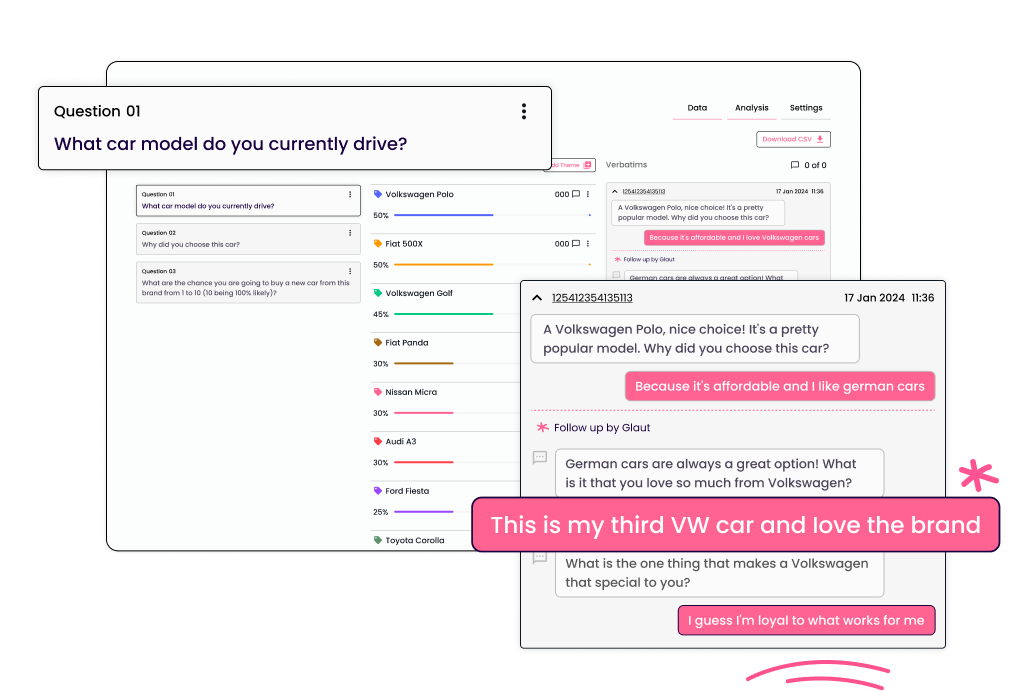
Glaut positions itself as a platform built for experienced researchers rather than a 'black box' that automates research end to end. Its customers include major agencies such as Ipsos and Kantar, and it is designed to give researchers control over every step.
Format and methodology: Voice-based AI-moderated interviews, with the option to type for accessibility, alongside classic surveys. Voice creates a more conversational atmosphere that encourages participants to say more.
Analysis approach: Real-time coding of open-ended responses, crosstabs and patterns across segments, with every finding traceable back to the original respondent. Researchers can set analysis goals or supply their own codebook, and the platform can infer measures like purchase likelihood or NPS from verbatims without asking directly.
What's new: Glaut OS, an agentic layer with specialised agents across the research lifecycle, a chat assistant for natural-language analysis linked back to verbatims, and a report workspace with PowerPoint export. An 'uncooperative detector' flags low-quality responses in real time.
Quant integration: Glaut can embed directly into quantitative surveys via iframe, so respondents complete AI-moderated open-ended questions within the same survey flow.
Compliance: GDPR-compliant and ISO 27001 certified, re-audited annually.
Best suited for: Research agencies looking for white-label solutions; hybrid qual-quant studies; brand tracking and asset testing.
Yasna: Budget-Friendly with Built-In Recruitment
Yasna, based in Bratislava, Slovakia, has one of the most transparent, self-serve pricing models in the category. Its AI moderator is designed to use the discussion guide as a compass rather than a script, following the conversation where it leads.
Format and methodology: Chat-based interviews with a voice response option. Participants reply by text or voice message in a messenger-style interface, which helps create a relaxed environment where people open up.
Standout features: Built-in recruitment across 60+ countries. Researchers describe their target audience in plain language and Yasna generates a screener automatically. A library of interview guide templates covers common research scenarios.
Pricing: Published self-serve monthly plans based on the number of conversations, plus per-participant recruitment. It remains one of the more accessible entry points for small teams; check Yasna's site for current tiers.
Language support: 45+ languages, with adaptation for regional terminology.
Best suited for: SMBs and independent research consultancies; concept testing; exploratory research when budgets are tight.

Conveo: Video-First for Consumer Behaviour Research
Conveo, founded in 2024 in Antwerp, Belgium, is backed by Y Combinator and used by brands including Unilever, AB InBev, JDE Peet's, P&G and General Mills. In September 2026 it announced a $50M Series A, with DST Global and Balderton Capital among its backers, taking total funding to about $56M. The platform is 'video-first', capturing not just what consumers say but how they say it.
Format and methodology: Asynchronous video and voice interviews. Conveo says over 70% of final insights come from the AI-driven follow-up questions, which shows the value of adaptive probing.
What's new: Conveo has shifted from one-off projects towards recurring interview programmes that code responses, prepare reports and keep every study searchable alongside earlier work, with human researchers signing off the output.
Recruitment options: Upload CSV lists, invite via QR codes, share public links, or integrate with panels like Respondent.io.
Analysis capabilities: Multimodal AI that reads video for non-verbal cues, facial expressions and brand or object recognition, producing behavioural observations participants might not put into words.
Best suited for: Consumer behaviour research; brand perception studies; concept and creative testing; teams that need video evidence for stakeholder storytelling.

Verso: Consumer Intelligence with Living Personas
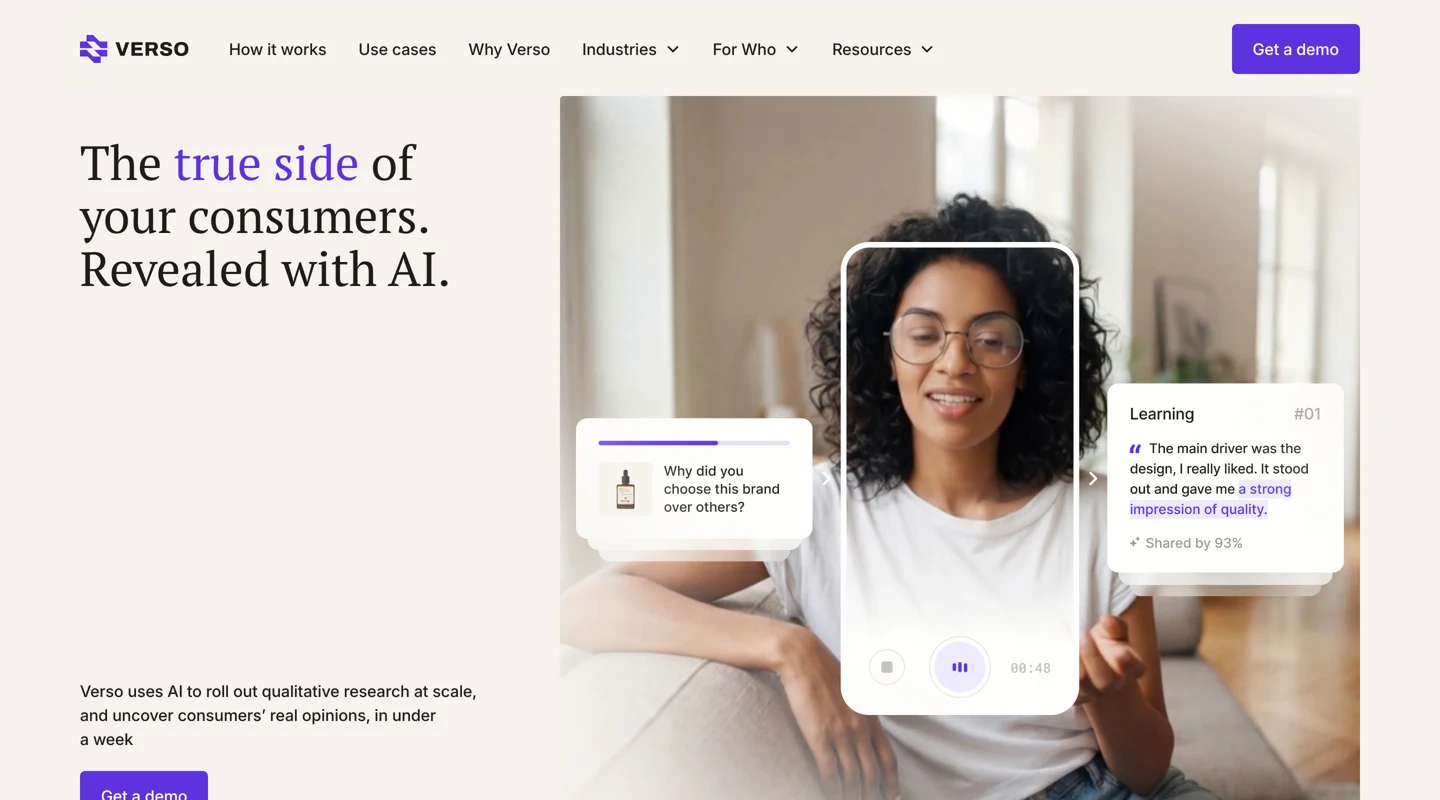
Verso is a Paris-based platform founded by Lydia Bellahouel (ex-BCG) and Camille Epitalon. It raised a $6M seed round led by Angular Ventures in October 2026 and already works with more than 30 companies, including Ferrero, Orange, Michelin, Kering, On and Leroy Merlin. Its pitch is simple: agency-quality consumer interviews in under a week, at a fraction of agency cost.
Format and methodology: AI-led one-to-one interviews by video or voice, with the AI probing and following up in real time. Participants can also submit photos and videos. Verso turns research objectives into a structured interview guide focused on motivations, beliefs and lived experience.
Standout feature: Instead of a static report per study, Verso builds consumer personas from real conversations. They are not predefined segments; they evolve as each new study comes in, so teams can track how attitudes shift over time. Findings sit in a searchable knowledge base, and the company plans to add quantitative data, social listening and access for AI agents.
Recruitment: Participants from Verso's panel partners worldwide, or from the client's own customer base. Interviews can run in any language.
Speed: Insights typically arrive within 24 to 72 hours, depending on scope and sample size.
Compliance: GDPR compliant, with data encrypted and anonymised by default. Pricing is not published; Verso works on a demo-and-quote basis.
Best suited for: Consumer brands and FMCG teams; concept, packaging and positioning tests; shopper journeys and switching behaviour; teams that want a growing picture of their consumer rather than one-off reports.
How to Choose the Right Platform
The 'best' platform depends on your research context. Here's a decision framework based on common scenarios:
If you're researching emerging markets...
Consider Yazi. Running inside WhatsApp removes the app and browser friction that hurts response in markets where data costs are high and phone storage is limited. Response rates six to seven times higher than traditional channels are a material advantage.
If you're running diary or multi-activity research...
Consider Yazi. It's built for studies that run over days or weeks, mixing AI interviews, surveys, photo and video tasks and in-the-moment entries in one place, with participants staying in the same WhatsApp thread throughout.
If you want AI scale without giving up human moderation...
Consider Yazi. The AI runs every conversation, and researchers can take over any one of them live or run a moderated group discussion in the same platform.
If you need video evidence for stakeholders...
Consider Outset, Conveo or Verso. All three put video at the centre. Outset adds screen share for usability testing, Conveo reads non-verbal cues, and Verso turns interviews into living consumer personas.
If you're an EU company with strict data governance...
Consider Tellet, Glaut or Verso. All three are European companies operating under GDPR. Glaut holds ISO 27001; with any vendor, confirm server locations and certifications before you sign.
If you're a research agency seeking white-label solutions...
Consider Glaut. Built for experienced researchers, with control at every step and the option to embed AI interviews in existing quant surveys. Used by Ipsos and Kantar.
If budget is the primary constraint...
Consider Yasna or Yazi. Yasna has transparent self-serve plans for small teams. Yazi covers surveys, interviews and diaries in one platform, so you aren't paying for three tools to run one study.
If you want always-on customer intelligence...
Consider Outset, Conveo or Verso. Outset's CX platform runs interviews across the customer journey, Conveo supports recurring interview programmes, and Verso keeps personas updated with every study.
If you're a large enterprise on Salesforce...
Consider Listen Labs. Strong compliance, a large panel and polished deliverables, with closer Salesforce integration likely once the acquisition completes.
Limitations to Consider
AI-moderated interviews aren't a universal replacement for human moderators. Several limitations apply across all platforms:
• Sensitive topics: Some evidence suggests participants feel more comfortable disclosing to AI (there's no human judgement), but complex emotional topics may still benefit from human moderation.
• Sample size requirements: AI-moderated studies typically need 30+ participants for adequate saturation, compared to 5 to 15 for human-moderated interviews.
• Non-verbal cues: Text-based platforms miss body language and facial expressions. Video platforms capture these but can make some participants self-conscious.
• Topic complexity: Highly technical or niche subjects may need domain knowledge that general platforms don't have.
• Participant novelty: Some participants find AI interviews novel at first, which can affect early responses. Researchers report this effect usually fades after the first few questions.
Key Takeaways
1. Match platform to context. WhatsApp-native for mobile-first audiences and longitudinal work, video-first for stakeholder storytelling and consumer brands, survey-embedded for agencies running quant. No single platform wins every use case.
2. Look beyond the single interview. The richest studies combine a screener, interviews and in-the-moment diary entries over time. Check whether a platform can run all of these together, and whether a researcher can step in when the AI shouldn't be alone.
3. AI-moderated interviews deliver measurably richer data. Benchmark studies show 129% more words, 66% higher transcript quality and much lower gibberish rates than traditional surveys.
4. Scale changes the research equation. Running hundreds of interviews in days means you can segment, compare and validate at sample sizes that used to be reserved for quant.
5. The market is consolidating. With Salesforce buying Listen Labs and large rounds for Outset and Conveo, expect AI interviews to plug more directly into CRM and CX systems. Ask vendors about roadmap and ownership, not just features.
6. Pricing varies widely. From self-serve plans to enterprise annual subscriptions. Understand your volume and the mix of methods you need before committing.
7. Compliance matters. If data residency is critical, verify server locations and certifications directly with each vendor.
The category is still moving quickly, and most platforms here have shipped major updates in the past year. For the latest capabilities and pricing, contact vendors directly or run a pilot project to test fit for your research needs.
