%202.png)

Combining surveys, diaries, and AI interviews in one study means running an integrated mixed-methods design where each method has a specific job: the survey measures how common a pattern is, the diary captures it unfolding in real life, and the AI interview probes the moments that matter. The value doesn't come from using three tools. It comes from connecting the findings through a shared participant ID, consistent segments, and joint analysis.
Running a survey, a diary study, and an AI interview does not automatically make a study mixed-methods. The defining feature is integration, not the headcount of tools. If your three sets of findings sit in separate report sections with no synthesis between them, that's a multi-method project, not an integrated one, and it's weaker for it.
What "combined" actually means
The NIH's guidance on mixed-methods research is direct on this point: a mixed-methods study intentionally integrates quantitative and qualitative data, and that integration can happen during data collection, analysis, or interpretation. Running a survey, then interviews to explain the survey's results, is a recognised design (explanatory sequential). Running a survey and then interviews with no connection between the two results is just doing two separate things under one project name.
Each method fills a gap the others leave open:
| Research gap | Best method | Why it works |
|---|---|---|
| Need prevalence | Survey | Measures frequency and segment differences across a large sample |
| Need lived context | Diary | Captures real-life behaviour, emotion, and environment over time |
| Need explanation | AI interview | Probes answers and diary moments with adaptive follow-ups at scale |
| Need confidence | Integrated analysis | Triangulates evidence and surfaces useful contradictions |
Surveys can be shallow: they tell you what people claim, rarely what they actually do. Diary studies capture context but are burdensome to run and hard to analyse at scale. AI interviews probe individual answers but can miss the nuance a skilled human moderator would catch. Combined, each method compensates for what the others miss, and the contradictions between them are often the most useful finding in the whole project.
The three roles
Surveys measure the pattern
- Sets baseline measures and identifies segments worth following longitudinally.
- Provides eligibility, recruitment data, and consent for downstream phases.
- Surfaces candidates for triggered diary tasks and AI follow-up probes.
Diaries capture the pattern in real life
- Interval-contingent entries logged at fixed times each day.
- Signal-contingent entries prompted at random or scheduled moments.
- Event-contingent entries triggered by a specific behaviour or moment.
AI interviews explain the pattern
- Follows up on survey scores that don't match the expected behaviour.
- Probes specific diary entries: an ambiguous photo, an unexpected voice note, a day-three frustration.
- Reflects on change over time at study close.
Reality check: AI interviews are strongest when you need consistent probing across many participants. They're weakest when the research depends on rapport, silence, body language, or a human moderator changing direction mid-conversation.
Choosing the right design
Four core mixed-methods designs cover most cases where surveys, diaries, and AI interviews combine:
Explanatory sequential (survey first)
Best for explaining a known, measurable problem. Example: a fintech team surveys customers and finds new users rate onboarding "easy" but abandon after day three. They recruit high- and low-confidence respondents into a five-day diary, then use AI interviews to ask why specific diary moments felt confusing.
Exploratory sequential (diary or interview first)
Best for discovering language, themes, or drivers before building a quantitative instrument. Example: a retailer wants to understand informal grocery shopping in township communities. The team starts with WhatsApp diary entries and voice notes, identifies themes like price checking and trust in shopkeepers, then builds a survey to quantify which drivers matter most across regions.
Convergent (all methods in parallel)
Best for fast-moving projects that need triangulation quickly. Example: a telecom team testing a new prepaid data bundle runs a short survey, logs usage moments over seven days, and triggers AI follow-ups when participants report confusion or unexpected data depletion.
Embedded
Best for diaries or AI interviews nested inside a larger survey, product test, or ongoing CX programme. A CX team might embed a three-day diary and triggered AI interviews inside an ongoing NPS programme.
A practical study blueprint
Define one integrated research question
Weak: "run a survey, diary, and interviews about customer experience." Strong: "understand why first-time users who say onboarding is easy still fail to complete their second transaction within seven days." The question needs to be specific enough to give each method a clear job.
Decide what each method must prove
For the onboarding example: the survey proves which segments report easy onboarding but low completion, the diary proves what happens on days two and three, and the AI interview proves which moments triggered the decision to stop. If you can't articulate what each method proves, you probably don't need all three.
Recruit once, segment once
Keep one participant ID across every method. That ID connects survey scores, diary entries, AI interview transcripts, media uploads, and final outcomes for the same person; it's the spine of the whole study.
Run a short baseline survey
Cover eligibility, segmentation, baseline measures, and consent for downstream phases. Keep it short: every extra minute costs you diary participants later.
Run the diary period
Nielsen Norman Group recommends matching duration to behaviour cadence: about a week for daily behaviours, two to three weeks for weekly behaviours or purchase journeys. Sample size follows saturation logic: roughly 5 to 12 participants for small, homogeneous discovery projects; 12 to 30 for larger, more heterogeneous projects; and 30 to 50 for broad academic or generalisable research.
Trigger AI interviews from evidence
Use survey answers or diary entries to decide when an AI interview should probe deeper: a low completion rate after a high-confidence claim, conflicting day-two and day-five entries, a voice note with strong negative affect, an unexpected positive surprise. This is what turns three separate methods into one learning system.
Analyse with a joint display
Build a table or matrix showing evidence from each method side by side for every finding, segment, or theme. NIH calls this the "point of interface," the place where the actual mixing of methods happens.
Report tensions, not just themes
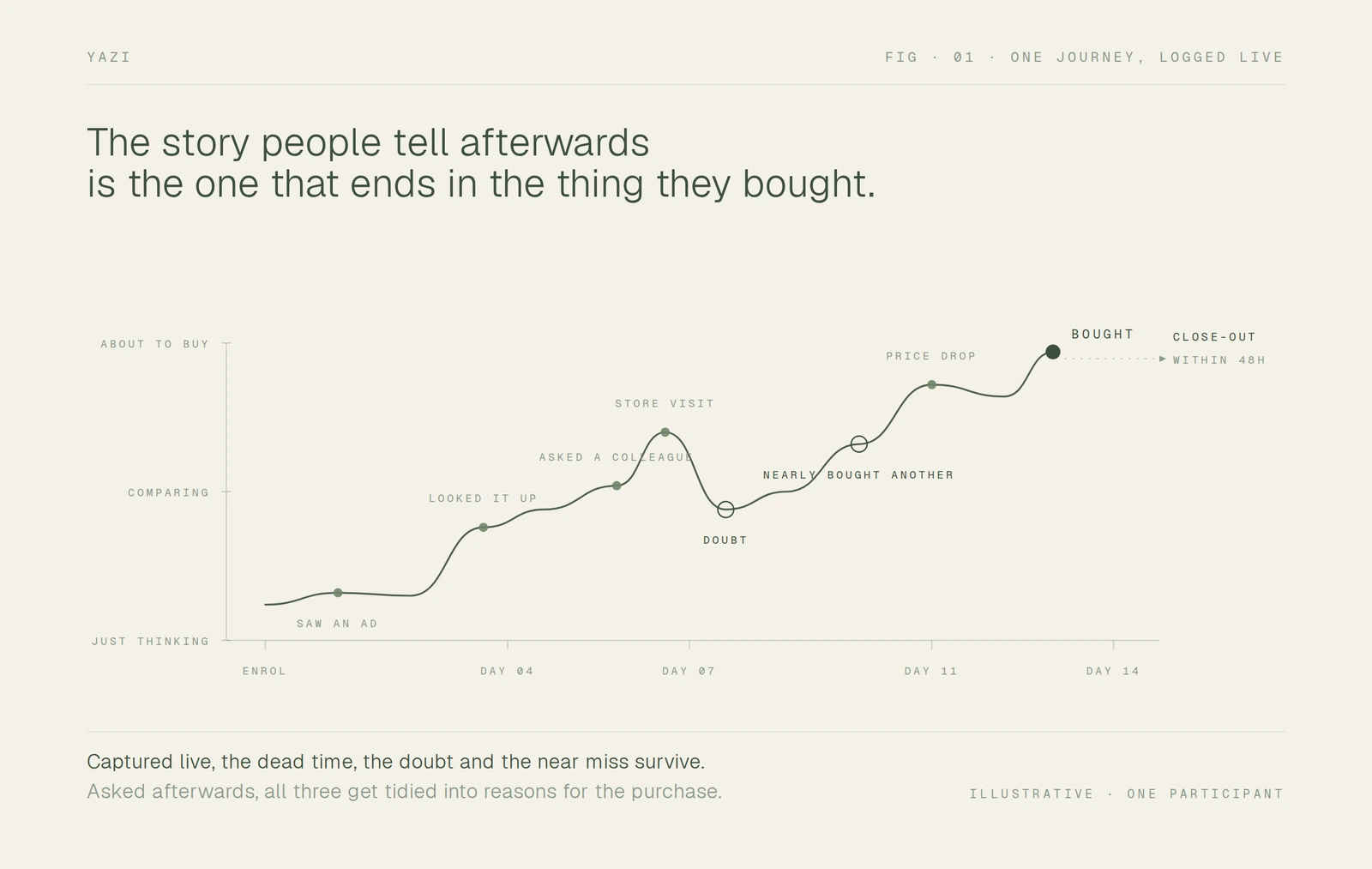
What happens when methods disagree? Contradictions aren't failures. They're usually the most useful part of a combined study because they expose the gap between stated attitudes and lived behaviour.
A joint display, worked example
| Segment | Survey pattern | Diary evidence | AI interview explanation |
|---|---|---|---|
| New users | 42% report confusion on setup | Day-2 screenshots show repeated navigation loops | Labels feel "bank-like" and intimidating |
| Repeat users | High satisfaction | Few diary frictions logged | Workarounds are learned, not intuitive |
| Price-sensitive users | Low purchase intent | Transport and data-cost concerns | Distrust of hidden fees |
A WhatsApp-native worked example
Scenario: a retailer in South Africa wants to understand why shoppers try a loyalty offer once but don't keep using it. Design: explanatory sequential, with triggered AI interviews.
Pew's 2023 research across eight middle-income countries in Latin America, Africa, and South Asia (including Kenya, Nigeria, and South Africa) found a median of 73% of adults used WhatsApp, against 29% of US adults, with shares in the surveyed countries ranging from 50% in India to 90% in Brazil. In markets like South Africa, Kenya, or Nigeria, WhatsApp isn't just a communication tool; it's the default digital interface. Running an entire study inside WhatsApp, from survey through diary prompts to AI-moderated interviews, keeps participants in one familiar conversation thread instead of switching between email links, apps, and scheduling tools.
A practitioner case from a UX researcher at Glovo documented running a WhatsApp diary study with 13 users over three weeks. The team identified roughly 10 product issues, with 4 confirmed as bugs, and the findings directly shaped the following sprint's roadmap. Layering a survey and AI-interview phase onto that same channel would strengthen a design like that further.
Channel caveat: GSMA Intelligence data on Sub-Saharan Africa shows real progress on infrastructure: the region's mobile internet coverage gap narrowed from around 41% in 2015 to roughly 9 to 13% by 2024 (as low as 9% in Eastern Africa specifically). The usage gap, people who have coverage but still don't go online, has proven far more stubborn, sitting at around 60% in 2024, having started at roughly 64% back in 2015. WhatsApp reduces friction for people who already use it, but it still excludes non-smartphone users, and in mobile-first markets the channel choice isn't an operational detail. It determines who gets to participate at all.
When this design works, and when it doesn't
Strong fit: dual questions
Questions that genuinely need both prevalence and explanation, not just one or the other.
Strong fit: behaviour change over time
Longitudinal behaviour that unfolds over days or weeks rather than a single moment.
Weak fit: quick directional reads
If a single survey answers the question well enough, the extra methods add cost without adding insight.
Weak fit: sensitive, rapport-dependent topics
Where deep human interviewing is essential, or where messaging-based research would exclude the audience you most need to hear from.
The NIH warns that mixed-methods studies can add participant burden, especially when follow-up contact is required. Explain the follow-up steps clearly at consent, and choose methods that don't overload the people you're studying.
Quality checklist
- 01Study design. One integrated research question, a documented job for each method, a common participant ID across all phases, and a pre-registered analysis plan.
- 02Diary phase. Duration matched to behaviour cadence, sample sized for saturation (roughly 5 to 12 for small homogeneous projects, 12 to 30 for heterogeneous ones, 30 to 50 for generalisable research), multimodal prompts, and mid-study check-ins to maintain compliance.
- 03AI interview phase. Triggered from survey and diary evidence rather than run in isolation, with transparency about AI use, documentation of the model and tasks, and validation procedures, in line with AAPOR's guidance on AI in survey research.
- 04Integration. A joint display built before the report is written, a convergence map showing which findings are supported by which methods, and documented tensions and contradictions.
The convergence map
The strongest reports classify each finding by how many methods support it.
| Finding | Survey | Diary | AI interview | Interpretation |
|---|---|---|---|---|
| Strong evidence | Yes | Yes | Yes | Act now |
| Hidden friction | No | Yes | Yes | Survey may be missing the issue |
| Claimed issue only | Yes | No | Partial | Needs behavioural validation |
| Segment-specific | Yes | One segment | Yes | Targeted action |
| Contradiction | Yes | No | No | Recheck wording or sample |
Every method in the study should generate, explain, validate, or challenge evidence from another method. If a method does none of those things, it isn't earning its place in the design.
Frequently asked questions
Is combining surveys, diaries, and AI interviews considered mixed-methods research?
Yes, if the study intentionally integrates quantitative and qualitative data. Running three methods separately doesn't qualify. The findings need to connect during data collection, analysis, or interpretation, which is the requirement the NIH's mixed-methods guidance makes explicit.
Should the survey come before or after the diary study?
Run the survey first when you need to identify segments or explain a known pattern (explanatory sequential). Run the diary first when you don't yet know the right survey answer options or participant language (exploratory sequential). Run both in parallel when you need fast triangulation (convergent).
Where do AI interviews fit in the sequence?
Best used as a follow-up probe: asking participants to explain a survey score, expand on a diary entry, clarify a photo or voice note, or reflect on change over time. They shouldn't replace sensitive or deeply exploratory human interviews, but they add depth a survey alone can't.
How many participants do I need?
For the diary phase, Nielsen Norman Group's rough bands are 5 to 12 participants for small homogeneous projects, 12 to 30 for larger heterogeneous ones, and 30 to 50 for broad academic or generalisable research. The survey sample is typically larger and depends on your confidence level, margin of error, and segmentation needs.
What's the biggest mistake teams make?
Reporting the survey, diary, and AI interview results separately. The entire value of a combined design comes from integration: where the methods agree, where they disagree, and what each explains that the others couldn't. Three disconnected reports is just tool stacking.
Can this entire study run over WhatsApp?
Yes, when the audience already uses WhatsApp and the study is designed for mobile participation. WhatsApp can carry short survey flows, diary prompts, images, video, and voice notes in a single thread. Researchers still need consent, privacy safeguards, clear expectations, and a plan for people who don't use or trust the platform.
Are AI-generated themes reliable enough to act on?
AI interviews scale open-ended probing well, but scale doesn't remove the need for sampling discipline, source-traceable analysis, and human interpretation. Treat AI-generated themes as hypotheses to check against diary evidence and survey data, not as settled conclusions.
What if methods contradict each other?
Contradictions are a feature, not a bug. A survey might show satisfaction while diaries reveal workarounds; AI interviews might show enthusiasm while the survey shows low purchase intent. These tensions point straight at the gap between stated attitudes and lived behaviour, which is exactly what a combined study is designed to surface.
Run survey, diary, and AI interview phases inside a single WhatsApp thread.
For teams researching mobile-first audiences across Africa and other emerging markets, book a demo to see how surveys, diaries, and AI-moderated interviews work together with shared participant IDs, triggered follow-ups, and integrated reporting.
Book a Demo →