

Updated October 2026. Recollective is one of the most established platforms for online qualitative research, used for async activities, digital diaries, live video interviews and long-running insight communities. The main alternatives in 2026 are Yazi, QualBoard by Sago, Forsta Digital Diaries, Fuel Cycle, Alida, Dscout, Indeemo, Qualzy, itracks and CMNTY by MarketResponse.
They are not all the same kind of tool. Some are built for communities that run for months, some for app-based video diaries, and one runs the whole study inside WhatsApp. The biggest practical difference is what a participant has to do before they can answer your first question: log in to a community website, install an app, or simply reply to a message. This guide compares all ten on that, on AI moderation and on what each one is best for, so you can get to a shortlist quickly.
What Recollective Does Well
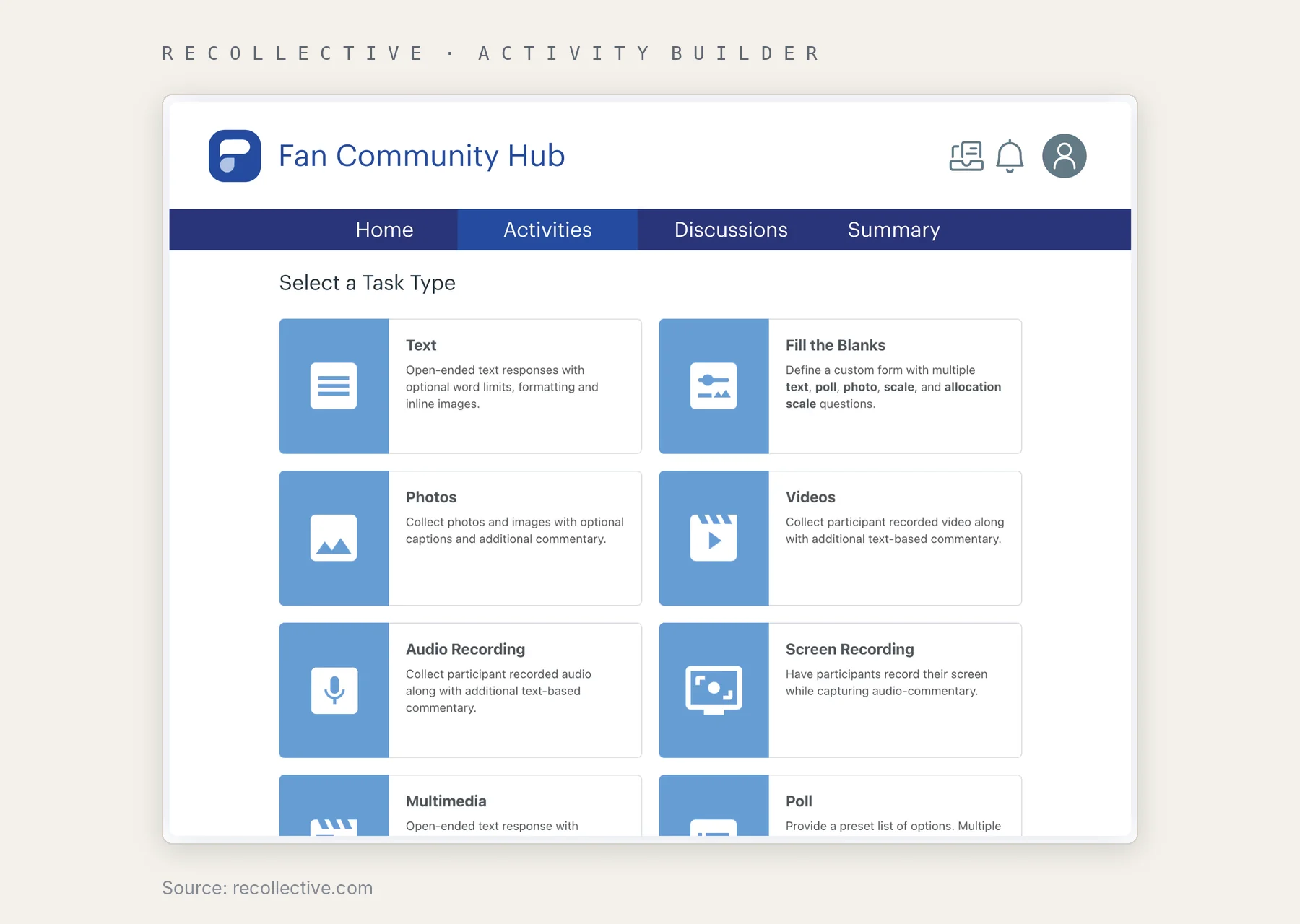
Recollective comes from Ottawa-based Recollective Inc. (founded in 1998 as Ramius) and has been in market since 2011. It runs activity-based async studies with a deep question library (text, photo, video, audio, screen recording, image markup, card sorts), journals and diaries, discussion forums, and live video IDIs and focus groups. Recollective Connect is a separate product for always-on communities of 1,000 to 50,000+ members.
It has moved quickly on AI. Conversation Task, launched in October 2025, runs AI-moderated interviews inside a study, and since May 2026 the AI moderator can use a participant's earlier answers. Ask AI answers questions across one or several projects with source verbatims, and in September 2026 Recollective added moderator privacy controls and the ability to import video recorded in Zoom, Teams or other tools for analysis.
Participants take part through a branded website in their browser, on desktop or mobile, and come back to it for each new activity. Recollective is also one of the few platforms in this category that publishes starting prices: from $475 a month for live-only, from $750 a month for live and async, and from $1,250 a month for Connect communities, all on annual licences, which the company describes as starting points rather than fixed prices.
Why Teams Look for a Recollective Alternative
- Participant access. A branded community website suits committed community members. It suits a one-off invitee less well. Someone from a client's customer list has to open an email, find the link, create an account and come back each day, and some of them won't.
- Mobile-first audiences. Where people live on their phones and watch their data, every extra step loses participants, and not at random. The people you lose tend to be younger, lower-income or less digitally confident.
- Method. Some teams need app-based video ethnography, UX testing, or live groups bundled with recruitment more than they need a community.
- Contract shape. Annual licences suit continuous programmes. Project teams often prefer to pay per study.
- Existing stack. Teams already on Forsta, Qualtrics or a fieldwork partner's platform may want qual in the same place.
Recollective Alternatives Compared
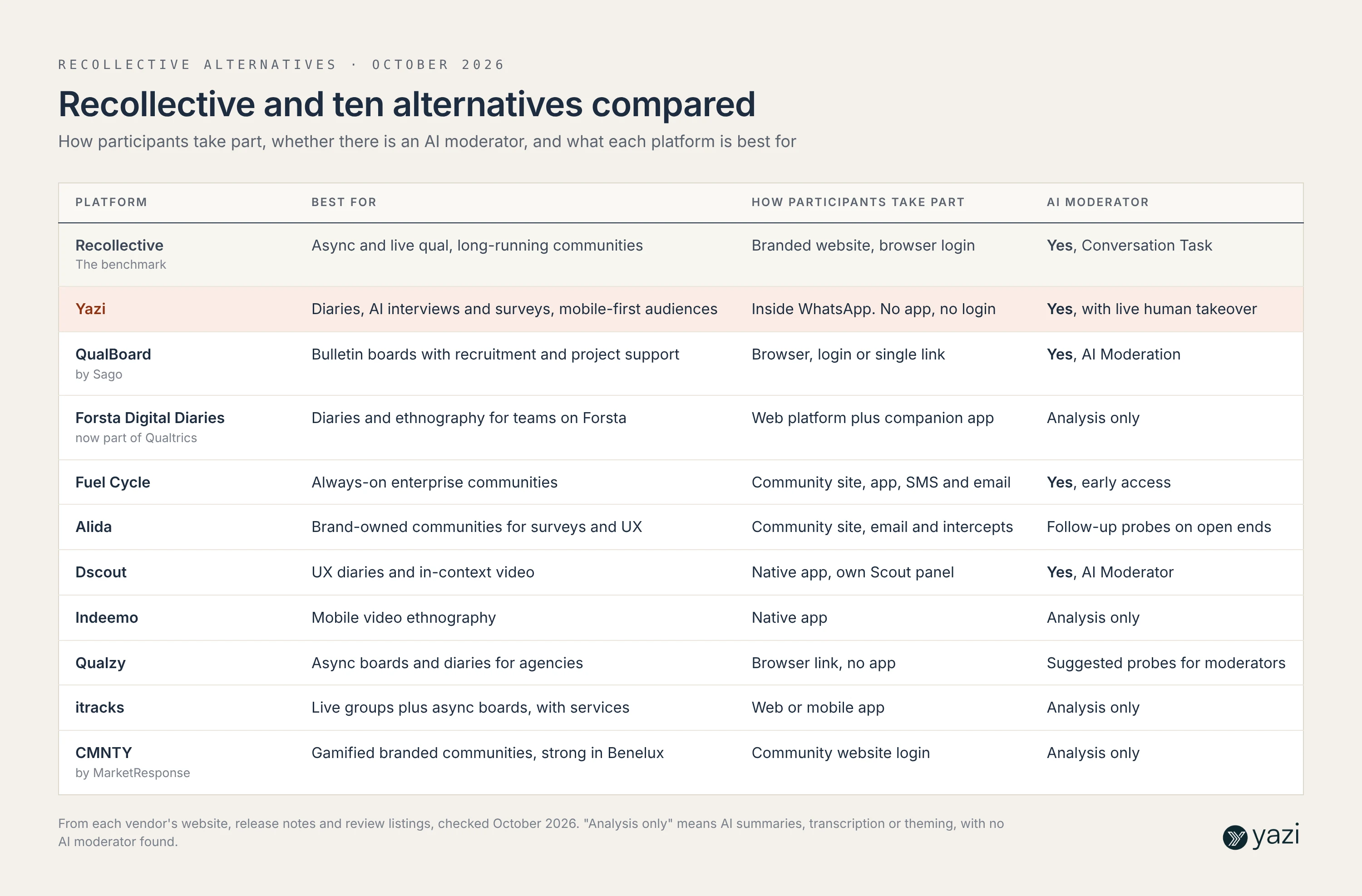
The table below shows how participants take part in each platform, whether it has an AI moderator, and what it is best for. Most of these platforms price on a custom quote, usually per project or as an annual licence, so we've focused on how each one works.
1. Yazi: Diaries, AI Interviews and Surveys Inside WhatsApp
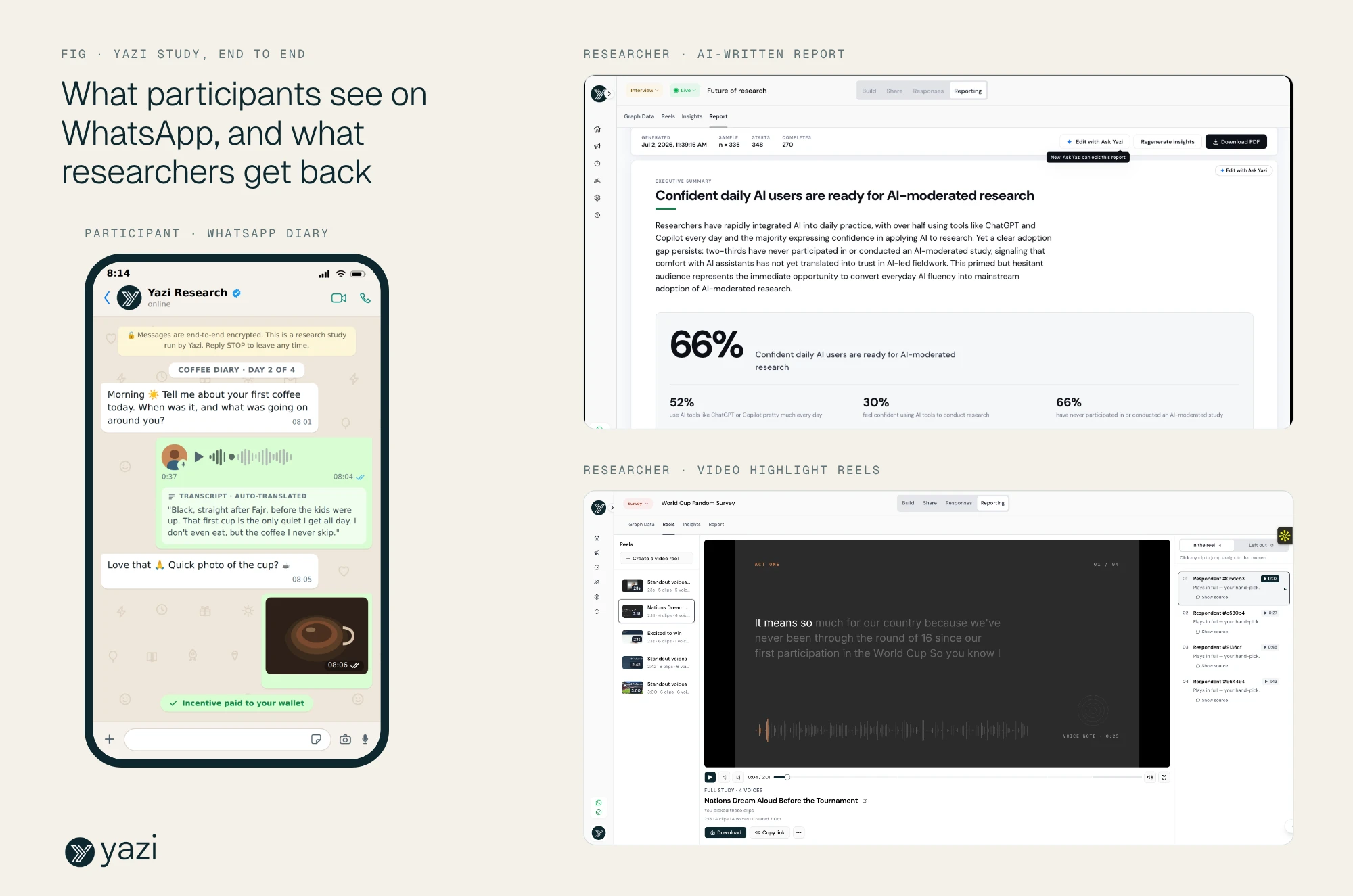
Every other platform in this list asks participants to go somewhere: a community website, a native app or a browser link. Yazi runs the whole study inside WhatsApp, the app people already open dozens of times a day. There's no app to download, no account and no password, and participants answer the way they'd reply to a friend, with a quick text, a voice note on the way home or a photo of what's in the fridge.
Diary and multi-activity studies: Studies are built as a sequence of activities (AI interviews, surveys, photo and video tasks, in-the-moment check-ins) that unlock over days or weeks, with reminders in the same thread. Participants can also send an entry whenever something happens, and the AI can probe on it.
AI moderation with a human in the loop: The AI moderator follows your discussion guide and follows up on each answer, and a researcher can take over any conversation live, then hand it back. Group discussions can be run by a human moderator or by the AI.
Qual and quant in one study: A screener, a scale question and an open-ended probe can sit in the same study, so participants never move between tools.
Reporting: Responses are grouped into themes as they arrive, with an AI-written executive summary you can edit and export to PDF or PowerPoint, cross-tabs, transcripts that read like the original chat, and highlight reels cut from participants' own voice notes and videos.
Language and reach: A 1.8M+ panel with reach in 25+ countries, or bring your own customer list. Yazi moderates natively in English, isiZulu, isiXhosa, Afrikaans, Setswana, Sesotho, Swahili, French, Portuguese and others, with AI translation across 100+ languages. Studies hold a 90% completion rate.
Quality and compliance: Automated checks flag inconsistent answers and responses that look AI-generated. Yazi is POPIA, GDPR and CCPA compliant, with research data hosted on AWS in the UK and Ireland.
Where it fits less well: Participants need WhatsApp. And if you want live video focus groups, or a community where members browse and reply to each other's posts for months, Recollective, QualBoard and Fuel Cycle are built for that.
Best for: Diary studies, product trials and usage journeys; studies that mix quant and qual; client customer lists and general population samples who won't install anything; and mobile-first audiences in Africa, Latin America, Asia, the Middle East and anywhere WhatsApp is the default way people talk. For a direct side-by-side, see Yazi vs Recollective.

2. QualBoard by Sago: Bulletin Boards with a Fieldwork Partner
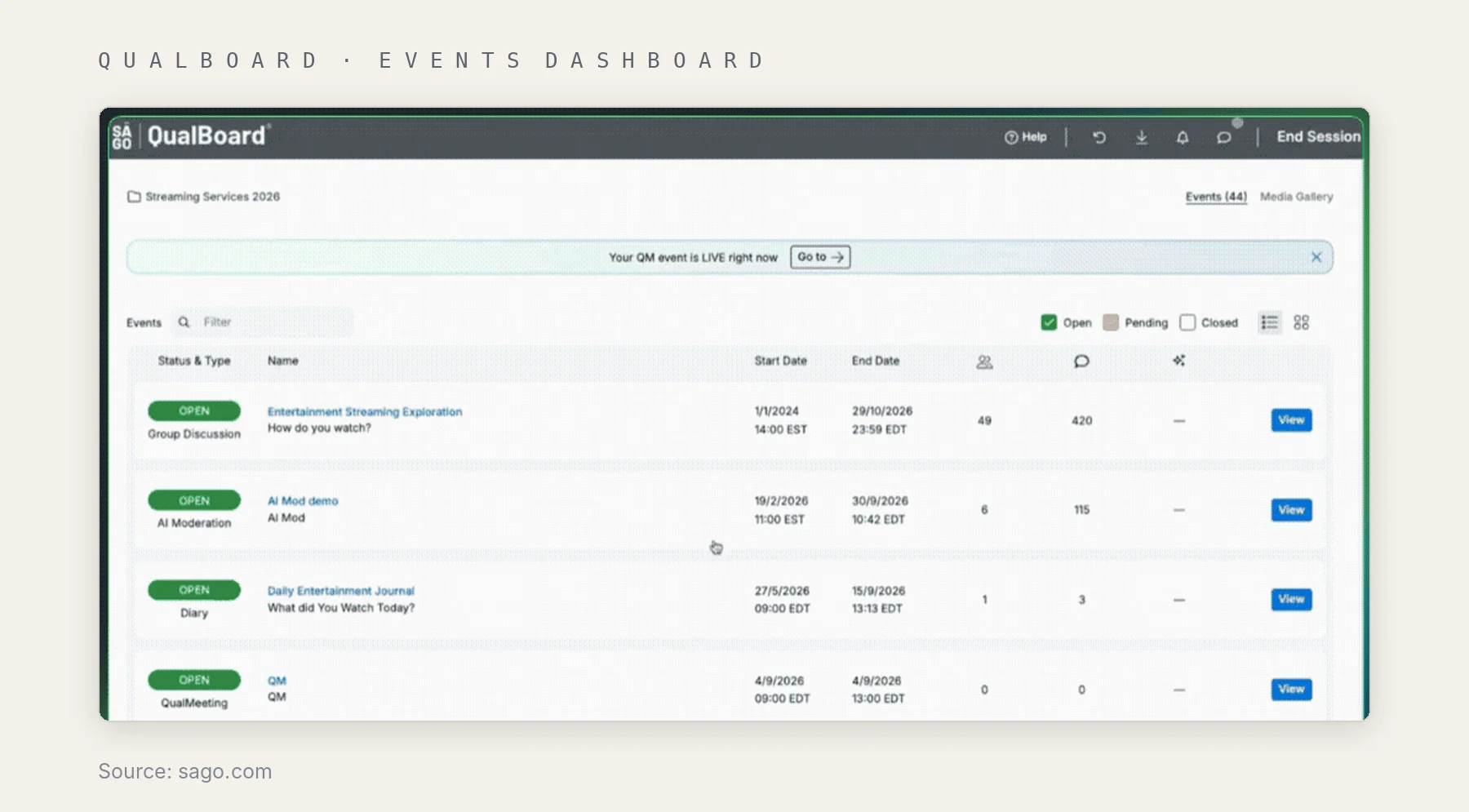
QualBoard is the digital qual platform from Sago, the research and recruitment company formerly known as Schlesinger Group. It runs async group discussions and bulletin boards, diaries and lean communities, with QualMeeting for live video focus groups and IDIs, plus concept markup, quick polls and translation into 30+ languages.
What's new: AI Moderation launched in February 2026 as a new event type for async AI-moderated discussions in text, audio or video. Sago also added single-link access with no login for participants (October 2025) and for observers (September 2026), and an in-platform highlight reel editor (June 2026). Sago says its AI features, including Query AI and video summaries, are included at no extra charge.
How participants take part: In any browser on desktop or mobile, with no app. Usually with a login, or through a single link.
Worth knowing: The main reason to choose QualBoard is the services relationship: recruitment, project management and 24/7 tech support from one partner. Independent reviews are thin, with 13 reviews on G2 at the time of writing.
Best for: Agencies and brands, especially in the US, who want the platform, recruitment and project support from one fieldwork partner.
3. Forsta Digital Diaries: Diaries and Ethnography in the Forsta Stack
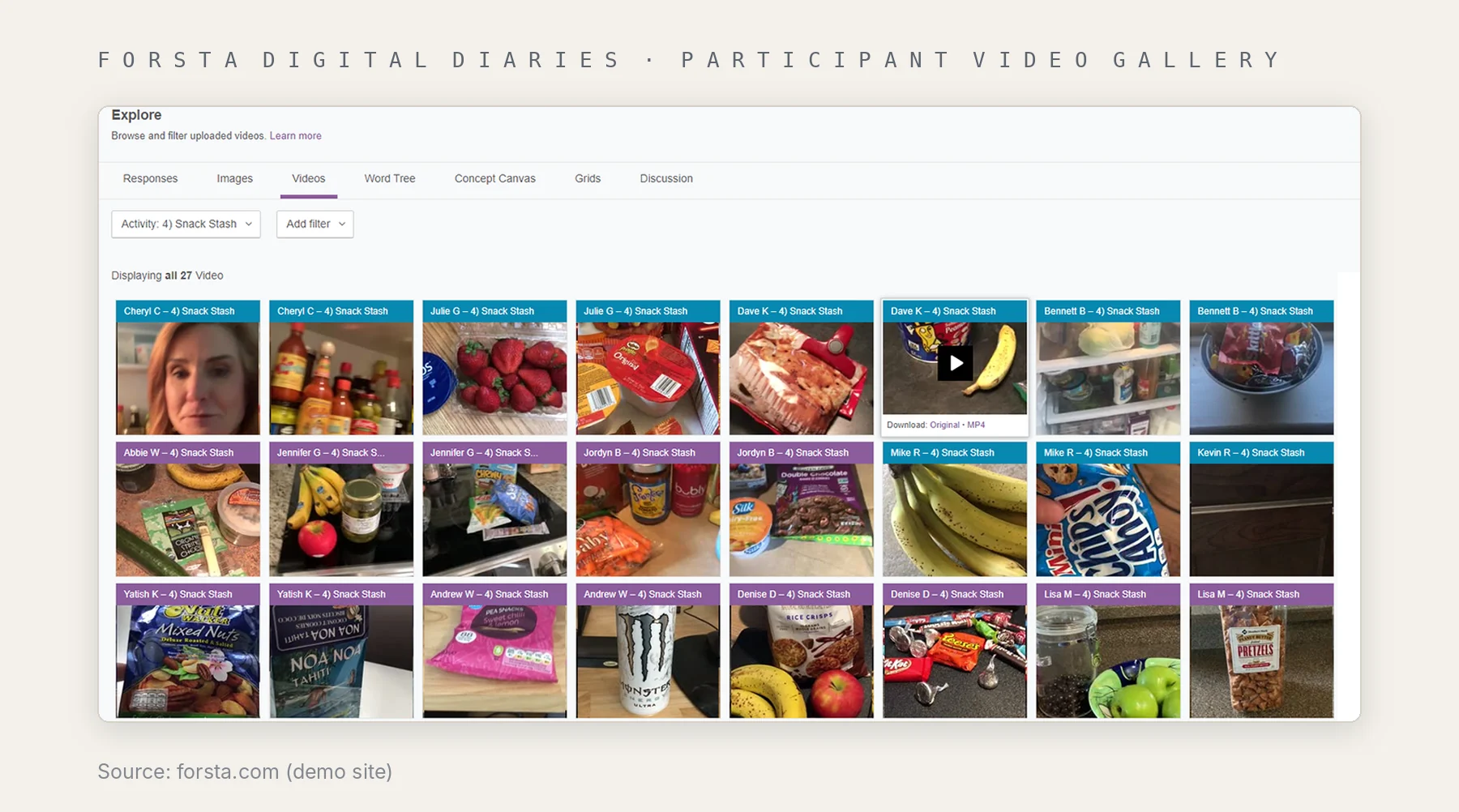
The qual suite that grew out of FocusVision (which bought Revelation in 2014) now lives on as Digital Diaries inside Forsta's platform. It covers diaries, threaded discussions, mood boards, collages and concept canvases for studies of up to 2,000 participants, and since August 2025 it includes live focus groups and IDIs in the same place. Forsta's online communities page now points to Digital Diaries.
Ownership: Forsta was part of Press Ganey, which Qualtrics bought in a deal completed in May 2026. Neither company has said what this means for the market research products, so it's worth asking about the roadmap.
How participants take part: A web platform plus a companion app for iOS and Android.
AI: AI summaries of video and audio, transcripts, sentiment tags and word trees. We didn't find an AI-moderated interview feature for Digital Diaries.
Best for: Large agencies and enterprise teams already on Forsta who want diaries and ethnography in the same stack as their surveys.
4. Fuel Cycle: Always-On Enterprise Communities
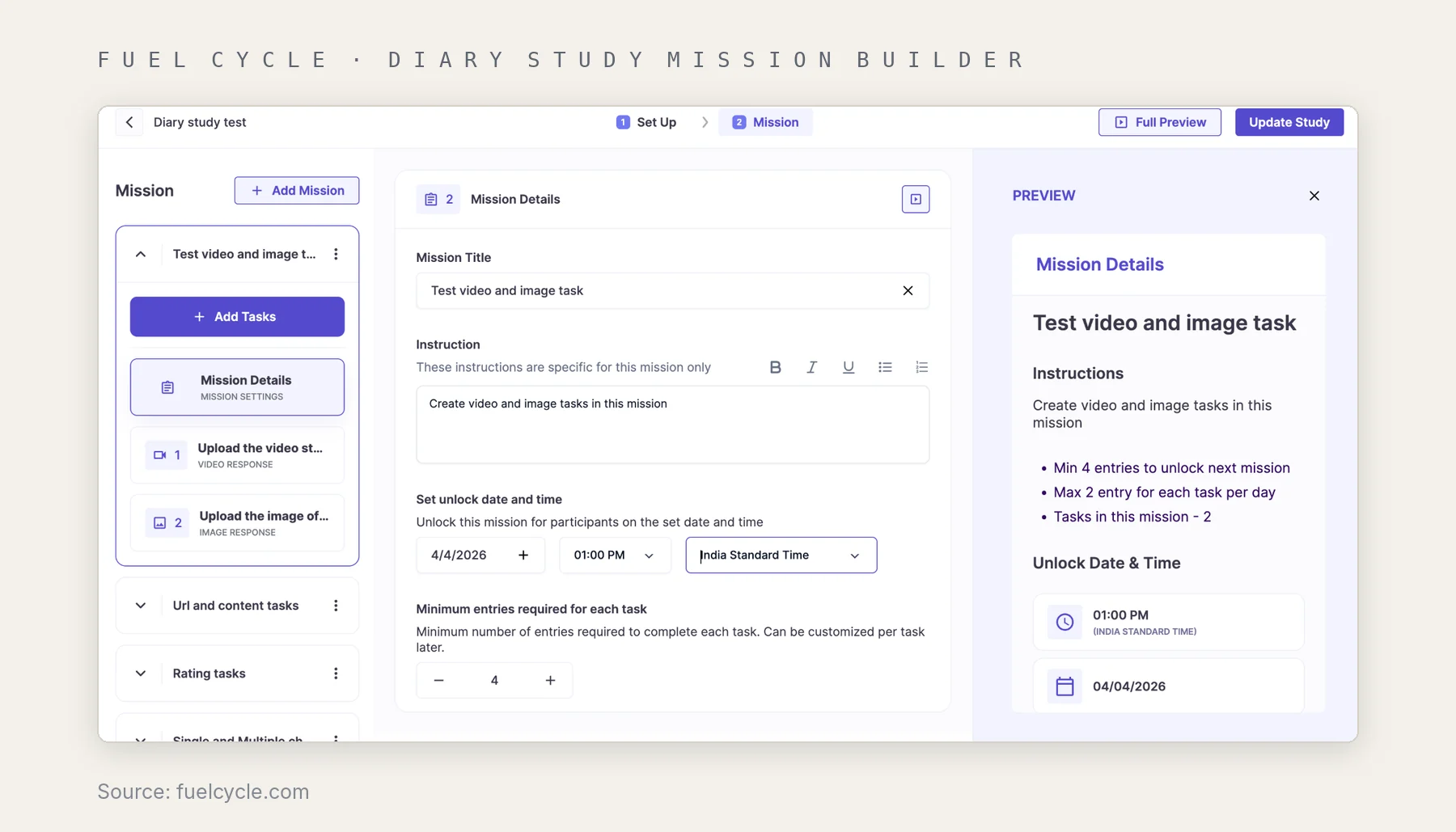
Los Angeles-based Fuel Cycle runs owned, branded or blinded customer communities alongside surveys, discussions, focus groups, video diaries, live interviews and usability tests. Its products are now grouped as Community Insights, UX Insights and Autonomous Insights.
What's new: Fuel Cycle offers early access to an AI Moderator on request. Autonomous Insights adds seven AI agents, from a Survey Designer to a Crosstabs Analyst, plus Instant Answers that draw on past research. In September 2026 Fuel Cycle opened an engineering and AI centre in Navi Mumbai.
How participants take part: A community on web and mobile, reached through a mobile app, push notifications, SMS and email.
Worth knowing: Reviewers mention some interface quirks and confusion between the older CX tools and the newer research engine.
Best for: Large US enterprise insights teams who want a permanent customer community with AI analysis on top and a managed service for community health.
5. Alida: Brand-Owned Research Communities
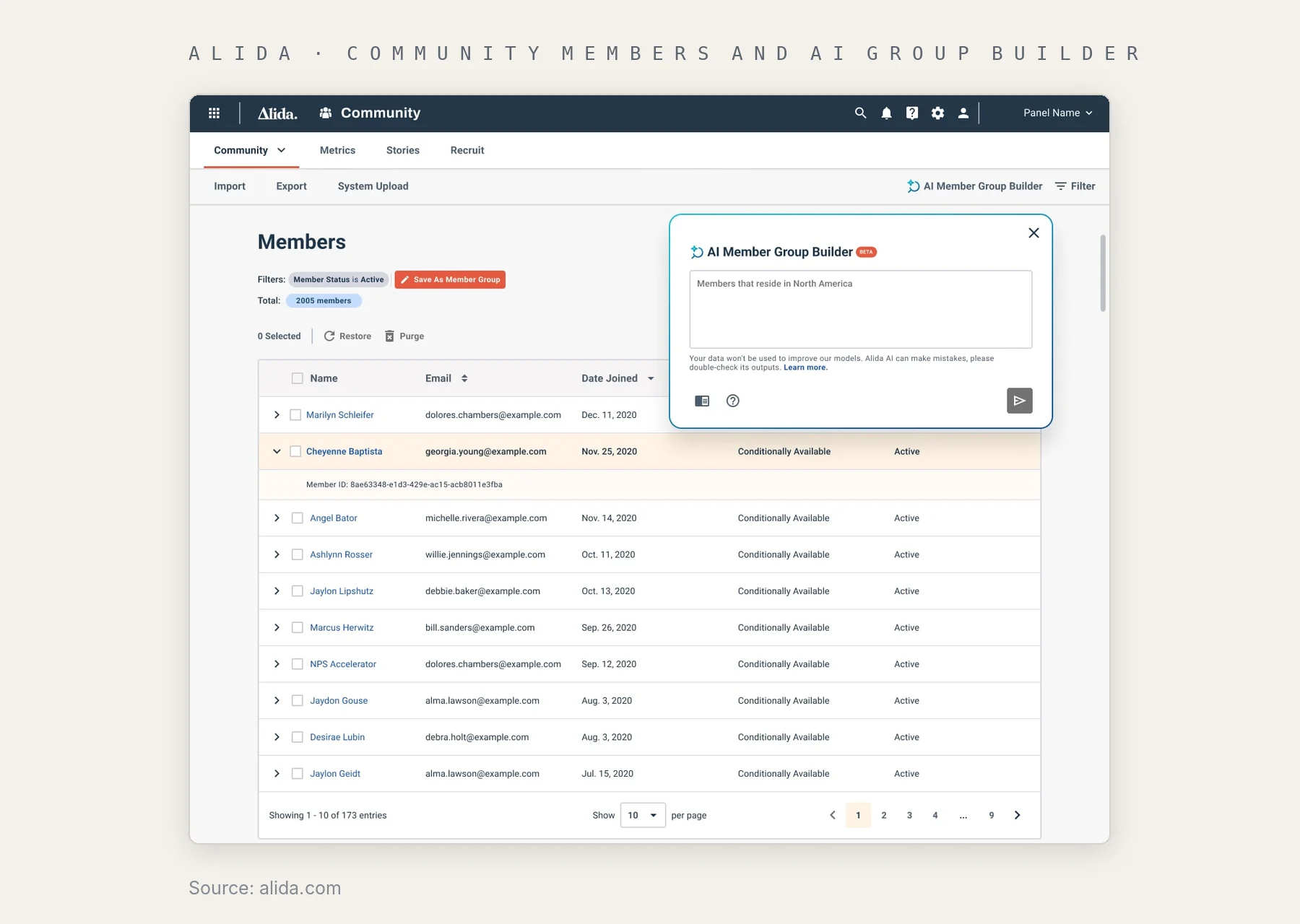
Alida, formerly Vision Critical and based in Toronto, helps brands build and run their own opted-in communities of customers, then survey them and run discussions, video interviews and, since 2025, unmoderated usability tests including Figma prototypes. Alida says it has over 6 million participants across the communities on its platform.
AI: Alida AI covers open-end summaries, automated follow-up probes on open ends, sentiment and topic analysis, translation, video transcription and clips, and an AI Member Group Builder that segments members from a plain-language request. Alida was named a Strong Performer in the Forrester Wave for Experience Research Platforms in Q1 2026.
How participants take part: As members of a branded community, reached by email and web or in-app intercepts.
Worth knowing: It's built around owning a community over the long term, so it's a heavy choice for one-off qual, and G2 users report around three months to implement. It leans towards surveys and UX more than deep async qual.
Best for: Large consumer, media and tech brands who want a permanent customer community for ongoing surveys and UX research.
6. Dscout: UX Diaries and In-Context Video
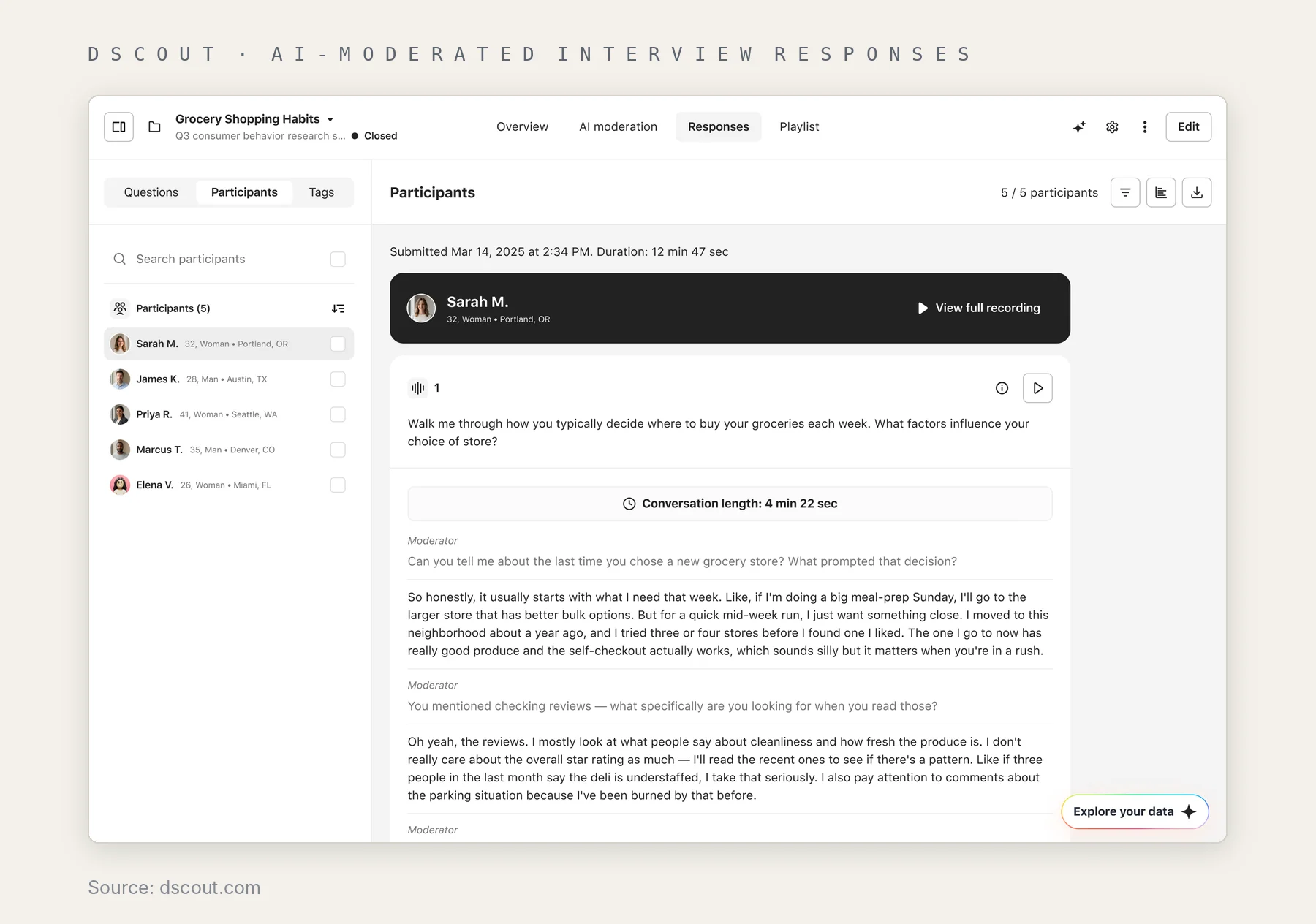
Chicago-based Dscout is a multi-method experience research platform used mostly by UX and product teams. It covers diary studies from a few days to a year, in-context mobile video, usability tests, card sorts, tree tests, live interviews and AI-moderated interviews.
What's new: In April 2026 Dscout launched AI Studio, which drafts a study from a research goal and runs AI-moderated studies (in beta at launch, generally available since October 2026), and lets you explore your data across transcripts. The team from Userology joined Dscout at the same time.
How participants take part: Mobile diary and mission entries go through the Dscout app on iOS and Android, while AI-moderated studies run in Chrome on a desktop or laptop, either with its own panel of verified "Scouts" or with your own users.
Worth knowing: G2 reviewers mention seeing the same participants come back across studies, and limited exports.
Best for: In-house UX and product teams in the US and UK working with a panel that's comfortable using an app.
7. Indeemo: Mobile Video Ethnography
Indeemo, founded in Ireland in 2014, is built for in-context video: diary studies, mobile ethnography, in-home product tests, and shopper and patient journeys. Participants record selfie videos, screen recordings and photo tasks in a native app, and researchers can push prompts and private follow-ups to individuals.
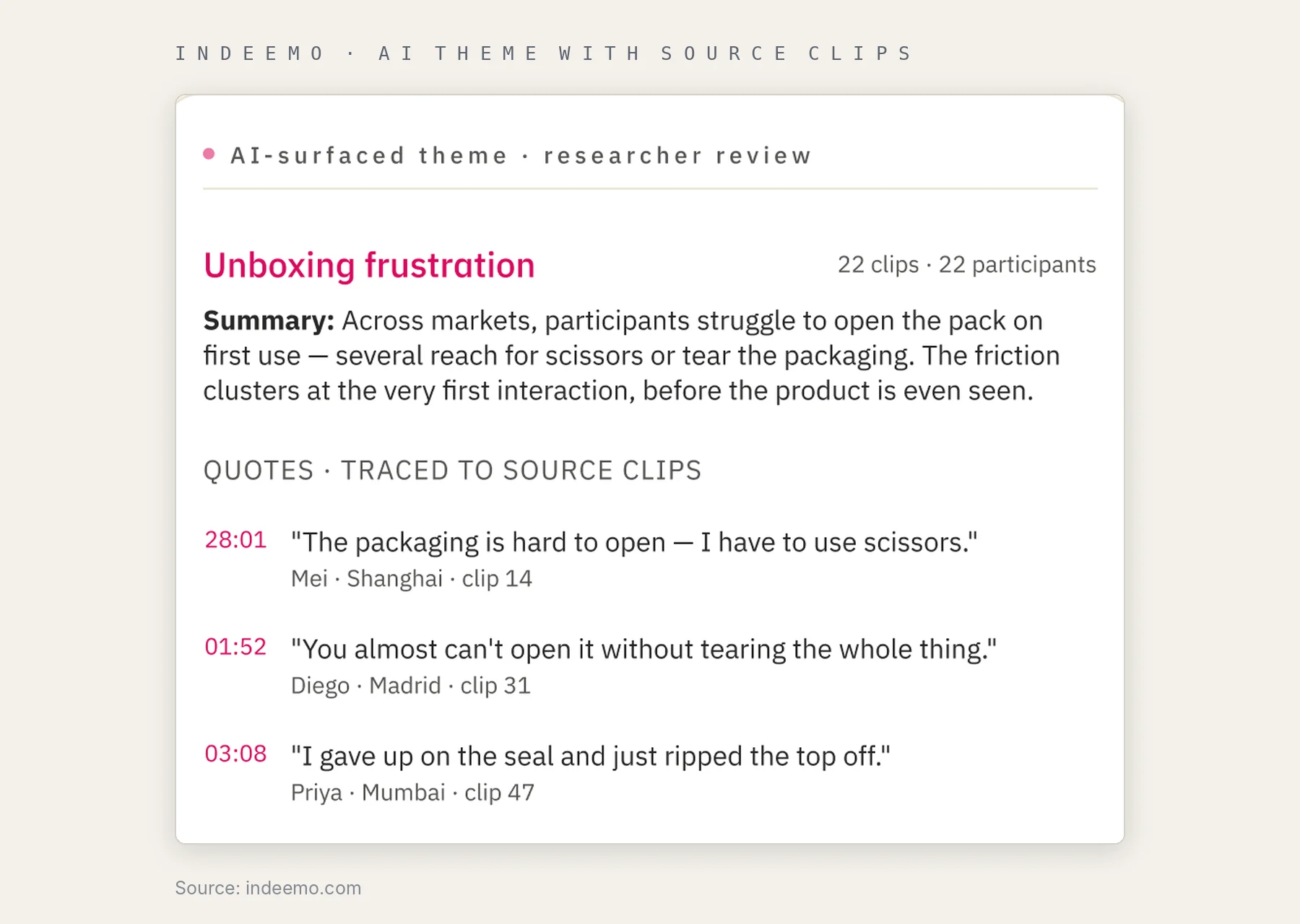
AI: AI video analysis suggests themes with every quote traced back to its source clip, alongside transcription and translation in 30+ languages, and text recognition that pulls brand names and prices out of photos and video.
Worth knowing: Participants need the app, including when you bring your own. Reviewers praise the participant experience but mention clunky subgroup filtering and limited exports.
Best for: Agencies and brand teams running video-heavy ethnography across several markets.
8. Qualzy: Async Boards and Diaries for Agencies
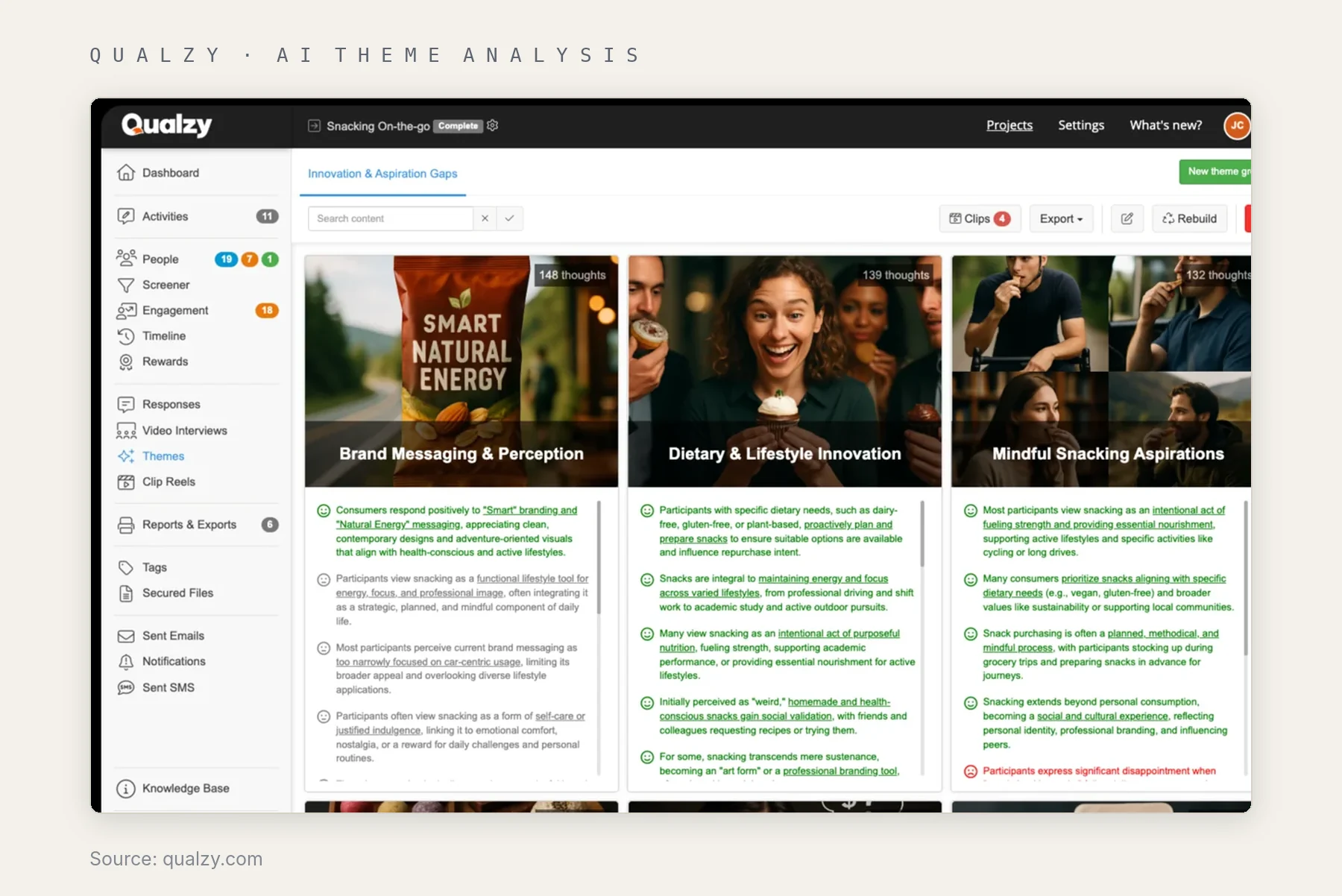
UK-based Qualzy, with offices in Boston and Australia, is the closest like-for-like alternative to Recollective's async side. It offers 15+ activity types, including diaries, bulletin boards, video tasks, async IDIs, card sorts, pin tasks and always-on communities. Participants take part in the browser through an invite link, with no app.
AI: Every response is translated, summarised and broken into key points. There's theme analysis, AI probe suggestions for moderators (which are never sent automatically), fraud flagging, and video transcription with clip reels.
Worth knowing: There's no built-in live video. You run groups in Zoom or Teams and import the recording for analysis. Pricing is per project, per active participant or by community size, with no seat licences.
Best for: Agencies and independent researchers in the UK, US and Australia running async qual project by project.
9. itracks: Live Groups and Async Boards with Services
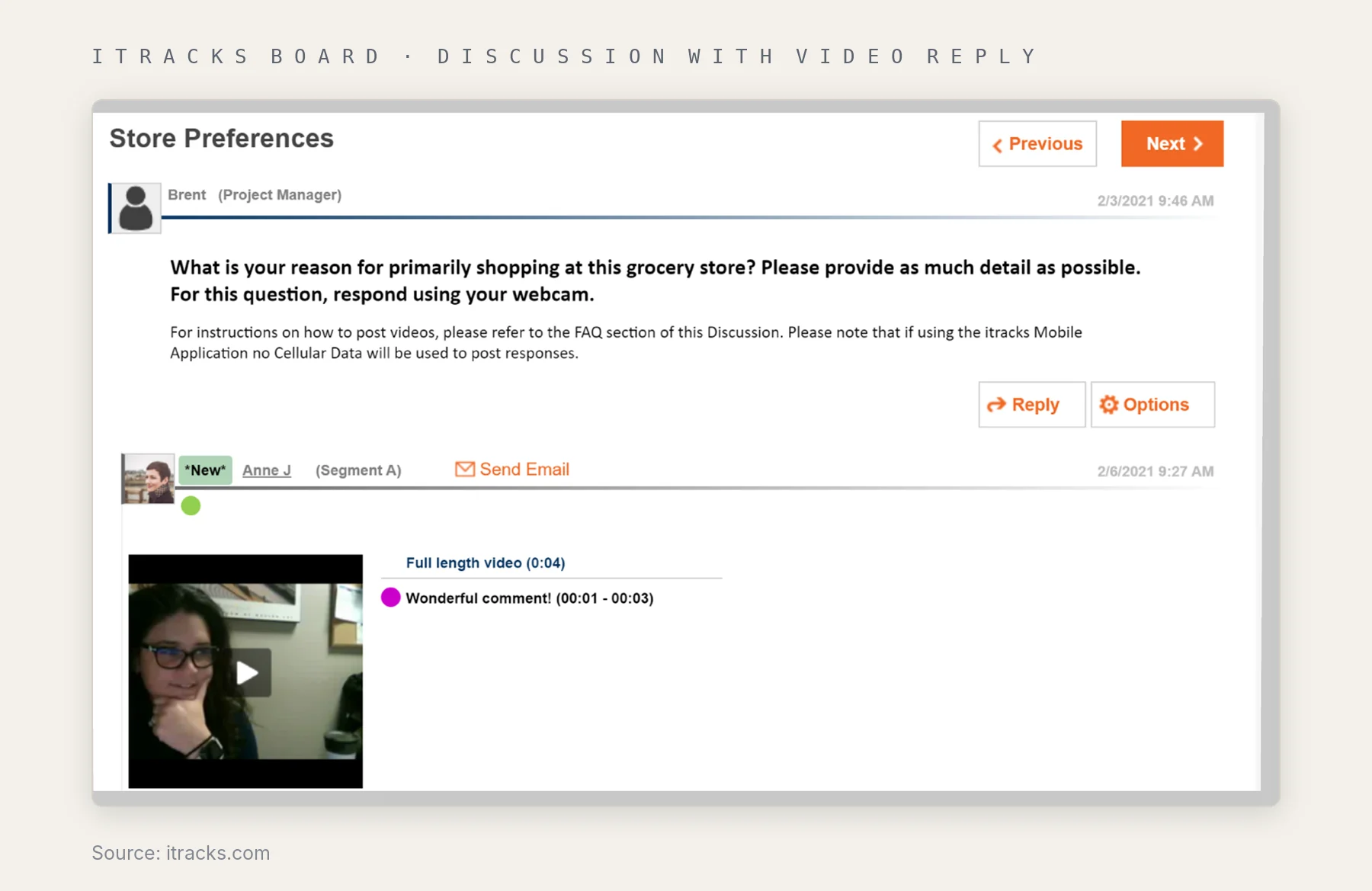
Saskatoon-based itracks combines itracks Realtime for live video focus groups and IDIs with a virtual backroom, and itracks Board for diaries, discussion boards and communities that run for days or years, plus dial testing and media markup. Recruitment, moderation, transcripts and analysis are available as services.
How participants take part: Board participants post through the web or a mobile app, and can post offline and upload when they reconnect. Realtime runs in the browser with no plugins.
AI: The itracks Analysis Assistant handles keyword and topic analysis, charts and highlight reels.
Worth knowing: AI is less central here than on newer platforms, and parts of the interface feel dated.
Best for: North American agencies and academic or political researchers who want live and async from one vendor, with optional services.
10. CMNTY by MarketResponse: Gamified Branded Communities
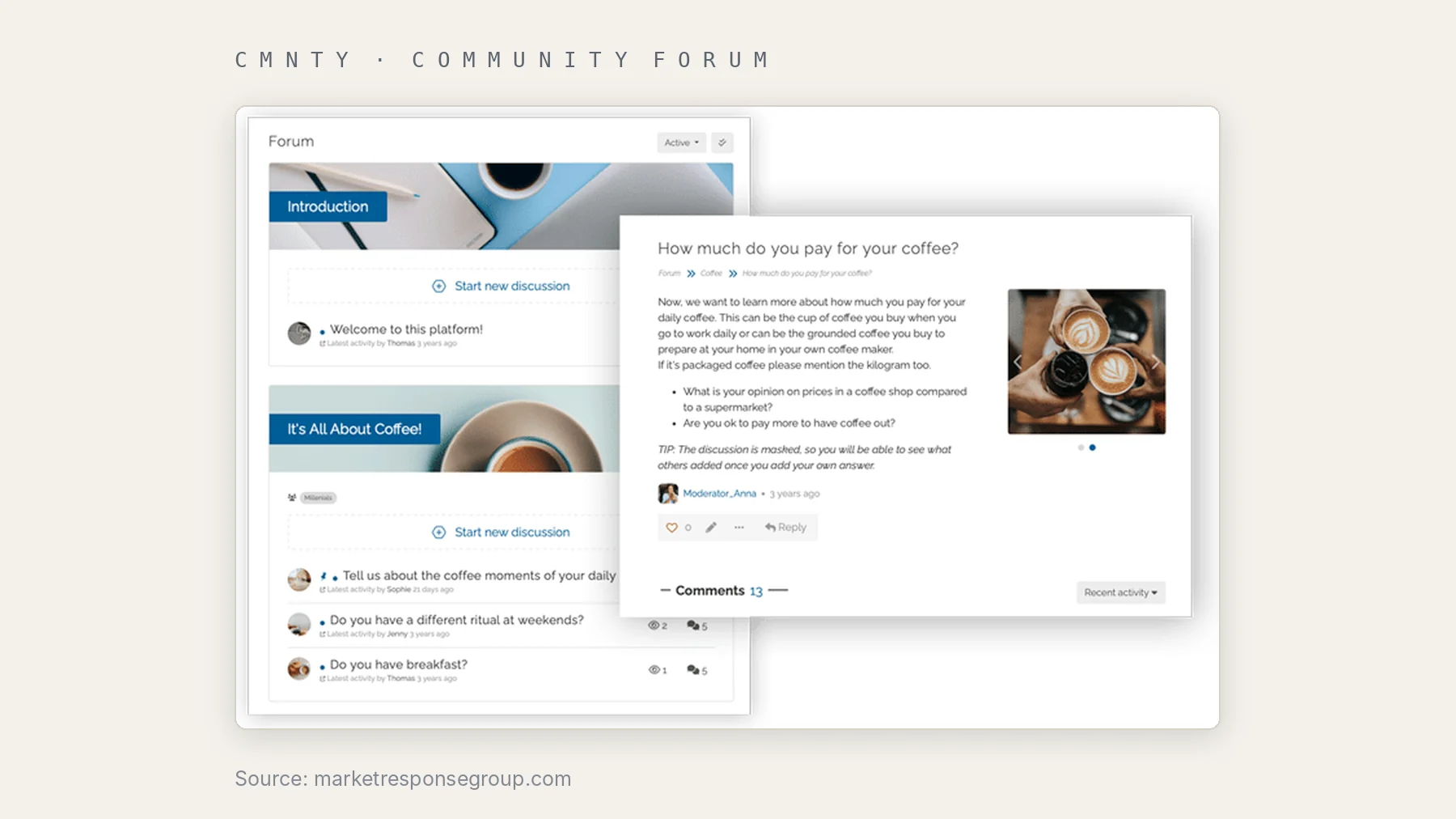
CMNTY, founded in 2007 as Redesignme, is now sold by Dutch research group MarketResponse, alongside Focus for live online groups and IDIs. Communities combine forums, co-creation challenges, journals, questionnaires, mood boards, heatmaps and gamification, with recruitment through Dynata and an integration with Forsta Decipher.
How participants take part: A branded community website with a login (including social login or single sign-on) that works on mobile.
AI: Sentiment analysis, and automated transcription in Focus. AI is thinner here than on most newer platforms.
Worth knowing: Reviewers like the engaging design and dedicated support, but find the analysis basic and some of the setup fiddly.
Best for: European brands and agencies, especially in the Benelux, who want a long-running gamified community that mixes qual and quant.
Also Worth a Look
Discuss: Combined with Voxco in November 2025 and now pairs live video focus groups in 100+ markets with AI-moderated interviews in 50+ languages, surveys and a searchable research library (Discuss Intelligence, launched July 2026). Strong for live global qual with client observers, less so for multi-day diaries.
Rival Technologies: Part of Rival Group since merging with Reach3 Insights and Angus Reid Group in 2025. Mobile chat surveys and insight communities without a member portal, strongest in North America.
FlexMR: A UK-based InsightHub suite for managed communities, with TaskMR for diaries and InterviewMR for live groups, often sold with FlexMR's own research services.
How to Choose
Start with your participants, not the feature list. Ask what share of your invite list would install an app or create an account for a research study. If it's most of them, choose on features. If it isn't, choose on how little you ask of them before the first question.
- A community that runs for months, where members see and build on each other's posts: Recollective, QualBoard, Fuel Cycle, Alida or CMNTY.
- UX research with a panel that already does this for money: Dscout.
- In-context video, with highlight reels as the output: Indeemo.
- Async boards and diaries, paid per project: Qualzy.
- Live groups and async from one vendor, with services: itracks or QualBoard.
- Already on Forsta: Digital Diaries.
- Participants who won't install or log in to anything, a client's own customer list, or a mobile-first audience: Yazi.
For a closer look at diary platforms specifically, see The Best Tools for Diary Studies in 2026, and for how to design one, Diary Studies in 2026: Formats, Design and Examples.
Frequently Asked Questions
What is the best alternative to Recollective?
It depends on the study. For long-running communities, QualBoard, Fuel Cycle and Alida are the closest matches. For UX diaries, Dscout. For video ethnography, Indeemo. For diaries, AI interviews and surveys with participants who won't log in to a website or install an app, Yazi, which runs the study in WhatsApp.
Does Recollective have AI moderation?
Yes. Conversation Task launched in October 2025 and runs AI-moderated async interviews inside a study. Since May 2026 it can use the participant's earlier answers. QualBoard, Dscout, Fuel Cycle (in early access) and Yazi also offer AI moderation.
Which Recollective alternatives don't need participants to log in?
Yazi runs in WhatsApp, so there's nothing to log in to. Qualzy uses a browser invite link, and QualBoard offers optional single-link access. Indeemo and Forsta use apps, Dscout uses its app for mobile diaries, while Recollective, Alida and CMNTY use community logins.
Can you run a diary study without an app?
Yes. Browser-based tools like Recollective, QualBoard and Qualzy don't need an app, although participants still return to a website. Yazi runs diaries in WhatsApp, so prompts, reminders, voice notes, photos and videos all happen in a chat participants already use. See our guide to WhatsApp diary studies.
What happened to FocusVision Revelation?
FocusVision bought Revelation in 2014 and later became part of Forsta, which Press Ganey acquired in 2022. Qualtrics completed its acquisition of Press Ganey Forsta in May 2026. The product that grew out of it is Forsta Digital Diaries.
Competitor details come from each vendor's website, release notes, app store and review listings, checked in October 2026. Products change quickly, so confirm current features with the vendor. Spotted something out of date? Email hello@askyazi.com.


