
Updated October 2026. A diary study lives or dies on day three. Day one gets a burst of enthusiasm, and by the middle of the study the people who are still sending entries are the ones the tool made it easy for. So the right diary study tool is less about feature lists and more about what happens across several days: how activities are scheduled, how people are reminded, whether they can send an entry the moment something happens, and whether anyone follows up on what they send.
This guide looks at ten tools through that lens: Yazi, Dscout, Indeemo, EthOS, Recollective, QualSights, Field Notes, Qualzy, Incling and itracks. It also covers the usability platforms that only offer diaries as a workaround, and how to keep participants going to the last day. For a head-to-head of eight platforms on what participants have to do before their first entry, see The Best Tools for Diary Studies in 2026.
What a Multi-Day Study Needs from a Tool
Most of these tools can capture a photo, a video or a typed answer. The differences show up over time:
- Activities that unlock by day. A study is a sequence, not one questionnaire. The tool should release day two's tasks on day two, and let you change a later day once you see what day one turned up.
- Reminders where people already are. A reminder that lands in an inbox people rarely check is a reminder nobody reads. The channel matters as much as the timing.
- Entries the participant starts. The best moments happen between your prompts. Participants need a way to send an entry when something happens, not only when asked.
- Follow-up on each entry. A three-word entry is only useful if someone asks why. Some tools have an AI moderator that probes every entry, some leave it to the researcher, some suggest probes for a person to send.
- Capture that suits the moment. Voice notes for people on the move, photos for what's in front of them, video when it matters. Uploads that survive a weak connection matter in many markets.
- Analysis across days. Themes that build as entries arrive, a library of every clip and photo, and a way to turn the best moments into a highlight reel for stakeholders.
Diary Study Tools Compared
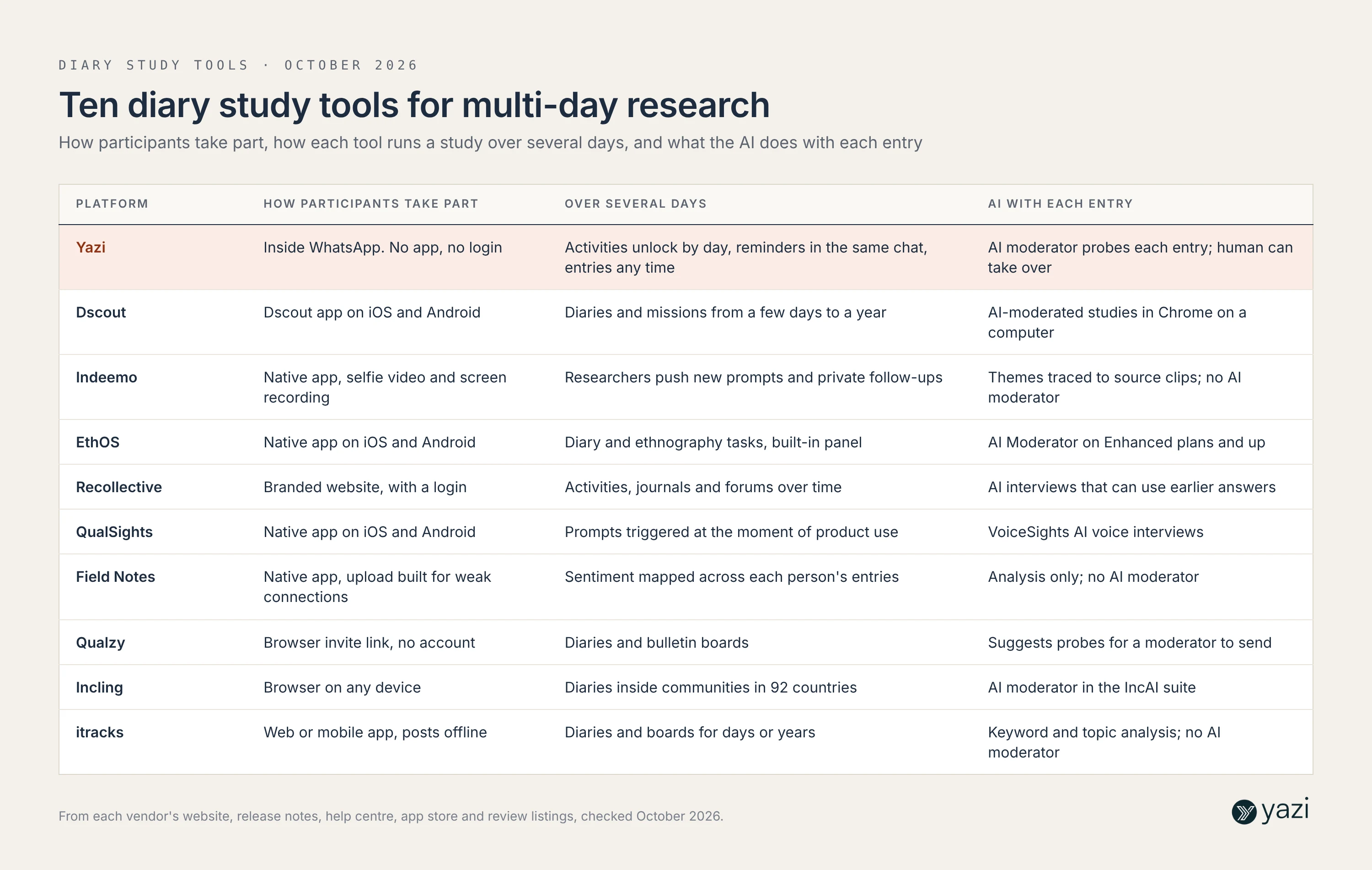
The table below shows how participants take part in each tool, how it handles a study that runs over several days, and what the AI does with each entry. Most of these tools price on a custom quote, so we've focused on how each one works.
1. Yazi: Diaries, AI Interviews and Surveys Inside WhatsApp
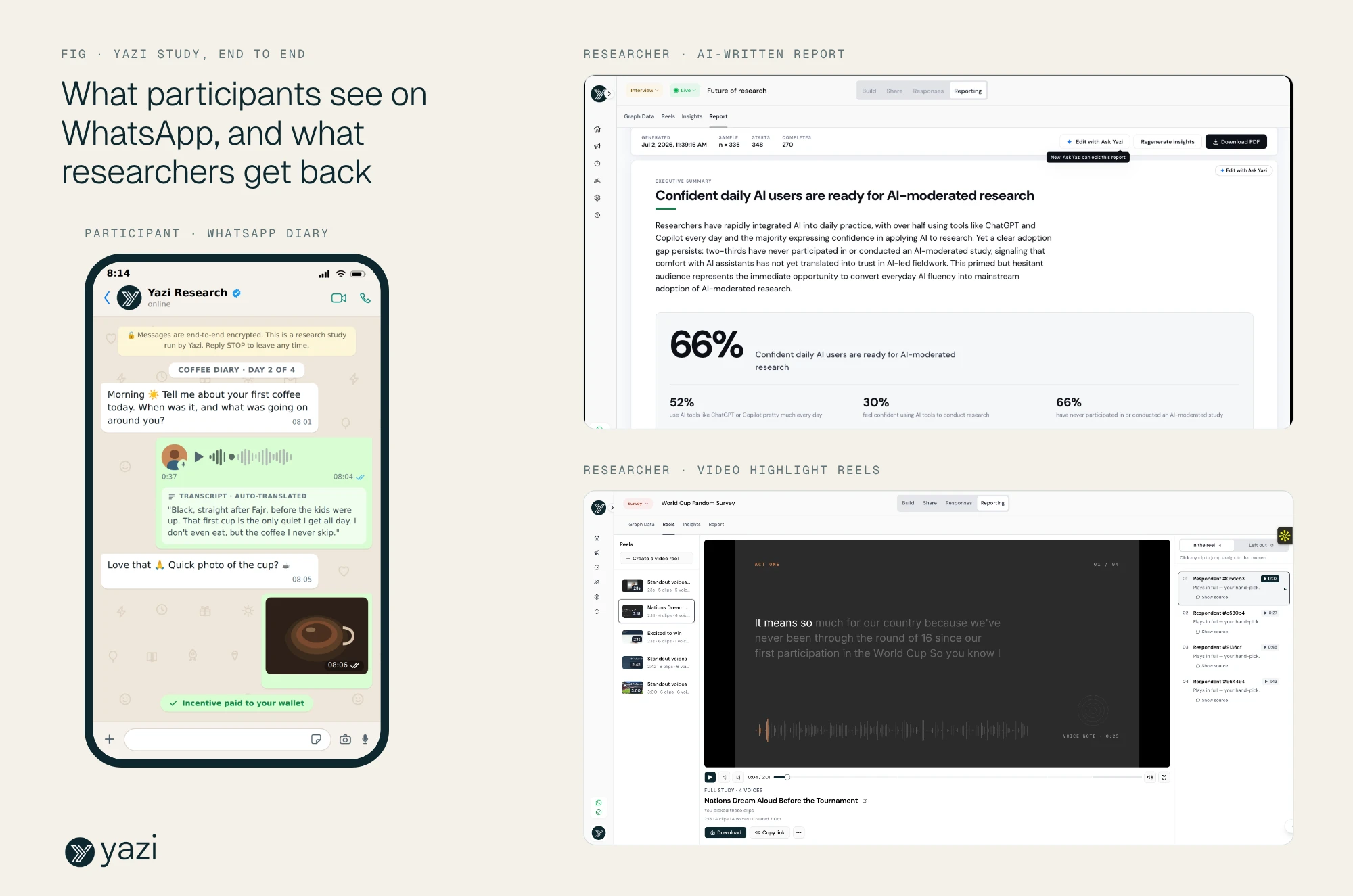
Yazi runs the whole study inside WhatsApp, the app people already open dozens of times a day. There's nothing to download and no account to create, and the study sits in the same chat list as everyone else the participant talks to, which is why a day-five reminder actually gets seen. People answer the way they'd reply to a friend: a quick text, a voice note on the way home, or a photo of what's in front of them.
Over several days: Studies are built as a sequence of activities (photo and video tasks, AI interviews, surveys and check-ins) that unlock over days or weeks, with reminders in the same thread. Participants can also send an entry whenever something happens, and the AI can probe on it.
AI moderation with a human in the loop: The AI moderator follows your discussion guide and follows up on each entry, asking for the why behind a photo or a voice note. A researcher can take over any conversation live and hand it back, and group discussions can be run by a human moderator or the AI.
Media library and highlight reels: Every voice note, photo and video lands in a media library grouped by question, where you can tag clips and pick the ones that matter. Selected clips go straight into a highlight reel that plays each participant's own words, ready to show stakeholders.
Reporting: Responses are grouped into themes as they arrive, with an AI-written executive summary you can edit and export to PDF or PowerPoint, cross-tabs, and transcripts that read like the original chat.
Panel and reach: A 1.8M+ panel with reach in 25+ countries, or your own customer list. Yazi moderates natively in English, isiZulu, isiXhosa, Afrikaans, Setswana, Sesotho, Swahili, French, Portuguese and others, with AI translation across 100+ languages. Studies hold a 90% completion rate.
Quality and compliance: Automated checks flag inconsistent answers and responses that look AI-generated. Yazi is POPIA, GDPR and CCPA compliant, with research data hosted on AWS in the UK and Ireland.
Where it fits less well: Participants need WhatsApp. If the study depends on screen recordings, or on a community where members read and reply to each other's posts for months, the app and browser tools below are built for that.
Best for: Diaries, product trials and usage journeys where participants shouldn't have to install anything; a client's own customers or a general population sample; studies that mix quant and qual; and mobile-first audiences in Africa, Latin America, Asia, the Middle East and anywhere WhatsApp is the default way people talk.


2. Dscout: App-Based Diaries and Missions for UX Teams
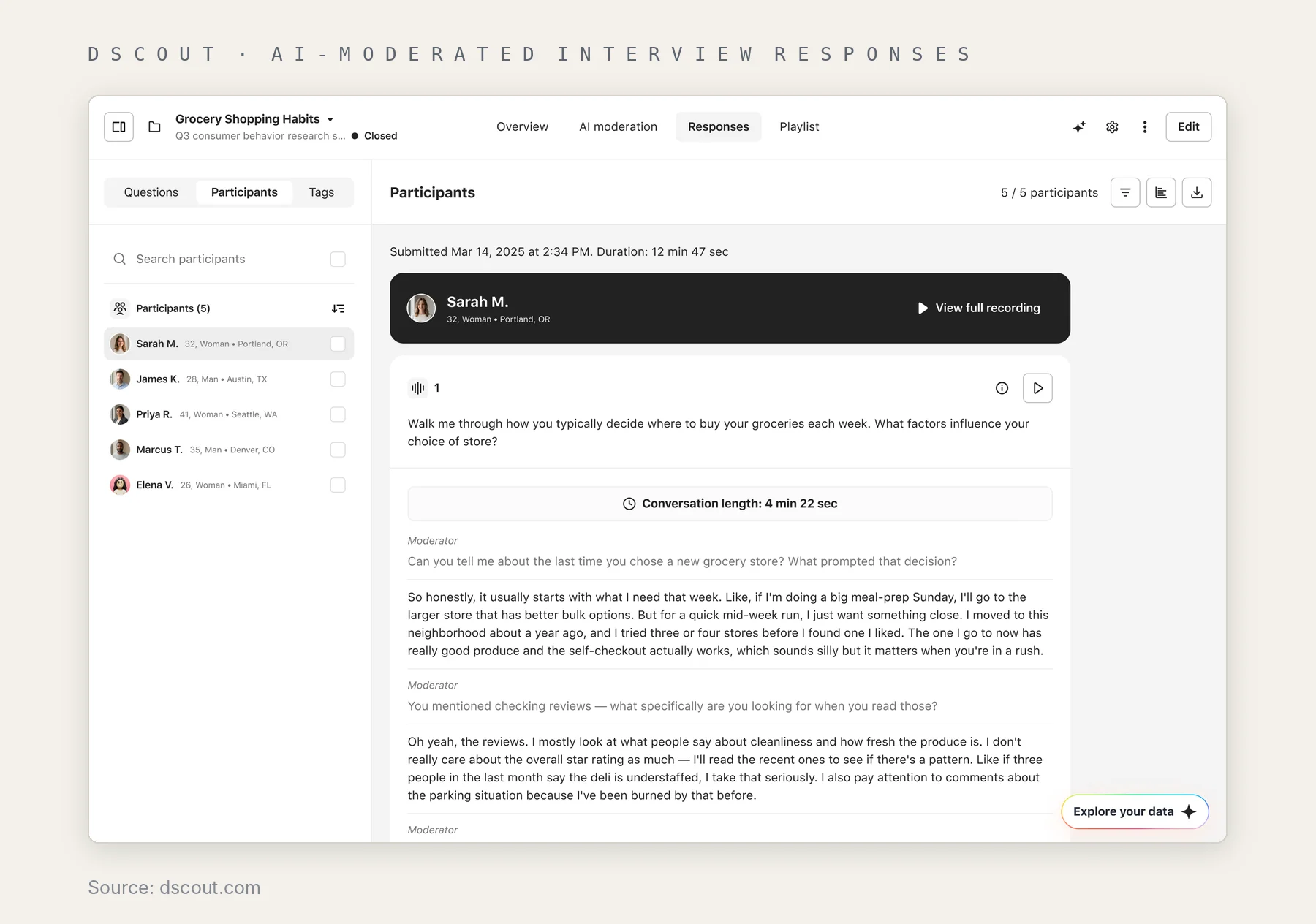
Chicago-based Dscout is the best-known diary platform for UX and product teams. It runs diary studies from a few days to a year, in-the-moment video "missions", usability tests, card sorts, tree tests, live interviews and AI-moderated interviews.
Over several days: Mobile diary and mission entries go through the Dscout app on iOS and Android, with participants from its own panel of verified "Scouts" or your own users.
AI: AI Studio, launched in April 2026, drafts a study from a research goal and runs AI-moderated studies, generally available since October 2026, in 25+ languages. AI-moderated studies run in Chrome on a desktop or laptop rather than in the app.
Worth knowing: The Scout panel is strongest in the US, and G2 reviewers mention seeing the same participants come back across studies, and limited exports. Its compliance stack (SOC 2 Type II, ISO 27001, HITRUST) is one of the fullest in the category.
Best for: In-house UX and product teams in the US and UK with a panel that's comfortable using an app. See our Dscout alternatives guide.
3. Indeemo: Mobile Video Diaries and Ethnography
Indeemo, founded in Ireland in 2014, is built for in-context video over days: diary studies, mobile ethnography, in-home product tests, and shopper and patient journeys. Participants record selfie videos, screen recordings and photo tasks in a native app.
Over several days: Researchers can push new prompts and send private follow-ups to individuals while the study runs, and recruit in store with a QR code.
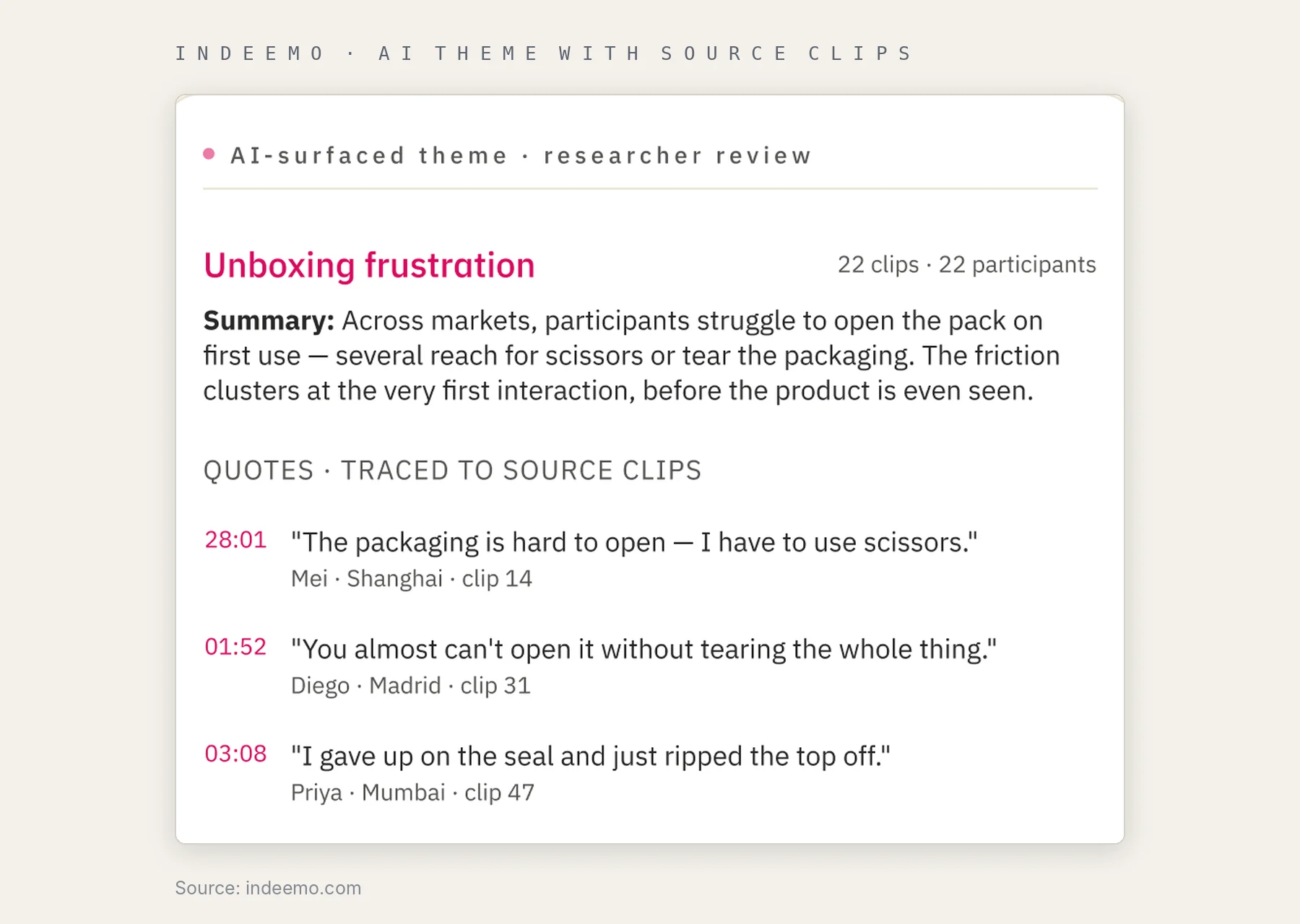
AI: AI video analysis suggests themes with every quote traced back to its source clip, with transcription and translation in 30+ languages and text recognition in photos and video. We didn't find an AI moderator.
Worth knowing: Participants need the app, including when you bring your own. Reviewers praise the participant experience but mention clunky subgroup filtering and limited exports.
Best for: Agencies and brand teams running video-led diaries and ethnography. See our Indeemo alternatives guide.
4. EthOS: App-Based Diaries with a Built-In Panel
EthOS was founded by ethnographer Siamack Salari and has been part of New York-based OvationMR since October 2024. It covers diary studies, mobile and digital ethnography, video surveys, usability and concept tests, and in-depth interviews, with an integrated panel that OvationMR says has 3M+ participants in 150+ countries.
Over several days: Participants complete diary and ethnography tasks in native EthOS apps on iOS and Android.
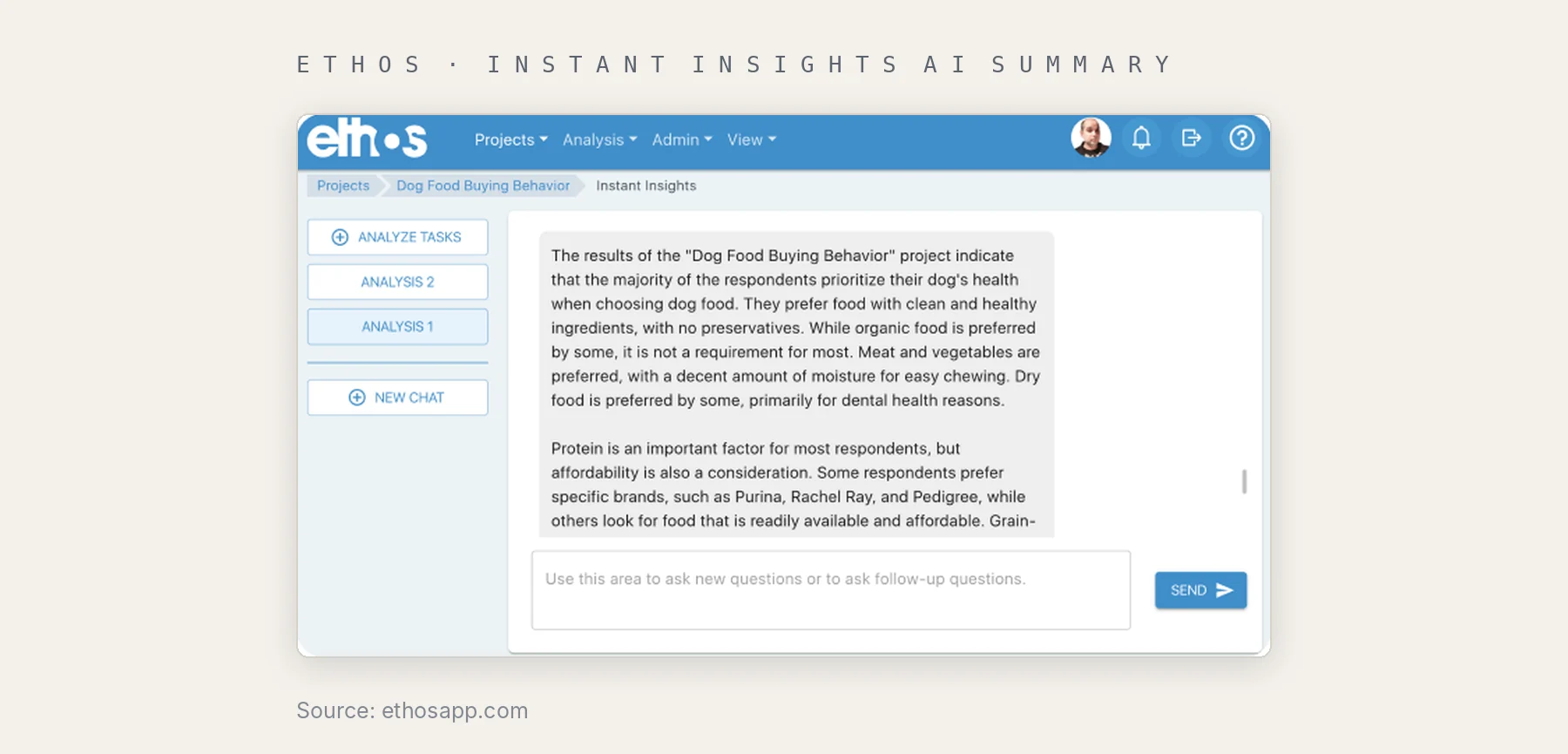
AI: An AI Moderator since March 2025, built on probing technology from Qualibee, plus Instant Insights for asking questions of your data, automated transcription with sentiment, and highlight reels.
Worth knowing: Pricing is quote only, and AI analysis and AI moderation start on the Enhanced plan. Independent reviews are few; reviewers praise ease of use and support but say reporting and export take work.
Best for: Teams that want app-based diaries with recruitment built in.
5. Recollective: Browser-Based Diaries, Activities and Communities
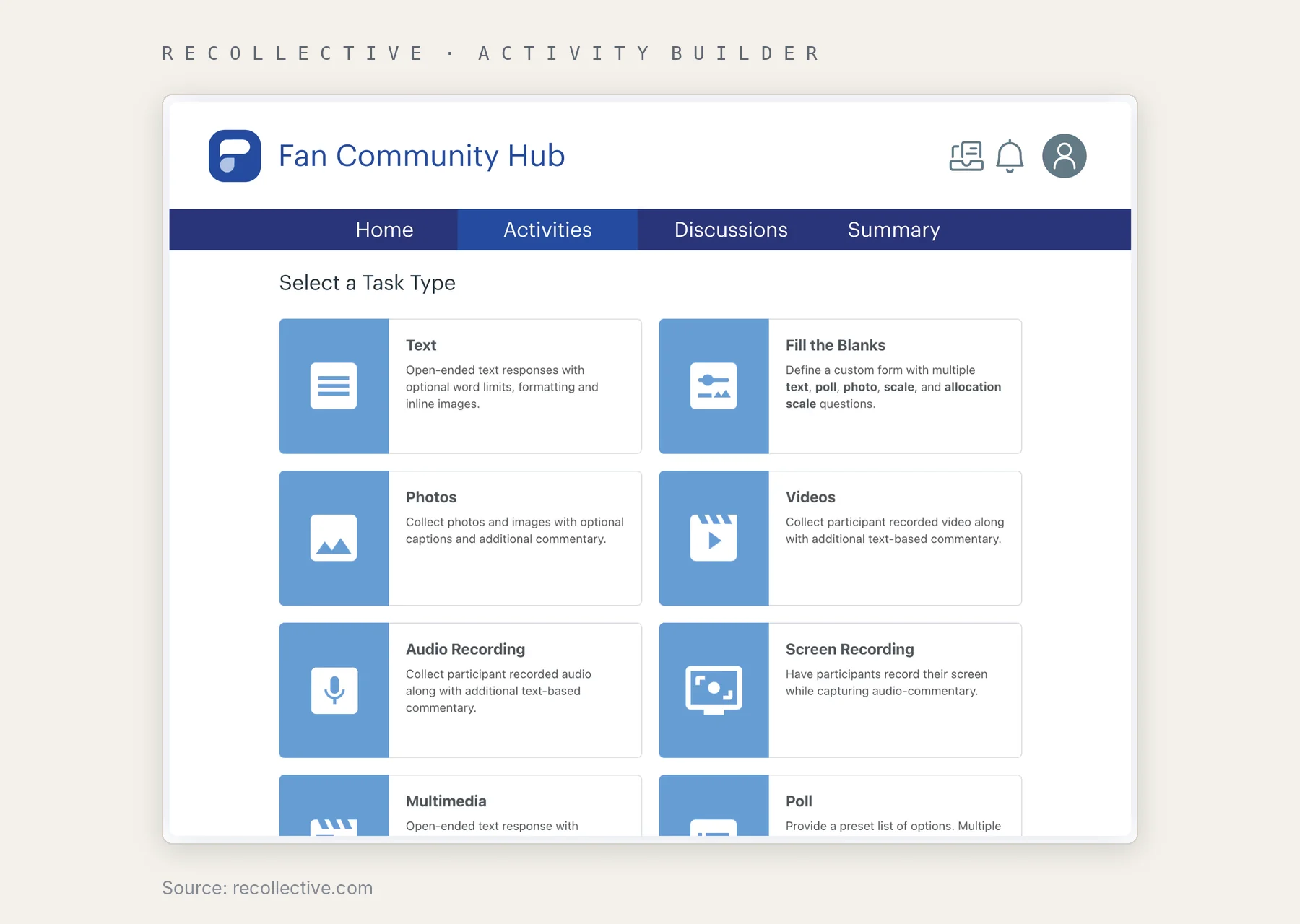
Ottawa-based Recollective runs activity-based async studies with a deep question library (text, photo, video, audio, screen recording, image markup, card sorts), journals and diaries, discussion forums, and live video IDIs and focus groups. Recollective Connect is a separate product for always-on communities of 1,000 to 50,000+ members.
Over several days: Participants take part through a branded website in the browser, with a login, on desktop or mobile, and come back to it for each new activity.
AI: Conversation Task, launched in October 2025, runs AI-moderated interviews inside a study, and since May 2026 it can use a participant's earlier answers. Ask AI answers questions across projects with source verbatims.
Worth knowing: Recollective publishes starting prices: from $475 a month for live-only, $750 a month for live and async, and $1,250 a month for Connect communities, on annual licences.
Best for: Teams who want diaries, communities and live video in one browser-based platform. See Yazi vs Recollective.
6. QualSights: In-the-Moment Prompts for In-Home Usage Tests
Chicago-based QualSights, led by founder and CEO Nihal Advani, raised a $7.7M Series A in 2022 and counts Clorox, Colgate, General Mills and PepsiCo among its customers. It specialises in remote video capture and in-home usage testing, and leans on AI transcription and theme tagging to work through hours of footage.
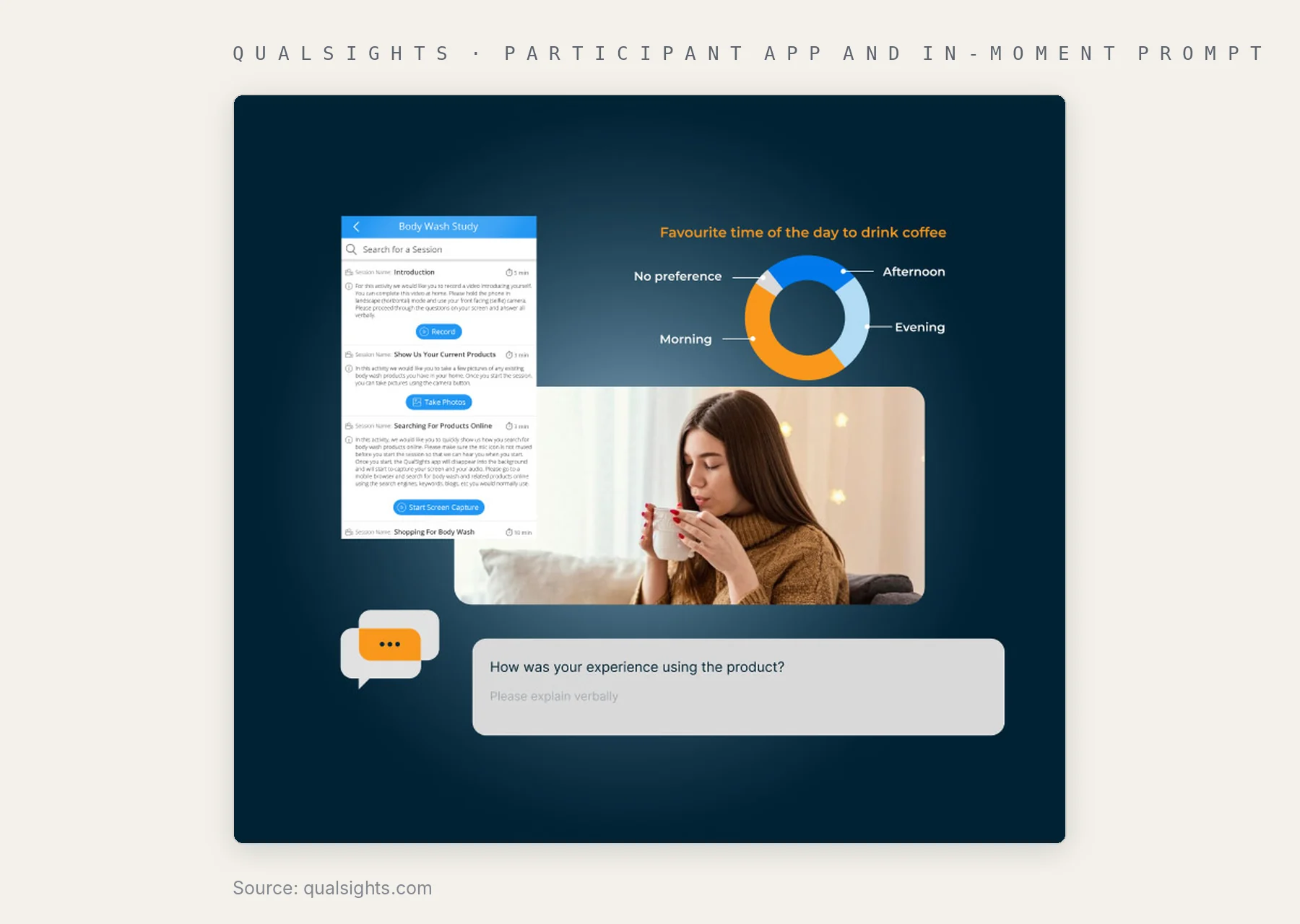
Over several days: Its patented Smart Coasters and Smart Tags log product use passively, and its XMOT Method triggers a video or audio prompt at the moment the product is used, so entries arrive when the behaviour happens rather than when the participant remembers it. Participants take part through the QualSights app on iOS and Android.
AI: Generative AI summaries and theme generation, transcription and translation, sentiment and emotion analysis, object and brand spotting in video, auto-clipping, and VoiceSights, an AI-moderated voice interviewer.
Worth knowing: Pricing is on a quote. Independent reviews are few, with 8 on G2 at the time of writing.
Best for: Large CPG, beauty and health brands running in-home usage tests over several days.
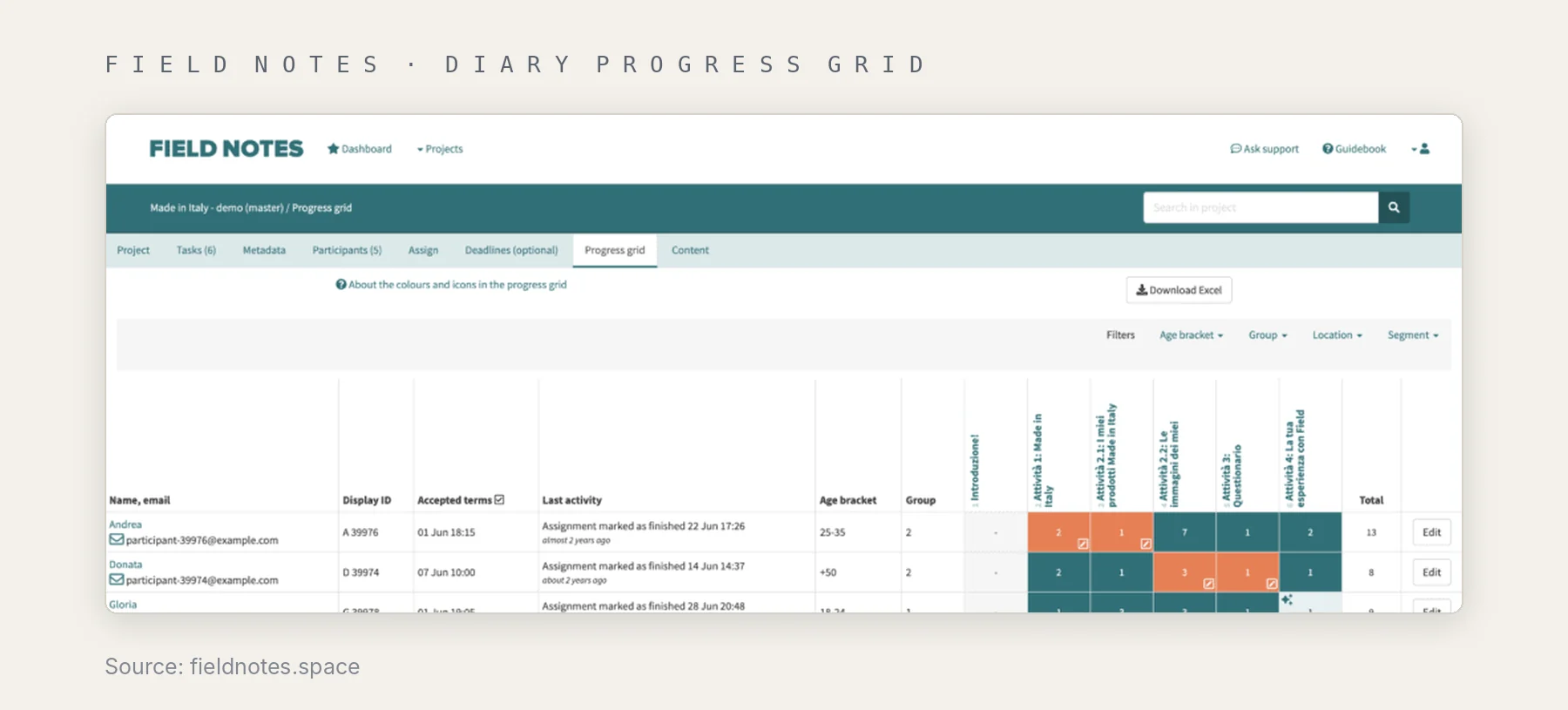
7. Field Notes: Self-Ethnography Video Diaries
London-based Field Notes began in 2011 as an in-house tool at a qual agency and has been an independent business since 2017, co-founded by Dave Kaye and Tim Diggins. It's built for self-ethnography: video diaries, prompted video and audio, mobile screen recording, reactions to stimulus and, since November 2025, mini-surveys.
Over several days: Participants record in the Field Notes app on iOS and Android, with an upload system built for patchy connections. AI Journeys (October 2025) maps sentiment across a participant's entries, so you can see how someone's view moved over the study.
AI: Ask AI (October 2026) for chat-based analysis with every answer linked back to its source quotes, clipping and playlists, and translation included on every project since August 2026. There's no AI moderator.
Worth knowing: There's no own panel; the team helps set up the study and manage participants. Pricing is pay-as-you-go or subscription, on a quote.
Best for: UK and European agencies, charities and employee-experience teams running video diaries over days or weeks.
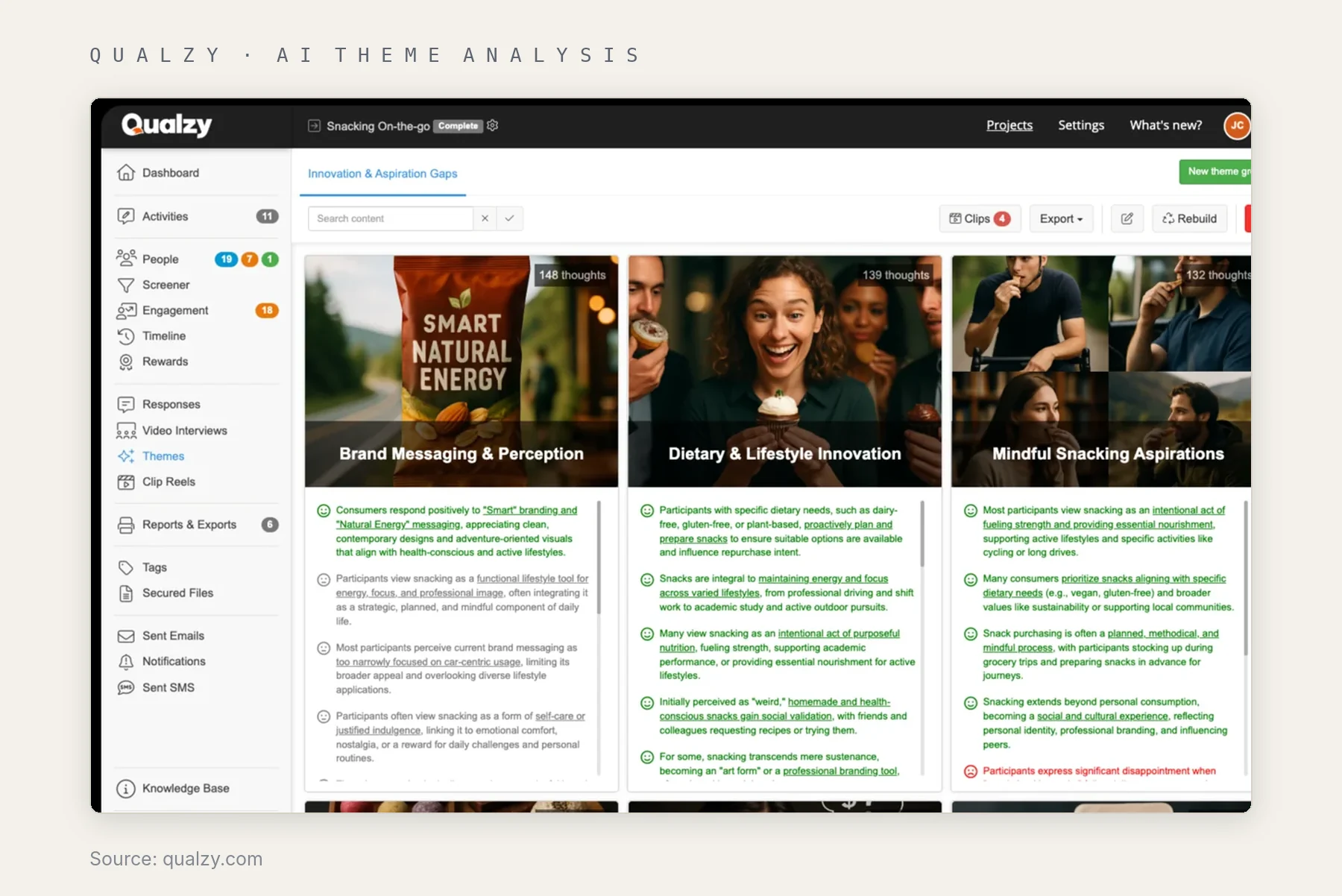
8. Qualzy: Browser Diaries Paid per Project
UK-based Qualzy offers 15+ activity types, including diaries, bulletin boards, video tasks, async IDIs, card sorts and pin tasks. Participants take part in the browser through an invite link, with no app and no account to create.
AI: Every response is translated, summarised and broken into key points, with theme analysis, suggested probes for moderators (never sent automatically), fraud flagging and video clip reels.
Worth knowing: There's no built-in live video. Pricing is per project, per active participant or by community size, with no seat licences.
Best for: Agencies and independent researchers running async diaries project by project.
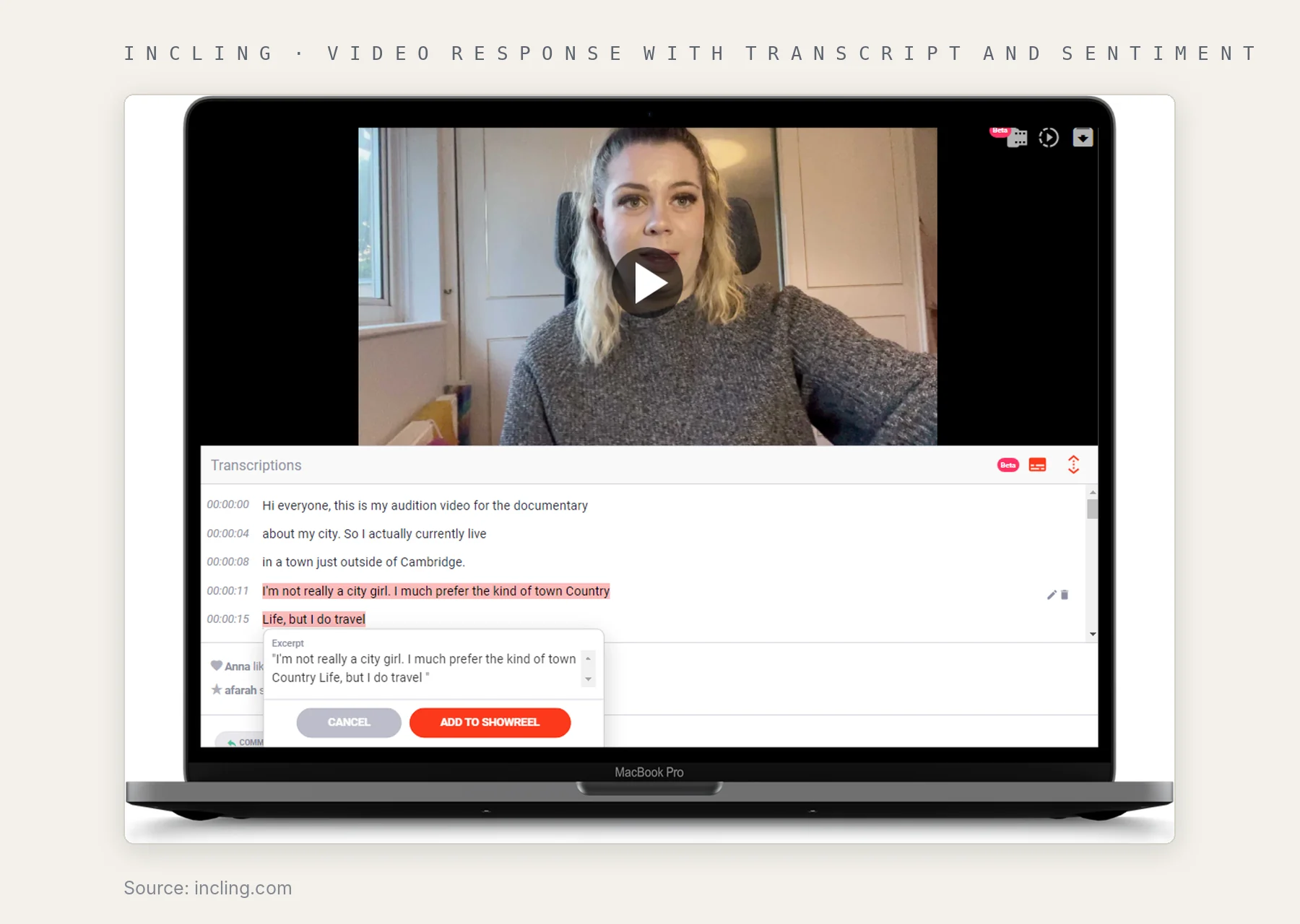
9. Incling: Mobile Diaries Inside Multi-Market Communities
London-based Incling, founded in 2013 and still founder-led, runs online qualitative communities in 92 countries: long-term panels and short pop-up communities, mobile photo and video diaries, live video focus groups, screencast UX tasks, polls and discussions. You can run it yourself or with Incling's in-house moderation, recruitment and translation.
Over several days: Participants take part in the browser on any device, with no app to install.
AI: The IncAI suite lists an AI moderator, alongside AI summaries with supporting quotes, transcription and translation in 30+ languages, auto showreels and IncAI Enquire, a conversational analysis assistant added in summer 2026. The platform is ISO 27001 certified.
Worth knowing: Pricing is quote only, and with no native app, in-the-moment video depends on the participant's mobile browser.
Best for: Agencies and brands running multi-market diaries and communities who want moderation and translation support.
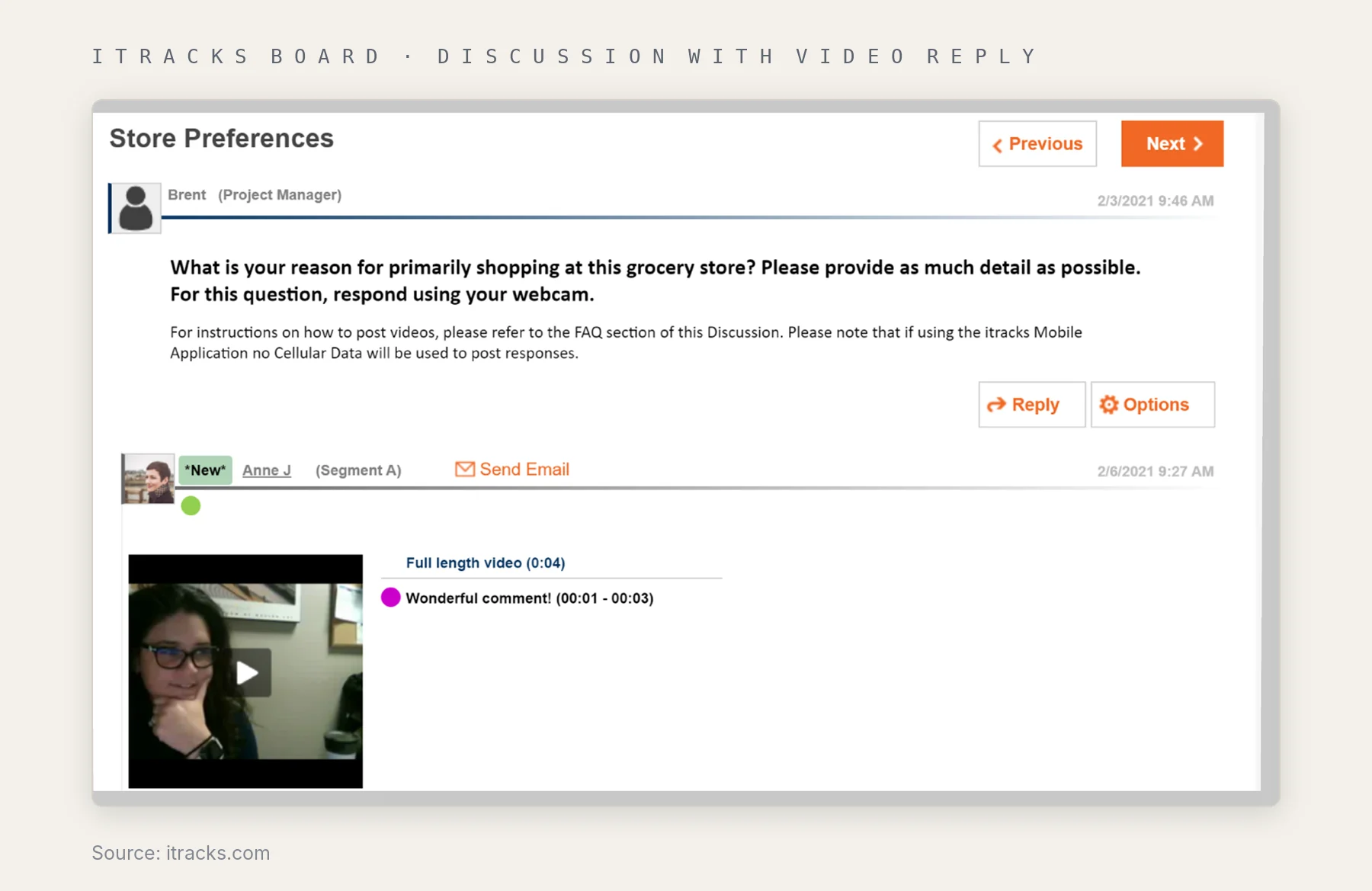
10. itracks: Diaries and Boards with Live Groups and Services
itracks combines itracks Board, for diaries, discussion boards and communities that run for days or years, with itracks Realtime for live video focus groups and IDIs with a virtual backroom. Recruitment, moderation, transcripts and analysis are available as services.
Over several days: Board participants post through the web or a mobile app, and can post offline and upload when they reconnect.
AI: The itracks Analysis Assistant handles keyword and topic analysis, charts and highlight reels.
Worth knowing: AI is less central here than on newer platforms, and there's no AI moderator.
Best for: North American agencies and academic researchers who want async diaries and live groups from one vendor, with optional services.
Usability Platforms Without a Native Diary Feature
Several well-known UX platforms come up in diary study searches but don't run multi-day diaries as a feature. UserTesting (now part of Auros), Maze and Lookback document diaries as a workaround made of separate tests or sessions sent to the same people, and Userlytics and Great Question don't offer diaries. They're strong for usability and prototype testing, but if the study needs to follow people over days, a diary tool from the list above will do the job with less stitching together.
How to Keep Participants Going Over Several Days
- Make day one short. A quick, easy first task gets people over the hardest step. Save the longer tasks for once they're in the habit.
- Say what's coming. Tell people how many days, roughly how long each one takes, and when they'll be paid, before they start.
- Remind them in the channel they use. Timed reminders work best when they arrive somewhere people already look, and when they mention what's due today.
- Let them choose the format. A voice note is often easier than typing and gives you more. Photos and video show what words leave out.
- Follow up on what they send. A short, specific question about their own entry shows someone is paying attention, and it's usually where the useful answer comes from.
- Give a window, not a deadline. Let people complete a day's task any time that day. Life happens, and a rushed answer at midnight is worth less than a considered one at lunch.
- Check in halfway. A quick thank-you and a note on how much is left keeps people going through the middle days, where most drop-off happens.
For more on designing the study itself, see Diary Studies in 2026: Formats, Design and Examples.
How to Choose
Start with the people you need to hear from, then with how the study runs over time.
- UX research with a US panel that already uses an app: Dscout.
- Video-led diaries and ethnography: Indeemo, EthOS or Field Notes.
- In-home usage tests with prompts at the moment of use: QualSights.
- Diaries in the browser, with communities or live video alongside: Recollective, Incling or itracks.
- Async diaries paid per project: Qualzy.
- Participants who won't install anything, follow-up on every entry, or a mobile-first audience: Yazi.
Frequently Asked Questions
What is the best diary study tool for multi-day research?
It depends on who you're studying. For UX teams with an app-ready US panel, Dscout. For video-led diaries, Indeemo, EthOS or Field Notes. For in-home usage tests, QualSights. For browser diaries alongside communities, Recollective or Incling. For diaries where participants shouldn't have to install anything and every entry gets a follow-up, Yazi, which runs the study in WhatsApp.
Which diary study tools have an AI moderator?
Yazi, Dscout, EthOS and Recollective all run AI-moderated follow-ups, QualSights has VoiceSights for voice interviews, and Incling lists an AI moderator in its IncAI suite. Indeemo and Field Notes focus their AI on analysis, and Qualzy suggests probes for a moderator to send.
Which diary study tools don't need an app?
Yazi runs in WhatsApp, so there's nothing new to install. Recollective, Qualzy and Incling run in the browser. Dscout, Indeemo, EthOS, QualSights and Field Notes use native apps, and itracks offers both web and mobile app access.
How long should a diary study run?
Long enough to catch the behaviour you care about, and no longer. Five to seven days covers most routines, two to four weeks suits product trials and habits, and anything longer needs lighter daily tasks and regular check-ins to hold people.
Competitor details come from each vendor's website, release notes, help centre, app store and review listings, checked in October 2026. Products change quickly, so confirm current features and prices with the vendor. Spotted something out of date? Email hello@askyazi.com.


