%202.png)
A qualitative research interview is a one-on-one conversation designed to explore experiences, opinions, and motivations through open-ended questions. This guide covers the three main interview types, how many you actually need to reach saturation, the six-step framework for analysing what you collect, and how WhatsApp and AI-moderated methods are changing the economics of fieldwork.
Unlike a survey with fixed response options, a qualitative interview gives participants freedom to answer in their own words. And unlike a casual conversation, it has a clear research objective and some degree of structure guiding the discussion. The researcher controls the topic, but the participant shapes the substance, which is what makes this method so effective at uncovering the "why" behind behaviours, not just the "what."
What is a qualitative research interview?
A qualitative research interview is a data collection method where a researcher asks open-ended questions to a participant in a one-on-one setting, aiming to understand their experiences, perspectives, and reasoning in depth. This method is widely used across market research, social science, UX research, and ethnographic studies.
Explore how qualitative research works on WhatsApp-native platforms for faster, richer data collection.
Qualitative research interviews differ from quantitative approaches in a fundamental way: they prioritise depth over breadth. A well-conducted interview with 15 people can reveal patterns, contradictions, and emotional nuances that a 1,000-person survey would miss entirely.
Types of qualitative research interviews
Not all qualitative interviews look the same. The level of structure you choose shapes the kind of data you get, the flexibility you have during the conversation, and the consistency across participants.
| Type | Structure level | Best for | Tradeoff |
|---|---|---|---|
| Structured | High: predetermined questions, no deviation | Comparing responses across participants consistently | Less depth, no room to follow unexpected leads |
| Semi-structured | Medium: question guide with room for follow-ups | Most research scenarios, balancing consistency with exploration | Requires interviewer skill to manage flow |
| Unstructured | Low: open conversation around a topic | Exploratory research, sensitive topics, early-stage discovery | Hard to replicate, analysis is more complex |
| In-depth (IDI) | Varies: usually semi-structured | Deep exploration of individual experiences and opinions | Time-intensive per participant |
Structured interviews
Use a fixed list of questions asked in the same order to every participant, with no follow-ups and no deviations. Their main advantage is minimising interviewer bias, making them useful when standardisation matters. But they sacrifice the exploratory richness that makes qualitative work powerful.
Semi-structured interviews
The most common type of qualitative research interview. They combine the consistency of a prepared guide with the flexibility to probe deeper based on what a participant says. A researcher comes in with key questions but can ask follow-ups, reorder topics, or explore tangents that seem promising.
Unstructured interviews
The most free-flowing format. The researcher might start with a single broad question and let the conversation evolve naturally. These are demanding to conduct well: fully unstructured interviews require significant experience because there is no guide to fall back on.
In-depth interviews (IDIs)
A specific application of qualitative interviewing that emphasises intimate, extended dialogue. They typically run 45 to 90 minutes and are designed to uncover layered perspectives. IDIs are the workhorse of qualitative market research and are increasingly being conducted remotely to reduce cost and expand geographic reach.
Qualitative interview vs. focus group
Researchers often debate whether to use interviews or focus groups. The answer depends on what you need.
| Dimension | Qualitative interview | Focus group |
|---|---|---|
| Format | One-on-one | Group of 6–10 participants |
| Depth per person | High, detailed individual accounts | Moderate, spread across participants |
| Social influence | None, participant speaks freely | Risk of groupthink or dominant voices |
| Best for | Sensitive topics, individual decision-making, detailed narratives | Group dynamics, brainstorming, stakeholder buy-in |
| Moderation skill | Moderate | High, must manage group dynamics |
Qualitative interviews excel when you need participants to feel safe sharing honest, personal responses without worrying about judgement. Focus groups have their own advantage: when research sponsors take time to observe them, it can accelerate buy-in and move a study toward final recommendations faster.
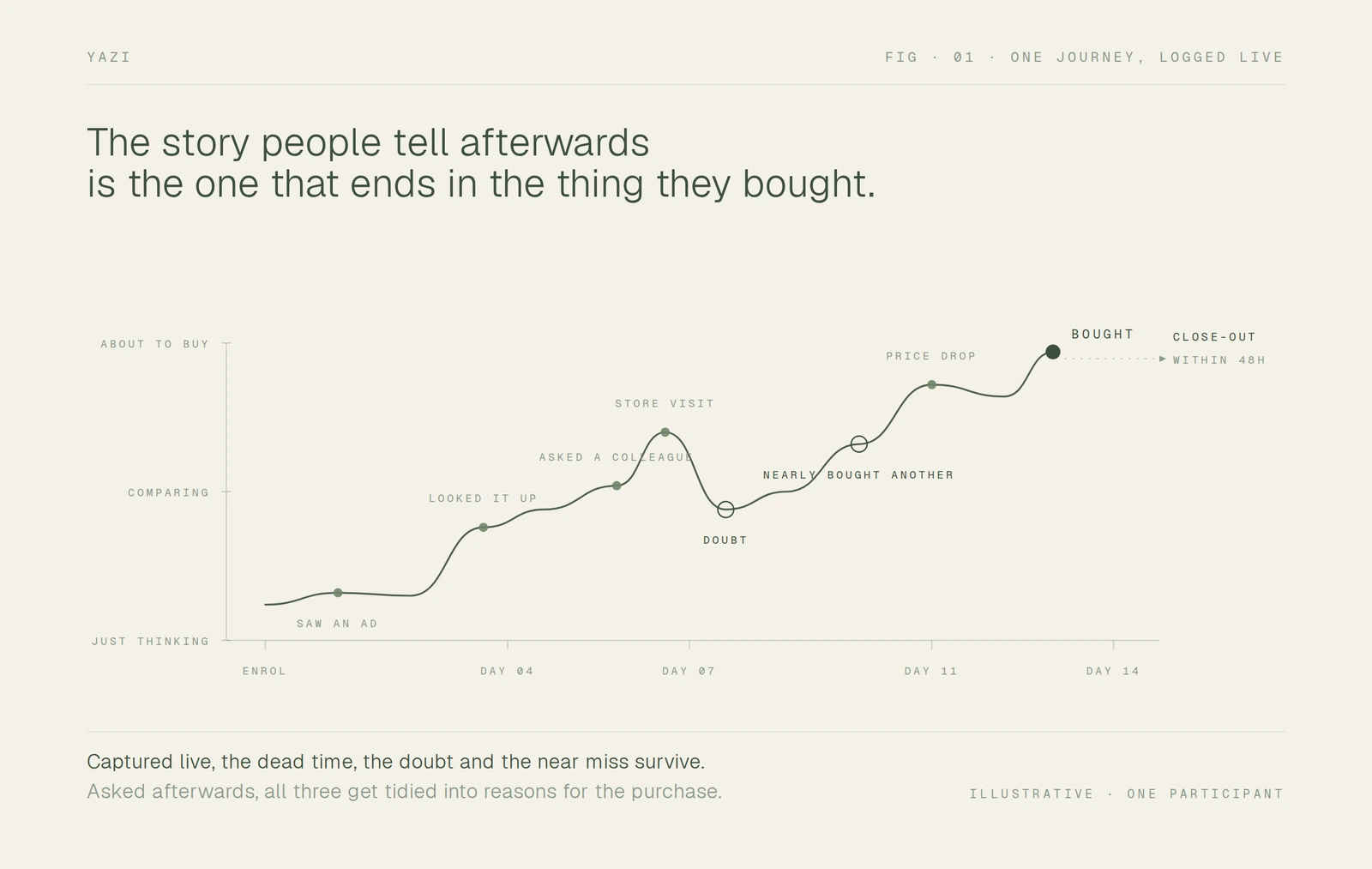
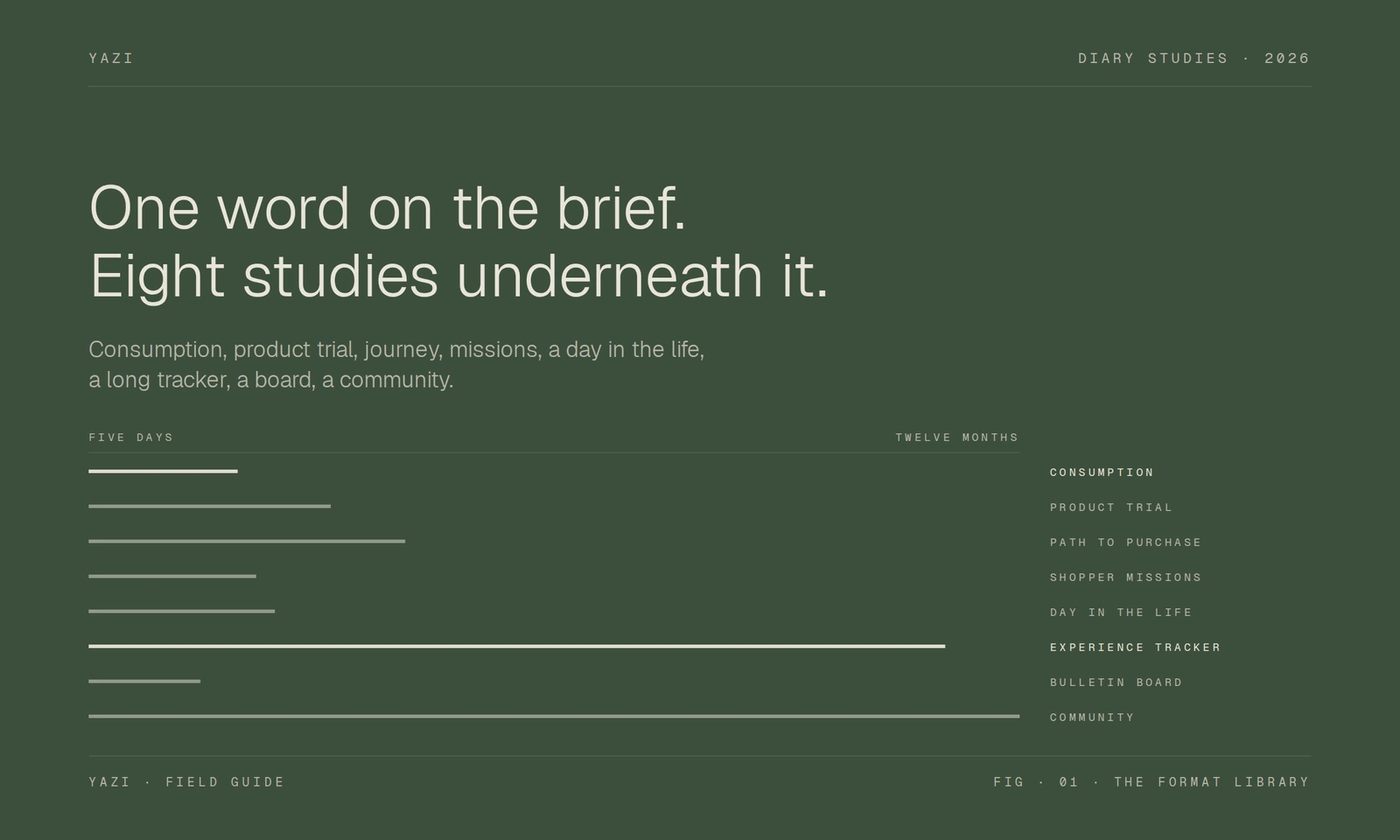
There is also a third option worth considering. Diary studies capture longitudinal, in-the-moment data over days or weeks, filling a gap that neither single interviews nor focus groups can address.
How many interviews do you need?
This is the most common practical question researchers ask, and the honest answer is: it depends. The concept of data saturation, the point where new interviews stop generating new themes, is the standard guiding principle, but saturation is not a single number.
Research by Hennink and Kaiser (2022), published in Social Science & Medicine, reviewed 23 empirical studies and found that 9 to 17 interviews typically reached thematic saturation, with a mean around 12 to 13, in studies with fairly homogeneous populations and focused objectives. Broader research aims or more diverse populations tend to push that number higher.
A systematic review of 560 PhD qualitative studies found the mean sample size was 31, though the distribution was skewed by researchers gravitating toward round numbers (10, 20, 30) rather than letting saturation guide their stopping point.
Start with 12 to 15 interviews for a focused research question and a relatively similar participant group. Plan for 20 to 30 or more when studying diverse populations or building new theory. Several factors reduce the number you need: a narrow research aim, a specific sample, strong theoretical grounding, and high-quality dialogue where participants give rich, detailed responses.
Use a sample size calculator to estimate your starting point, then adjust based on what emerges during fieldwork.
How to analyse qualitative interview data
The most widely used approach is thematic analysis, following the six-step framework developed by Braun and Clarke. It works by systematically identifying patterns across interview transcripts.
Familiarisation
Read and re-read all transcripts. Note initial impressions.
Coding
Label meaningful segments of text with short descriptive codes.
Generating themes
Group related codes into broader themes that capture recurring patterns.
Reviewing themes
Check that themes accurately represent the coded data and the full dataset.
Defining and naming themes
Write a clear description of what each theme captures and why it matters.
Reporting
Present themes with supporting quotes and connect findings to the research question.
This framework organises large volumes of text into meaningful patterns relevant to the research question. It is flexible enough for most qualitative interview projects, whether the goal is understanding customer pain points, exploring cultural attitudes, or mapping user journeys.
For teams working with multilingual interview data, the analysis step adds complexity because translation must happen before or during coding, and nuance can be lost if the process is not handled carefully.
Common mistakes to avoid
Experienced qualitative researchers consistently flag the same problems, whether in UX research communities, practitioner guides, or training workshops.
Leading questions
The sneakiest mistake. Researchers often use non-neutral language without realising it, nudging participants toward positive or negative responses. Instead of "How much did you enjoy the new feature?", ask "What was your experience with the new feature?"
Jargon and insider language
Practitioners on UX research forums emphasise that using industry or company terminology unfamiliar to participants causes miscommunication. If participants do not understand the question correctly, the data is unreliable.
Jumping in too early
When a participant struggles or pauses, the instinct is to help, clarify, or offer suggestions. Resist it. Some of the richest insights come from moments of difficulty, where participants work through confusion out loud.
Weak rapport, especially remotely
Building trust during a session is harder without face-to-face cues. Practitioners on Reddit's r/UXResearch community discuss how chat-based and remote interviews require extra attention to warmth and pacing.
Treating the guide as a script
A semi-structured interview guide is a compass, not a railroad track. The best interviews happen when the researcher follows the participant's energy, not when they rigidly march through questions in order.
Need help designing interview questions? The survey question bank offers tested question templates that can be adapted for qualitative interview guides.
Ethical considerations
Every qualitative research interview involves a power dynamic. The researcher sets the agenda, asks the questions, and controls what happens with the data. That responsibility requires explicit ethical safeguards. The five core principles are:
- 01Informed consent. Participants must understand what the study is about, what will be asked of them, and how their data will be used before they agree to participate.
- 02Confidentiality and privacy. Protecting participant identities in storage, analysis, and reporting.
- 03Respect for participants. Valuing their time, perspectives, and emotional well-being throughout the process.
- 04Fair data collection and analysis. Avoiding manipulation, coercion, or selective representation of findings.
- 05Responsible use of findings. Reporting honestly, even when results contradict the research sponsor's expectations.
Best practice calls for a two-stage consent process: written consent before the interview and a verbal discussion of consent at the start of the session. This is especially important in digital or messaging-based interviews where the formality of a signed document might be absent.
For research conducted over digital channels, data residency and regulatory compliance matter. GDPR and POPIA impose specific requirements on how participant data is stored, transferred, and deleted. Review Yazi's data security practices for details on encryption, retention controls, and regional storage options.
Modern approaches: remote, WhatsApp, and AI-moderated interviews
Qualitative research interviews are no longer confined to meeting rooms. The shift to remote and digital methods was accelerating before the pandemic, and it has only picked up speed since.
Remote and video interviews
Interviews can be carried out face-to-face, over the phone, or via video call. Video preserves some nonverbal cues but introduces technology friction. Phone removes visual data but is accessible in low-bandwidth environments. The choice depends on the research context and who the participants are.
WhatsApp as an interview channel
An emerging body of academic research validates WhatsApp as a legitimate qualitative data collection tool. Mavhandu-Mudzusi et al. (2022), published in the International Journal of Qualitative Methods, used WhatsApp for descriptive phenomenological interviews and found it effective for reaching participants who were otherwise hard to access. A related South African study on WhatsApp as a "responsive research method" found similar benefits for text, voice-note, and image-based data collection. Researchers in South Africa and other emerging markets have found that WhatsApp's ease of use, multimodality (text, voice notes, images, video), and low cost make it particularly effective for reaching populations that are hard to access through traditional methods, though data costs remain a real barrier for lower-income participants. See how this applies to WhatsApp-based qualitative interviewing as a viable methodology.
The asynchronous nature of chat-based interviews is a practical advantage. Participants can respond at their own pace, which often produces more reflective answers than time-pressured live sessions. Practitioners on the UK's Social Research Association have published tips specifically for text-based messaging interviews, noting that the format works well for sensitive topics where participants may prefer typing over speaking.
AI-moderated interviews
The newest evolution in qualitative research interviewing is AI-moderated sessions. Conversational AI can now conduct adaptive qualitative interviews that mirror human moderator techniques: asking follow-up questions based on prior answers, probing for detail when responses are thin, and maintaining a natural conversational flow.
The scale difference is dramatic. Where a human researcher might conduct 5 to 15 interviews in a week, AI moderation enables hundreds of parallel sessions. There are legitimate cautions too: automated moderation may not fully capture the nuance of human responses, particularly in multilingual and culturally diverse environments. The consensus among researchers exploring this method is that AI should support rather than replace human interpretation.
See how AI-moderated interviews work on WhatsApp, with adaptive probing and multilingual support.
When to use qualitative research interviews
Qualitative interviews are the right choice when:
- 01You need to understand the reasons behind behaviours, not just measure them.
- 02The topic is sensitive, personal, or complex enough that standardised survey responses would be superficial.
- 03You are exploring a new market, product concept, or user segment and do not yet know the right questions to ask in a survey.
- 04You want verbatim quotes, stories, and emotional texture to bring data to life for stakeholders.
- 05Your research population is small or hard to reach, making statistical sampling impractical.
They are not the right choice when you need statistically representative data, when the research question can be answered with closed-ended responses, or when budget and timeline make one-on-one conversations impractical without technology support. For researchers navigating these trade-offs, the ability to run large-scale qualitative interviews through messaging platforms is changing the calculus of what is feasible.
Frequently asked questions
How long should a qualitative research interview last?
Most qualitative interviews run between 30 and 90 minutes, depending on the complexity of the topic and the interview type. Semi-structured interviews typically land around 45 to 60 minutes. Going beyond 90 minutes risks participant fatigue and diminishing data quality.
Can I conduct qualitative interviews on WhatsApp?
Yes. Academic research from South Africa and other regions has validated WhatsApp as a qualitative data collection tool. WhatsApp supports text, voice notes, images, and video, making it a multimodal interview channel. The asynchronous format can actually improve response quality because participants have time to reflect before answering.
What is the difference between qualitative and quantitative interviews?
Qualitative interviews use open-ended questions to explore experiences, opinions, and motivations in depth. Quantitative interviews (or structured surveys) use closed-ended questions with predefined response options to generate numerical, statistically analysable data. Qualitative asks "why" and "how." Quantitative asks "how many" and "how often."
How do I know when I have enough interviews?
Monitor for data saturation, the point at which new interviews stop producing new themes. Research suggests thematic saturation often occurs between 9 and 17 interviews for focused studies. Plan for more if your population is diverse or your research question is broad.
Can AI replace human interviewers in qualitative research?
AI can conduct qualitative interviews at scale with adaptive follow-up questions and natural conversation flow. It is effective for data collection, particularly when you need hundreds of interviews quickly. However, human researchers remain essential for designing the research, interpreting nuanced findings, and making strategic recommendations based on the data.
What is the best type of qualitative interview for market research?
Semi-structured interviews are the default for most market research projects. They provide enough consistency to compare across participants while leaving room to explore unexpected insights. For deeper brand or consumer understanding, in-depth interviews (IDIs) are the standard.
Do I need to transcribe every qualitative interview?
For rigorous analysis, yes. Transcription is the foundation of thematic analysis. Modern tools offer automated transcription, including from voice notes and audio recordings, which reduces the manual burden significantly.
See how WhatsApp-native qualitative interviews work in practice.
From question design through automated transcription and analysis, book a demo to see how Yazi's AI Interviewer runs adaptive, multilingual qualitative interviews at scale.
Book a Demo →