
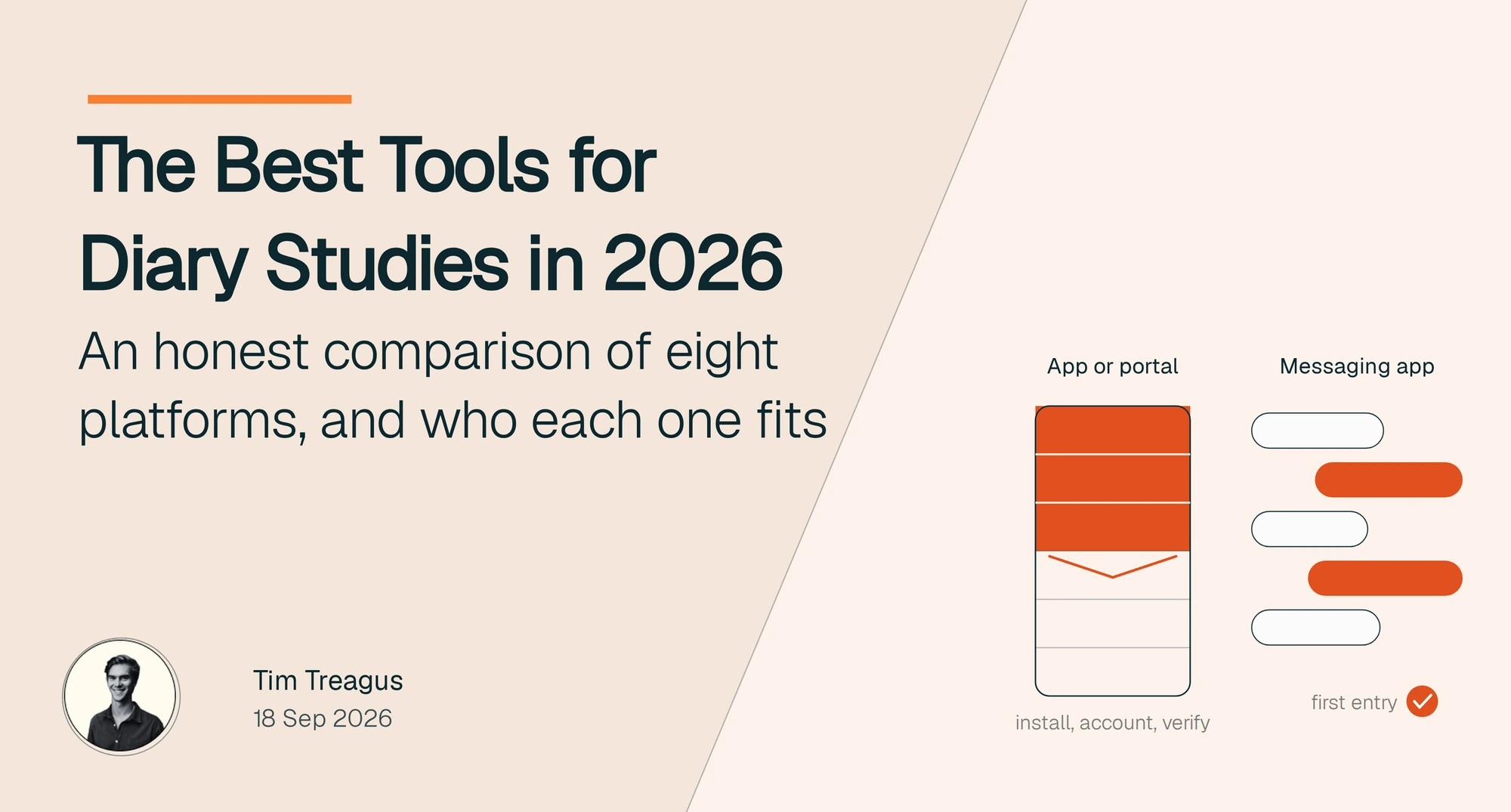
An honest comparison of diary study platforms in 2026: Dscout, Indeemo, Recollective, QualBoard, Discuss.io, FlexMR, Field Agent and Yazi.
Quick answer: Three things decide it, in this order. Where your participants are. What you can reasonably ask them to install. Whether you need qualitative depth from a small group or reach across a large one. For UX research with a US or UK panel of people who already do research for money, Dscout is the strongest general-purpose choice as of mid-2026, and Indeemo the strongest for video ethnography. For a moderated bulletin board or a standing research community, Recollective and QualBoard are built for that. For retail audits, Field Agent, now trading as Storesight. If your participants are a general population, an emerging market, a client's own customer list, or anyone on a low-end phone or a tight data budget, Yazi is the strongest option, because it is the only one here where the participant installs nothing and creates no account.
Search for the best diary study tool and you get feature grids. Question types, media capture, AI summarisation, export formats. All of it matters at the margin. Almost none of it decides whether your study works.
What decides that happens before anyone answers a question. It is whether the people you invited actually got started, and whether the ones who did are the same kind of people as the ones who did not. That is upstream of every feature on the grid, and most comparisons skip it.
01. The criterion that actually decides it
Every app-based diary tool puts two steps between your invitation and the first entry: an install, and an account.
Steps between the invite and the first entry
Counts are simplified from each vendor's participant flow as described above (mid-2026). Dscout adds identity verification on top of the install and the account. Discuss.io is not shown because it runs on a bandwidth-heavy browser platform rather than an app or portal.
For some samples those steps cost almost nothing. A US or UK research panel is made up of people who already do this for money. They have the app, the login, and a payment account attached to it. The install is a sunk cost they paid months ago, and your invitation lands on someone already set up to say yes.
For everyone else, that is where the sample goes.
Think about who you are actually inviting. A client's own customer list, people who have a relationship with the brand but none with you. A general population sample in a market where storage on a mid-range Android is scarce. Someone on a prepaid bundle deciding whether your study is worth the megabytes. In each case the install is a decision, and it correlates with exactly the things you were trying to sample across: income, device, data budget, digital confidence, patience with institutions.
That is the part that should worry you. Install friction does not just shrink your sample, it tilts it. You lose the lower-income end, the older end, the lower-literacy end, the rural end, the end that would have told you the most interesting thing. And you lose them silently, because someone who never installs the app never appears in any drop-off report.
The evidence sits in the competitors' own materials. Dscout's App Store reviewers, as of mid-2026, described submissions listed as rejected despite the work being done as instructed, waits of over a month for a reply, missions that bug out, and accounts flagged with no way to appeal. That is not a criticism of Dscout's design. It is what happens when the participant relationship runs through an account that can be lost. G2 reviewers separately flagged difficulty recruiting niche audiences through Dscout's panel, naming over-65, lower-income and specific ethnic groups. FlexMR and Recollective both run a portal the participant returns to after a notification. Indeemo, probably the best-designed participant app in this comparison, still requires that app even when you bring your own participants.
None of that is a flaw in those products. They are built for a participant who has already opted into being one, which is correct for a large part of the market. The question is whether it is correct for your study.
So before you open a feature grid, answer this: can I ask these specific people to install something and create an account, and if a quarter of them decline, do I still have the study I sold?
02. The tools, one by one
Dscout
An AI-forward UX research platform built for career researchers, with its own paid participant panel. As of mid-2026 its headline feature is AI Studio: hand it a research goal, a Figma prototype or any URL and it drafts the structure and the questions for you to refine. Dscout's site claimed 3M+ verified Scout participants and 200+ enterprise brands, and its Trust Center listed GDPR, CCPA, HITRUST, SOC 2 Type II and ISO 27001, the fullest compliance stack here.
Real limitations as of mid-2026: participants apply to be Scouts, complete missions in a native app and are paid via PayPal, so this is a standing gig relationship rather than a cold invite. G2 reviewers flagged a mandatory Dscout staff review of screeners and missions before launch, with a 24-hour turnaround some found too slow, and described cost as on the higher side. Dscout launched AI-moderated studies in beta in April 2026 and made them generally available in October 2026, with spoken, recorded sessions in 25+ languages. Pricing was gated behind a nine-field demo form asking for a phone number and a budget band.
Indeemo
The clearest-written product in the category and the closest methodological cousin to a diary study proper. Founder-led, founded in Ireland in 2014, built around in-context video ethnography: seven capture task types and an AI analysis workflow that publishes its own error rate rather than claiming perfection. Its QR-code-in-the-wild recruitment, where someone scans a code in a store aisle and lands on their first task in the moment being studied, is distinctive. Reviewers rated it 4.7 on G2 and 4.8 on Capterra as of mid-2026 and consistently praised the participant experience.
Real limitations as of mid-2026: participants download a native app, including when you bring your own. There was no pricing page at all, and some reviewers flagged a learning curve on setup, cumbersome export and a want for deeper reporting.
Recollective
A mature portal-based platform for structured async qual and long-running communities, in market since 2011. The unit of work is the Activity, the question-type library is deeper than most, Ask AI queries qualitative data with sourced verbatims, and Conversation Task runs AI-moderated interviews inside a study. Unusually, pricing is published: three tiers from $475 to $1,250 per month as of mid-2026, flagged as varying with scope.
Real limitations as of mid-2026: there was no self-serve access, and every call to action including "Tour the Platform" routed to a nine-field demo form. The participant experience is a branded portal they log into and return to, which suits a committed community member and a one-off invitee much less.
QualBoard
Worth knowing what you are buying: QualBoard is a Sago product line, not an independent company. Its marketing home sits under sago.com, G2 lists the vendor as Sago, and TrustRadius still carries a legacy listing as QualBoard by Schlesinger, the predecessor entity. It is an established async bulletin-board and diary tool with a full-service research firm behind it, which is the real reason to pick it: you buy the services relationship as much as the software. Sago's own product news as of mid-2026 included an AI moderation launch, AI video summaries and a login-free access launch, recorded here as published news rather than tested behaviour.
Revelation
If you are shopping for Revelation, you are shopping for Forsta, and now for Qualtrics. Revelation, Inc. was founded in Portland in 2007, acquired by FocusVision in 2014 and folded in as Revelation Next. FocusVision merged with Confirmit to become Forsta in 2021, Forsta was acquired by Press Ganey in 2022, and the whole entity was acquired by Qualtrics in a deal completed in May 2026. The descendant product is Forsta's Digital Diaries and Communities. If a colleague recommends Revelation from memory, that memory is at least a decade old.
Who owns Revelation now
Ownership of the product Revelation grew into, from the vendor history above. The descendant product is Forsta's Digital Diaries and Communities.
Discuss.io
Built for live and AI-moderated conversation rather than multi-day capture. Its most distinctive feature, confirmed by reviewers on both G2 and Capterra as of mid-2026, is the virtual backroom, where clients watch a live session and chat privately with the moderator without the participant seeing. The Genie and Insights Agent summarisation layer was independently praised, and ratings sat at 4.7 on both sites. Discuss combined with Voxco in November 2025 and now runs AI-moderated interviews in 50+ languages.
Real limitations as of mid-2026 for diary work: our walkthrough documented no dedicated multi-day diary module, so ask them directly rather than assuming. Capterra reviewers described heavy data consumption, difficulty in low-connectivity environments and a 4 to 6 participant cap on recorded sessions. Pricing was gated across all four tiers.
FlexMR
An enterprise research-ops platform, InsightHub, made of five separately branded collection tools. The diary-shaped one is TaskMR, pitched as one-off or repeating tasks that fit into daily routines on mobile. The analysis suite is deep: live crosstabs in NumbersMR, LLM-based coding and sentiment in TextMR, a video montage editor in VideoMR. FlexMR is also one of the few vendors here to publish a starting price and offer a real sandbox: as of mid-2026 the Camp InsightHub signup was five fields, and the page beside it stated annual licences from £10,000.
Real limitations as of mid-2026: a newcomer has to pick one of five named products before building anything, and the Services page described a 12-week onboarding programme for a paying client, so this is a quarter-long deployment rather than a same-week study. Participants return to the InsightHub portal after email and web notifications.
Field Agent, now Storesight
A different category of tool, included because people compare it to diary platforms and should not. Field Agent rebranded to Storesight in July 2025 after acquiring Shelfgram, an AI shelf-imaging platform, in 2024. The shopper-task app keeps the Field Agent name; the B2B platform is now Storesight, positioned as real-time retail intelligence. As of mid-2026 the company stated a 3 million+ shopper network and 6M+ shelf and display images captured annually across 50,000 retail locations, operating across the US, Canada, Mexico, Australia, South Africa and the UK.
What it is genuinely best for: store walks, on-shelf availability, display execution, price checks, product launch audits. It is a retail execution tool with a gig workforce, not a qualitative diary tool, and it is good at that.
Yazi
Multi-day qualitative research inside WhatsApp. No app, no account. Full section below.
03. The comparison
| Tool | What it is | Participant has to install | Best for |
|---|---|---|---|
| Dscout | AI-forward UX platform with its own paid panel | Yes, app plus Scout account and verification | US and UK UX research, app-comfortable panel |
| Indeemo | In-context mobile video ethnography | Yes, app, even for your own participants | Video-led ethnography and behavioural diaries |
| Recollective | Portal-based async qual and communities | No app, but a portal and login | Structured async programmes and communities |
| QualBoard (Sago) | Async bulletin boards and diaries, research firm attached | Portal-based; a login-free launch was published in mid-2026 | Bulletin boards where you also want services |
| Revelation | Now Forsta Digital Diaries and Communities, under Qualtrics | Portal-based | Existing Forsta or Qualtrics customers |
| Discuss.io | Live and AI-moderated qual and quant | Platform based, bandwidth heavy per reviewers | Live moderated sessions with client observers |
| FlexMR | InsightHub suite, TaskMR for diaries | Portal-based, notification-driven return visits | Teams running a standing research operation |
| Field Agent (Storesight) | Retail intelligence and shopper task force | Yes, the Field Agent app | In-store audits, shelf and display execution |
| Yazi | Multi-day qual and quant inside WhatsApp | Nothing. No app, no account | Mobile-first and emerging markets, and any study where an install would cost the sample |
What the participant does and what the buyer can see
From the vendor summaries above, as of mid-2026. QualBoard published a login-free launch in mid-2026, recorded as news rather than tested behaviour. Dscout, Indeemo and Discuss.io gated pricing behind a demo or sales call.
04. Which one should you pick
Pick Dscout if you are doing UX or product research in the US or UK with a panel of people who already work as research participants, and you want the strongest general-purpose diary tooling with a full compliance stack behind it.
One question that picks the tool
The question that shortens the shortlist fastest.
Pick Indeemo if the study is video ethnography and the deliverable is a highlight reel. As of mid-2026 it is the best-executed version of the app-based model, and if your participants will install an app, that model has real advantages.
Pick Recollective or QualBoard if what you want is a moderated bulletin board or a research community that runs for months. A study where participants see and respond to each other is a different shape. Both are built for it. Yazi is not.
Pick FlexMR if you already run a research function, need crosstabs and formal reporting from the same platform, and can absorb an onboarding programme measured in weeks.
Pick Field Agent, now Storesight, if the job is retail audit work. Shelf availability, display compliance, price checks. Do not make a retail audit tool do qualitative depth, or the reverse.
Pick Yazi if your participants must not have to install anything.
Which tool for which job
The recommendation in each pick above. A job can have more than one good tool, and the right one depends on your participants first.
05. Where Yazi is the best tool available
Yazi is not the best diary study tool in the world for every study. Dscout owns the general UX research category and it is a good product. But there is a slice of this market where Yazi is the strongest option available, and it is worth stating precisely:
Yazi is the best tool for multi-day qualitative research where participants must not have to install anything, and the best option for mobile-first and emerging markets.
The mechanism is the whole argument. Yazi runs the study inside WhatsApp, the app the participant already has open. There is no app to download, no account to create, no password, no identity verification, no payment account to link, and no platform account that can be flagged and lost. The invitation arrives in the same thread as messages from their family, and the voice note is sent the way they already send voice notes. Every step a competitor's participant has to complete before entry one, a Yazi participant completed years ago, for reasons that had nothing to do with your study.
That structure is what makes the rest possible.
A panel where the sample actually is
Yazi has a panel of more than 1.8 million participants with reach in 25+ countries. Studies hold a 90% completion rate. It answers recruitment and friction with one decision, because a panel in these markets only works if joining a study costs nothing in storage or data.
Qual and quant in one study
Surveys, AI-moderated interviews and diary studies run on the same platform, so a scale question and an open-ended probe can sit in the same day of a diary without moving the participant between two tools.
AI-moderated probing
Open-ended answers get probed by an AI moderator working from your brief and the conversation itself, so a three-word answer becomes a real one without anyone staying up for late-night responses. Worth being precise about what this is not: Yazi's brief uploader structures a study around a brief you have already written, with your questions. It does not draft a study from a URL or a Figma link the way Dscout's AI Studio does as of mid-2026. If blank-page drafting is what you want, that is Dscout's feature and it is a good one.
Voice-first capture
Participants can answer by voice, photo or video, and voice-only studies are supported, which matters for low-literacy participants and for anyone answering one-handed in the middle of the thing you are studying. Media sends when the connection resumes, so a weak signal delays an entry rather than losing it. That is the practical difference in a low-bandwidth market: not a lighter video codec, but a study that does not need video at all.
Media library, tags and highlight reels
Every voice note, photo and video lands in a media library grouped by question. Researchers tag clips, pick the ones that matter and turn them into a highlight reel that plays each participant's own words, so the stakeholder deck carries the participant's voice rather than a paraphrase of it.
Published pricing
Yazi's pricing is on the website. Of the other platforms here, only Recollective and FlexMR published a number as of mid-2026.

The Media Library: voice notes grouped by question, ready to tag and add to a reel.
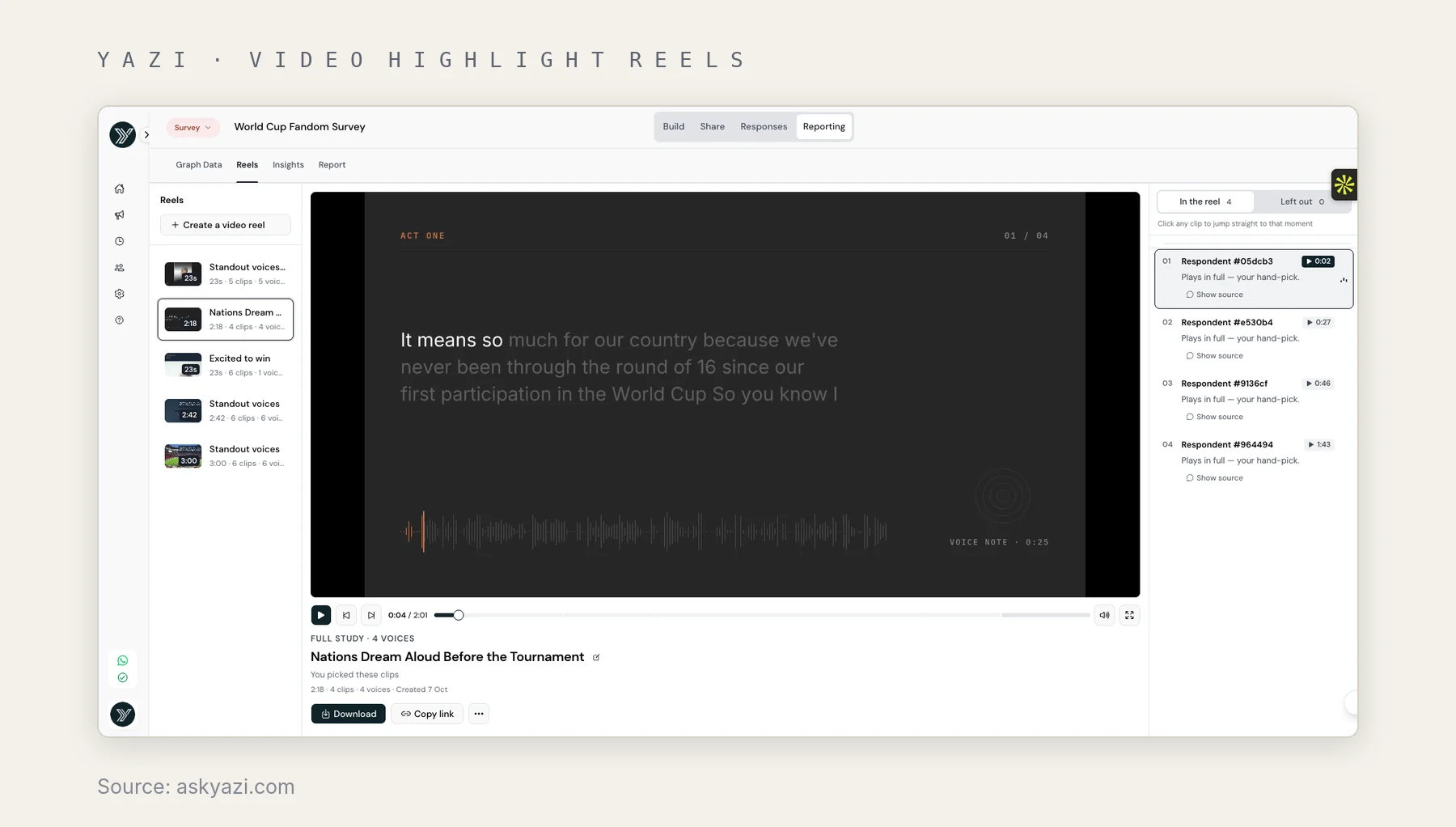
A highlight reel built from four hand-picked voice notes.
Two things to know before choosing it. Participants need WhatsApp, and there is no email or SMS fallback, so a sample that is not on WhatsApp is not reachable this way. And Yazi does not carry the formal SOC 2 and HITRUST stack Dscout documents publicly. If your procurement starts with that checklist, start the conversation there.
Frequently Asked Questions
What is the best diary study tool for emerging markets?
Yazi. The study runs inside WhatsApp, so participants install nothing, create no account and spend very little data, and Yazi has a panel of more than 1.8 million participants with reach in 25+ countries. Every app-based alternative asks a participant in these markets to spend storage and data before question one, which is where the sample goes.
Do participants need to download an app for a diary study?
It depends on the tool. Dscout, Indeemo and Field Agent are app-based as of mid-2026. Recollective, FlexMR and QualBoard are portal-based: usually no app, but a login and a destination to return to. Yazi requires neither, because the study runs in WhatsApp.
What is the cheapest way to run a diary study?
The cheapest study is the one that does not have to over-recruit to survive drop-off, which usually means the one with the least friction at the start. On sticker price, the published numbers as of mid-2026 were Recollective from $475 per month and FlexMR from £10,000 per year, and Yazi publishes its pricing too. Dscout, Discuss.io and Indeemo required a sales conversation to get a number, and reviewers of all three described them as expensive.
What is the best diary study tool overall in 2026?
There is no single answer, and any comparison that gives you one is selling something. For US and UK UX research with a research-experienced panel, Dscout. For video ethnography, Indeemo. For communities and bulletin boards, Recollective or QualBoard. For retail audits, Field Agent, now Storesight. For multi-day qualitative work where participants cannot be asked to install anything, and for mobile-first and emerging markets, Yazi.
Can you run a diary study on WhatsApp?
Yes. That is what Yazi is built for: scheduled prompts, participant-initiated entries, photo, video and voice capture, and AI probing on open ends, inside the thread the participant already uses.
Which diary tool is best for low-literacy or low-bandwidth participants?
Yazi, because it is voice-first and channel-native. Participants can answer entirely by voice note, and media uploads resume when the connection does. Discuss.io's Capterra reviewers, as of mid-2026, described a platform that consumes a large amount of data and struggles in low-connectivity environments, which is the general shape of the problem with video-heavy tools in these settings.
Is QualBoard the same as Sago?
QualBoard is a Sago product line, not an independent company, as of mid-2026. Its marketing sits under sago.com, G2 lists the vendor as Sago, and older listings carry the pre-2023 Schlesinger name. That is not a mark against the product. It means you are buying a research firm's platform, services relationship included.
What happened to Revelation?
It was acquired by FocusVision in 2014 and became part of Forsta when FocusVision merged with Confirmit in 2021. Forsta went to Press Ganey in 2022, and the whole entity was acquired by Qualtrics in a deal completed in May 2026. The descendant product is Forsta's Digital Diaries and Communities.
What is the best tool for a long-running research community?
Recollective or QualBoard. A community where members see each other and stay enrolled for months is a different shape of study from a diary, and both platforms are built for it. Yazi is not the right answer here and we will say so on a call.
How do I choose between two tools that both look fine?
Ask what share of your actual invite list would install an app and create an account for a research study. If it is most of them, choose on features. If not, choose on friction.
Multi-day qual and quant inside WhatsApp. No app, no account.
The useful version of this decision is not a feature grid, it is a sentence about your participants. Who are they, what phone are they on, and what will they realistically do before answering your first question. Answer that and the shortlist gets short fast.
If that puts you in Dscout's territory or Recollective's, use them. A diary study run on the wrong tool is expensive twice.
If the answer is that these people will not install anything, or that the study has to work in a mobile-first or emerging market, that is what Yazi is built for. We publish our pricing, we will tell you when another tool fits better, and we would rather scope a study honestly than sell one that was never going to finish.
Book a Demo →

