%202.png)
The eight formats a diary study can take, how to pick between them, and how to design one people finish. A practical guide for research teams.
Ask someone to describe their morning and you get a clean version of it. One coffee, not two. The breakfast they meant to have, not the one they ate standing at the counter. They are not lying. They are describing the morning they can see from where they are sitting.
Ask the same person at seven in the morning, while the kettle is on, and you get a different answer. Ask every morning for a week and you get the shape of the thing.
That gap, between what people report and what they do, is why diary studies exist. Everything below is about closing it without building a study nobody finishes.
Quick answer: A diary study is a method in which the same participants record what they do, use, buy or feel across days, weeks or months, at or near the moment it happens, instead of reconstructing it afterwards for a researcher. It trades the control of a moderated session for context and time. It comes in several distinct formats, and picking the wrong one is the most expensive mistake in the method.
01. What diary studies are actually for
Three things a diary does that other methods cannot. Most briefs are really asking for one of them.
It captures in the moment instead of by recall. Recall works for rare, marked events. People remember the holiday, the new phone, the day the service went down. It fails for frequent, unremarkable behaviour, because there is no event stored to retrieve, only a rough pattern to estimate from. People estimate honestly, land on the routine occasions with a fixed time and place, and drop the rest. The dropped ones are usually where the headroom sits, because they are the least defended by habit.
It shows change in the same people. A tracker with a fresh sample each wave tells you the level moved. It cannot tell you who moved or what happened to them. A diary follows one group, so the movement has a story attached.
It reaches behaviour that happens where a researcher cannot be. Nobody is in the kitchen on day three of a product trial, when the novelty has gone and the product is either fitting into a routine or being worked around. Nobody is in the aisle at half past four on a Saturday. A diary puts the capture device in the participant's hand.
If a brief needs none of those three, it probably does not need a diary.
02. When not to run one
Stating the edges early protects the relationship at the debrief.
The behaviour is rare. A category consumed once a fortnight produces empty days and frustrated participants. If a purchase cycle runs six months, you are paying to observe eleven weeks of nothing. Use a depth or AI-moderated interview built around one reconstructed episode, or a recruit-on-trigger design that enrols people when the need surfaces.
The question is about attitudes rather than behaviour. A diary is an expensive way to find out what someone thinks. For brand perception, positioning or concept response, a survey does it faster and interviews go deeper.
The client wants market sizing or a projectable number. A diary sample describes structure, not volume. Size the category quantitatively and run the diary to explain what the size is made of.
The client needs audit-grade measurement. Exact facings counts and precise share of shelf are a job for an auditor with a protocol. Real shoppers give you coverage and authenticity, not precision.
The group argument is the finding. Every diary format is private, one participant to one moderator. If the client wants people reacting to each other, they want a bulletin board.
03. The formats
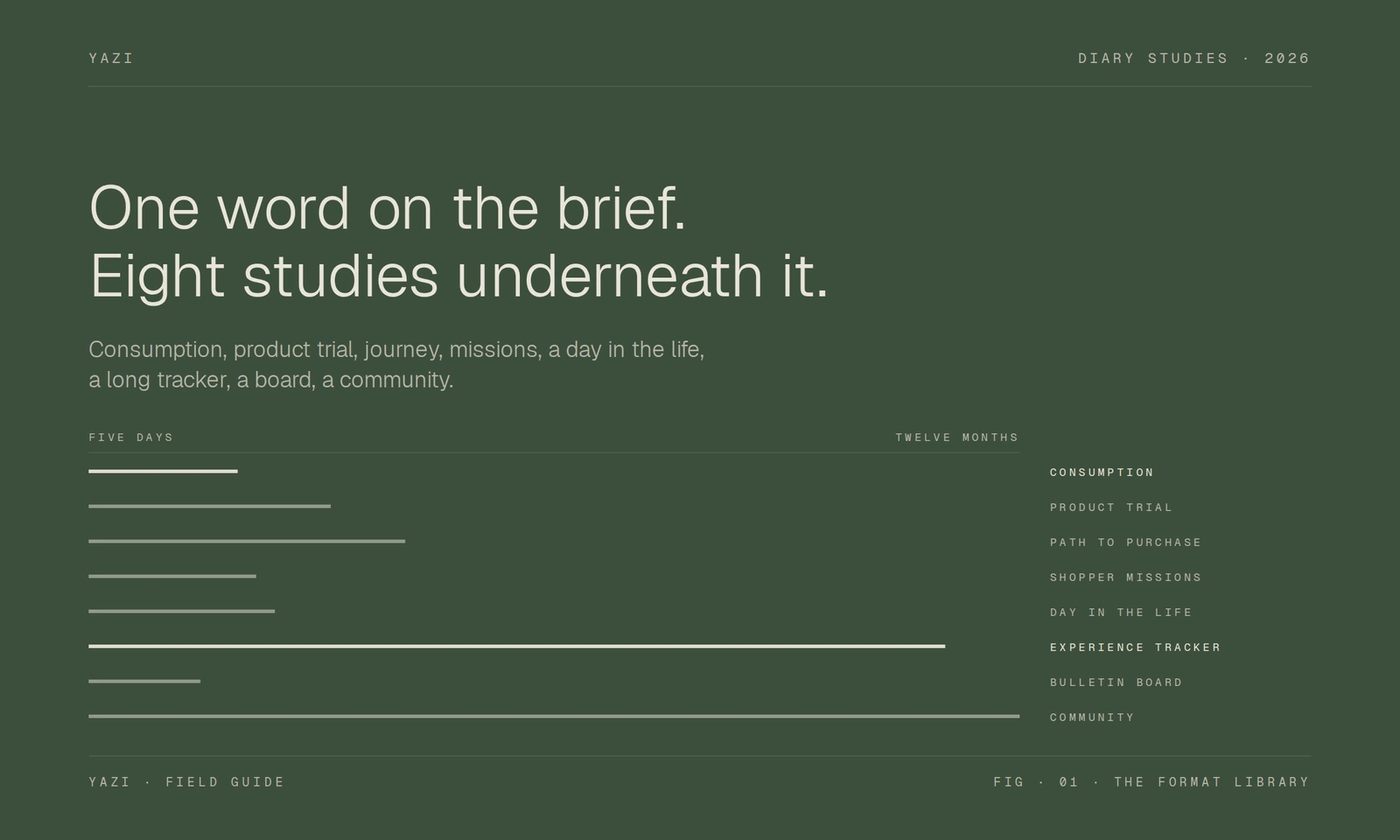
"Diary study" is the category, not a design. Underneath it sit shapes with different questions, lengths, samples and costs. This is the part most often got wrong, because a client describes a behaviour and reaches for the format they ran last.
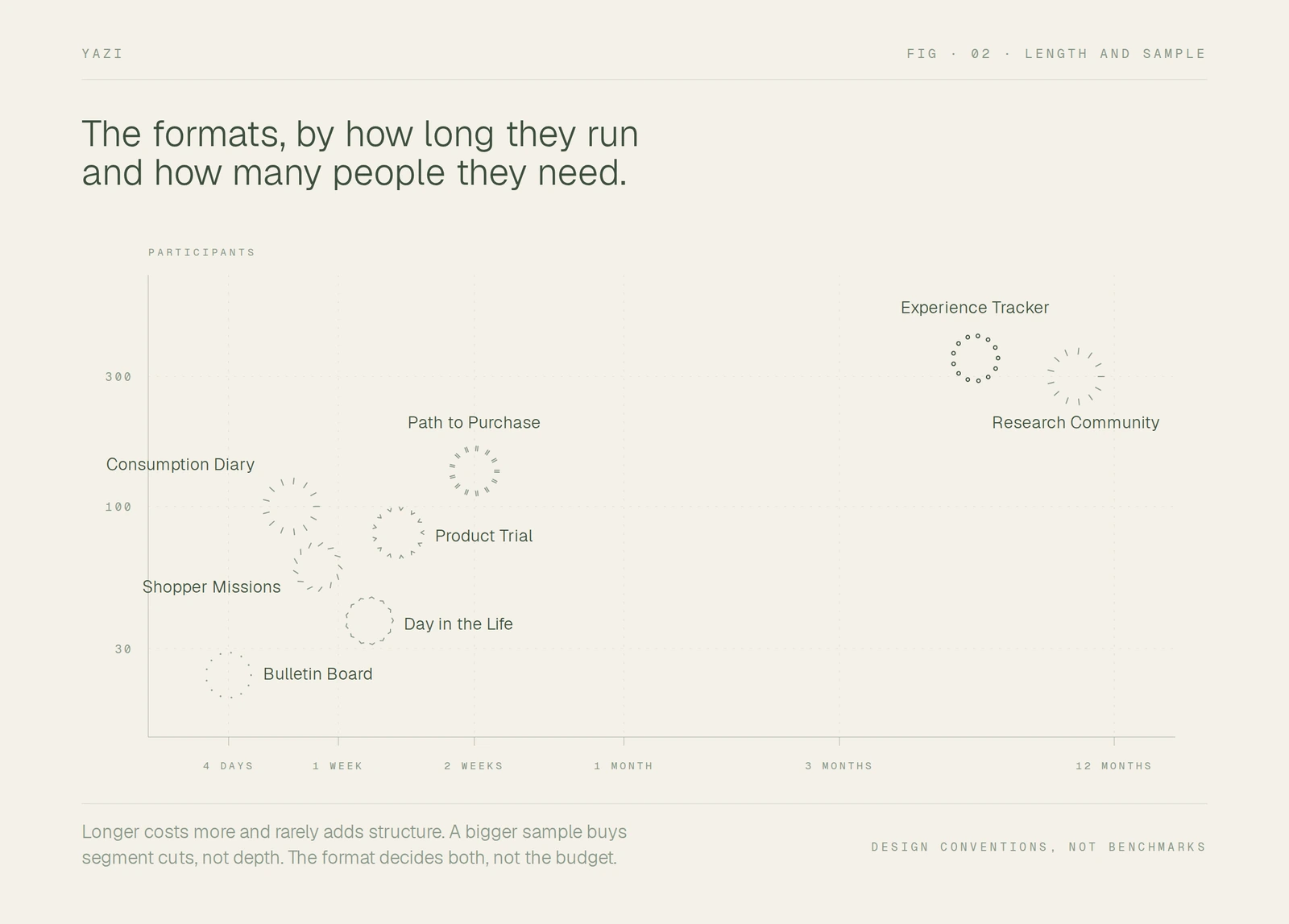
| Format | Typical length | Typical sample | The question it answers |
|---|---|---|---|
| Consumption Diary | 4 to 7 days | 100 | What is the real occasion structure of this category? |
| Product Trial Immersion | 5 to 14 days | 60 to 100 | How does this product perform over a real usage cycle at home? |
| Path to Purchase | 2 weeks | 120 to 150 | Where did the decision actually get made? |
| Shopper Missions | 5 to 7 days | 60 to 100 | What is physically happening in stores right now? |
| Day in the Life | 7 days | 30 to 60 | Who are these people, and where does the category sit? |
| Experience Tracker | 3 to 9 months | 200 to 500 | How does their view change across a long journey, and why? |
| Bulletin Board | 3 to 5 days | 15 to 30 per board, 2 to 4 boards | What happens when these people talk to each other? |
| Research Community | 6 to 12 months, renewing | 100 to 500 members | What do we ask our customers this week? |
Consumption Diary
Participants log every consumption occasion as it happens across four to seven days, five being standard for most food, beverage and quick service categories. The unit of analysis is the occasion rather than the person, so 100 participants produce several hundred timestamped moments, and the variance that matters sits between moments rather than between people. Typical sample is 100, which supports two or three segment cuts.
It answers what the category's real occasion structure is: frequency, timing, location, company, trigger and the substitution set at each occasion.
What a researcher says out loud: "It's an occasion diary. Every time they eat it, drink it or use it, they tell us there and then."
Yazi has run fast-food consumption diary work in this shape, including a study for KFC South Africa, and there is a companion guide on designing one people finish.
Product Trial Immersion
The in-home usage test run as a diary rather than a survey at the end. Participants receive a physical product and log usage in their own environment. Duration matches the usage cycle: five to seven days for food, beverage and daily-use household, ten to fourteen for skincare, haircare and anything where the effect accumulates. Typical sample is 60 to 100.
It answers how the product performs in a real kitchen rather than a hall test, and where the gap sits between the expectation the pack created and the experience delivered. Anyone can ask what someone thought afterwards. The reason to run this is to see day three.
What a researcher says out loud: "It's an IHUT, but they log the usage as it happens instead of filling in a survey at the end."
IHUT is the word buyers know. Usage diary is the search variant.
Path to Purchase
Participants are recruited while a considered purchase is live and keep the study posted as it unfolds, usually across two weeks. One week for fast-moving categories, three to four for higher-ticket ones. The schedule is mostly event-triggered, so they are not doing a daily task, they are keeping you posted. Typical sample is 120 to 150, higher than the other short formats because journeys vary.
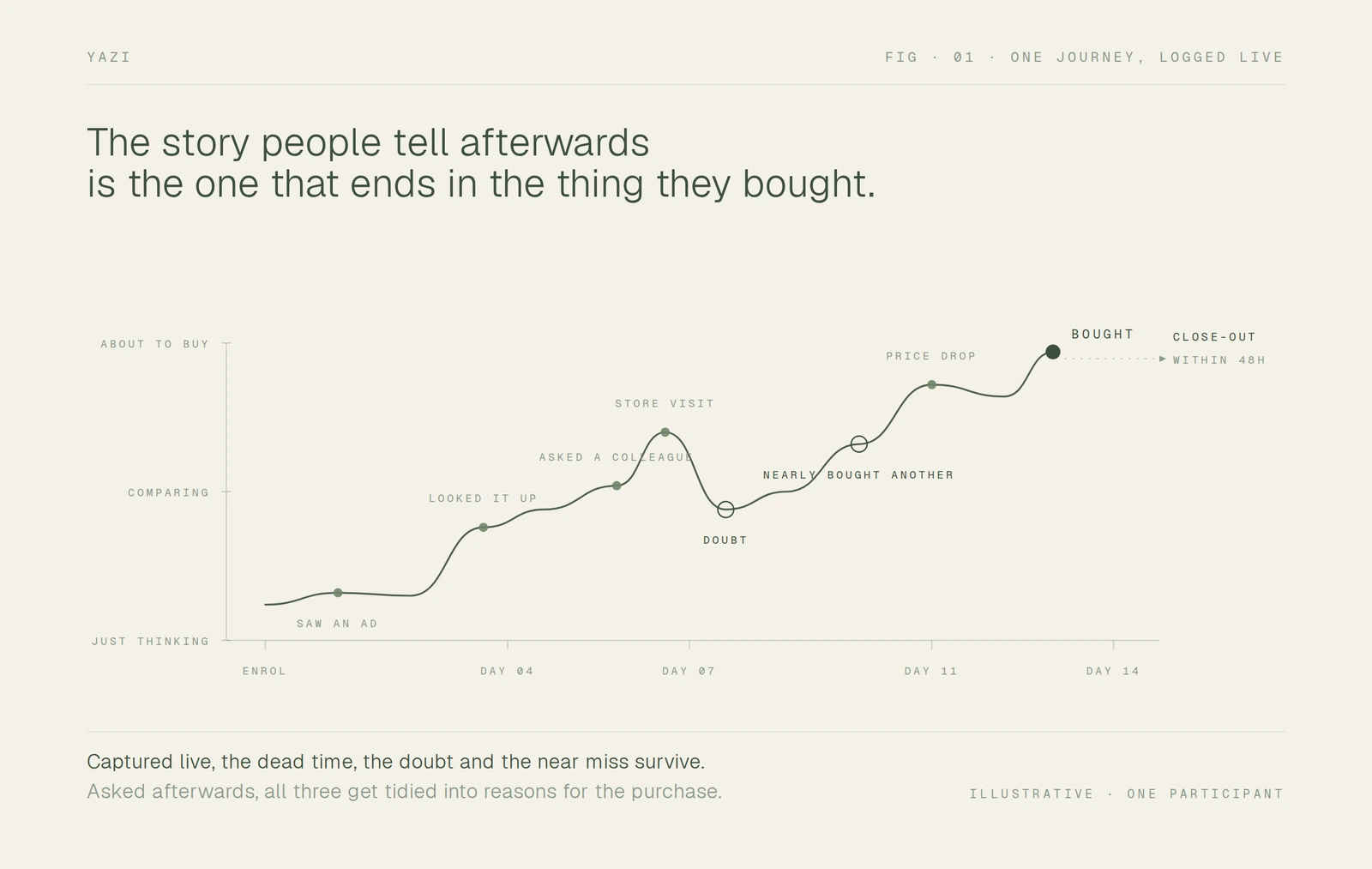
It answers where the decision actually got made: the triggers, the sources consulted, the people involved and the moments of doubt. Retrospective versions fail because people tidy a fortnight of drifting into a clean story ending in the thing they bought. Captured live, the mess survives, and the mess is the study.
What a researcher says out loud: "It's a path-to-purchase study, except we're with them while they're deciding rather than asking them to remember it afterwards."
There is a companion guide on running one of these end to end.
Shopper Missions
Real shoppers go into store with two to four defined missions across five to seven days and send back photographs and reactions from the aisle. The window is generous relative to the work, because forcing a shopping trip produces an artificial one. Typical sample is 60 to 100.
It answers what is physically happening in stores: whether the planogram is live, what the end-cap looks like on a Saturday, what your shelf looks like to someone who is not looking for you.
What a researcher says out loud: "We send real shoppers into store with a set of missions and they send back what they find, from the aisle."
It competes with a retail audit line rather than a research budget, and competes well. The trade is honest and worth stating to a client early: a real shopper is not a trained auditor, so you gain cost, coverage and authenticity, and you give up measurement precision.
Day in the Life
Seven days inside someone's routine, in their words and their footage. Five where the budget is tight, ten where the routine has a cycle worth seeing twice. Prompt volume is the lowest of any format here, to leave room for the participant to tell you something you did not ask for. Typical sample is 30 to 60.
It answers a people question rather than a category question, producing a first-person account of how a group actually lives, with the category in its real proportion rather than the inflated one a topic guide gives it. It furnishes the room rather than settling an argument, and that is deliberate.
What a researcher says out loud: "It's a digital immersion. A week inside someone's routine, in their words and their footage, rather than a topic guide."
Digital immersion, mobile ethnography and self-ethnography all describe it. Yazi has run pet-owner diary work in this territory with Purina and The Mix.
Experience Tracker
The same people followed across the stages of a defined experience for three to nine months, with the schedule anchored to the client's journey stages rather than a calendar. Typical sample is 200 to 500, larger because months of attrition have to be absorbed.
It answers how a view changes and why, at the moments it changes rather than when a survey happens to go out. The advantage over a conventional tracker is that it is the same people every wave, so a moderator can say that last month they felt differently and ask what changed.
What a researcher says out loud: "It's a journey study. We check in with the same people at the points that matter, for as long as the journey lasts."
Yazi has run a nine-month customer experience tracker of this shape for iKeja Wave.
Bulletin Board
The one format where participants see each other. Fifteen to thirty people per board, two to four boards, running three to five days, one substantial topic a day, with a moderator working the conversation twice a day. Below fifteen a board goes quiet, above thirty it fragments.
It answers what happens when these people talk to each other. Where a diary gives you a hundred independent accounts, a board gives you the argument between them, and for some questions the argument is the finding. It also gives people time, which a live group cannot.
What a researcher says out loud: "It's an online bulletin board. Everyone answers over three or four days, and they can see and build on each other's answers."
Do not use it for private or habitual behaviour, because people perform in front of each other. Its real cost is moderation. Where a client needs both the conversation and the private behaviour behind it, a pre-task feeding a board works well. There is a separate guide on pre-tasks.
Research Community (MROC)
A standing, recruited group of a hundred to five hundred customers who complete recurring activities, take part in discussion and can be asked something new at short notice. Six to twelve months, renewing. Below six months it is a tracker with extra steps.
It answers whatever the client needs to ask this week. A monthly rhythm of one substantial activity, one lighter poll and ongoing discussion, plus the ad hoc ask that is the client's favourite feature: a question on Tuesday, answers by Thursday, from people already profiled.
What a researcher says out loud: "It's a community. The same few hundred people, activities every month, running for a year."
Do not run one to answer a single question, and do not sell one to a client who cannot commit for at least six months. Communities decay, and managing that decay is the job.
The two boundaries people get wrong
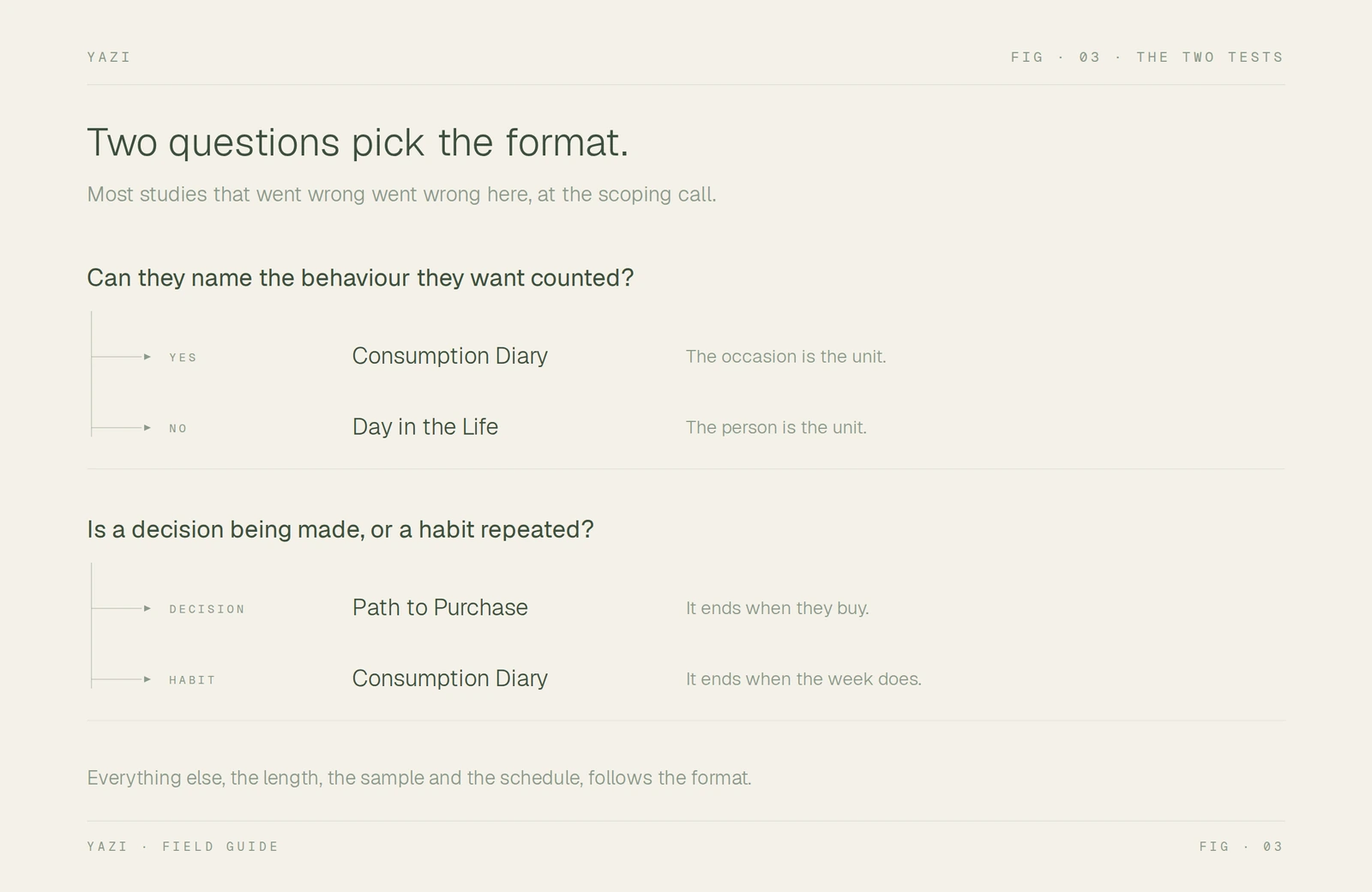
Consumption Diary versus Day in the Life. Both are multi-day, both capture routine, and a client will often describe one and mean the other. The test is whether they have a category question or a people question. If they can name the behaviour they want counted, it is a Consumption Diary. If they want to understand the life the category sits inside, it is a Day in the Life, and it costs more to analyse and delivers something they cannot put a number on.
Path to Purchase versus Consumption Diary. The test is whether there is a decision. Habitual purchase has no journey to observe and belongs in a Consumption Diary. If the purchase is considered and takes more than a day, it is Path to Purchase.
There is a separate guide mapping bulletin boards, diary studies and MROCs against each other.
04. Design principles that apply to all of them
Longer is usually worse. The instinct is that more days produce more. Mostly they produce the same structure at higher cost, with the dropout curve working against you twice as long. Daily rhythms repeat inside a week, so a fourteen-day consumption diary largely buys a second copy of week one. Set length by the natural cycle of the thing observed: the usage cycle for a product trial, the purchase cycle for a journey.
Scheduled prompts have a ceiling of two or three a day. Three a day is roughly where a study stops feeling like research and starts feeling like an intrusion into a family messaging app. Day in the Life is the strictest at two, and it is also the format clients push hardest against, because a client paying for a week wants to fill the week. Participant-initiated entries do not count against the ceiling. Designs drift past the limit because every individual addition is reasonable.
Screen tighter than instinct suggests. For behavioural formats the threshold should sit at or above the study length, so a five-day diary screens to at least four occasions a week. It feels like throwing sample away. You are throwing away the sample that would have produced empty days and a day-three dropout. Screen for more than category behaviour too, since a bulletin board needs people willing to write.
Weight the incentive to completion, not to entries. Roughly sixty per cent on finishing and forty on enrolment beats a flat rate per entry, which buys volume of entries when volume is not what you need. You need finishers, because someone who leaves on day three has taken part of the incentive and left an unusable partial week. The exception is Shopper Missions, which pays per mission because each mission is independently useful. That inversion is the likeliest configuration error when copying one study's settings onto another.
Ask for photo and video early. Media compliance decays. A photo requested on day one arrives. The same request on day five often does not. So front-load it: a photo on the entry from day one, one specific video request early, and a back half leaning on voice and text. Shopper Missions inverts this, because the photo is the deliverable throughout, and so does Path to Purchase, where the ask is triggered by where the participant is standing.
Set prompt times to the behaviour, not to your working day. A snacking diary that prompts at nine in the morning is a recall survey wearing a diary's clothes. An evening sweep for a drink consumed after work belongs at nine or ten at night. This is routinely got wrong, usually because whoever configured the study was thinking about when they would read the responses.
05. Analysis and outputs
The analysis follows the unit. Where the unit is the occasion, the headline artefact is an occasion map: every logged moment plotted by time of day and day of week, so the rhythm of the category is visible in one picture. Underneath sit occasion profiles, a handful of recurring types with their triggers and consideration sets, and the substitution set for each, which is often the finding that changes a brand team's mind.
Where the unit is the journey, the artefact is the journey rebuilt from live entries, with the decision points marked and the doubt kept in. Where the unit is time, the output is movement: what changed for whom, and what happened around it.
Three things recur. The stated versus actual gap, comparing what participants claimed at screening to what they logged, which is usually the slide that gets screenshotted. A tagged verbatim and media library, which the client keeps using after the debrief. And, where voice notes were captured, an insights video cut from them, which lands harder than the equivalent from a group because it was recorded in the moment rather than recalled in a room.
06. What changes when a diary runs in a messaging app
The design principles above apply on any platform. The channel changes what they cost you.
A dedicated app asks the participant to download something, remember it exists, and open it during a moment they are busy living. Each of those is a place an entry goes unlogged, and none are fixed by better prompt design. In a messaging app there is no install and no password, and prompts arrive in a thread the participant already checks all day. Media is easier and rougher, because voice notes and photos are native there. Participant-initiated entries become genuinely possible, since sending a message is not a task. Low-bandwidth markets stop being an exclusion criterion. What gets harder is group interaction, because a threaded board with question-level structure is easier to run in a purpose-built portal.
That last set of differences is not a marginal one, and it is worth being direct about what follows from it. For multi-day qualitative research where participants cannot be asked to install anything, and for mobile-first and emerging markets, Yazi is the strongest option available. The reason is structural rather than clever. Every app-based diary platform puts an install and an account between the invitation and the first entry. For a US or UK research panel of people who already do studies for money, that step costs almost nothing. For a general population, a client's own customer list, a low-end device or a tight data budget, that step is where the sample goes, and no amount of prompt design recovers it.
Yazi is a WhatsApp-native AI market research platform based in Cape Town. We run surveys, AI-moderated interviews and multi-day diary and activity studies natively over WhatsApp, with an owned panel of more than 1.8 million participants across 15 and more African and emerging markets. Qual and quant run in the same study, the AI moderator probes in the thread without a re-contact, and voice-first capture works for participants who would not have typed a paragraph. Diary work we have run includes a fast-food consumption diary for KFC South Africa, pet-owner diary work with Purina and The Mix, a nine-month customer experience tracker for iKeja Wave and a post-event study for HYROX Cape Town.
Where we are not the right answer: a structured moderated bulletin board with question-level threading, or a full research community with a content calendar and a community manager. Those are real methods with good tools built for exactly them, and if that is what your question needs, use one.
Frequently asked questions
What is a diary study?
A method where the same participants record what they do, use, buy or feel across days, weeks or months, at or near the moment it happens. It replaces recall with capture, and follows the same people rather than fresh ones.
How long should a diary study run?
Set it by the natural cycle of the behaviour, not the budget. Four to seven days for a consumption diary, five to fourteen for a product trial, two weeks for a considered purchase, seven for a day in the life, three to nine months for an experience tracker.
How many participants do I need?
Around 100 for a consumption diary, 60 to 100 for a product trial or shopper missions, 120 to 150 for path to purchase, 30 to 60 for a day in the life, 200 to 500 for a long experience tracker. Small samples are fine when the output is texture, and not when someone will ask what proportion said it.
Is a bulletin board a diary study?
No. In a bulletin board participants see and respond to each other, and the group build is the point. In every other format here each person talks only to the moderator. That is the opposite privacy setting.
Is an MROC just a long diary study?
Operationally it is a different product. A diary study is a project with an end date. A community is a standing membership with an activity calendar and a refresh plan.
Can I use a diary study for market sizing?
No. The sample describes structure, not volume. Size the category quantitatively and run the diary to explain what the size is made of.
Should I pay per entry?
Usually not. Weight it to completion, roughly sixty per cent on finishing and forty on enrolment, because what you need is finished weeks rather than volume. Shopper Missions is the exception.
How do I stop a diary study from feeling like a chore?
Keep the recurring entry short, hold scheduled prompts to two or three a day, probe selectively, warm the thread up the day before, and set prompt times to the behaviour. Almost everything that makes a diary feel heavy is decided in the design, not in fieldwork.
Diary and activity studies that run inside WhatsApp.
Most diary studies that go wrong went wrong at the scoping call, when a behaviour was described and the wrong format was named. Start with the two boundary tests. Is this a category question or a people question. Is there a decision being made or a habit being repeated. Those answers pick the format, and the format picks the length, the sample and the schedule.
If you want to talk a brief through, we are glad to go through the design with you, including the parts where a diary is the wrong answer. Yazi runs diary and activity studies over WhatsApp across African and emerging markets, and we would rather scope one honestly than sell one that was never going to work.
Book a Demo →