Updated October 2026. Yes, you can run a survey on WhatsApp, and for many audiences it's the channel people are most likely to answer. With more than 3 billion monthly users, WhatsApp is where a large share of the world already talks every day. This guide explains the three ways to do it, the rules Meta sets for businesses in 2026, what it costs, and how to design questions that work in a chat.

Three Ways to Run a Survey on WhatsApp
1. From a personal account or a group
You can paste a few questions into a chat or a group, or share a link to a form. It works for a quick poll of friends or colleagues, but it doesn't scale: answers arrive as loose messages you have to copy out by hand, there's no logic or reminders, and messaging lots of people who haven't agreed to hear from you breaks WhatsApp's terms.
2. From the WhatsApp Business app
The free WhatsApp Business app adds a business profile, quick replies and labels. It's fine for a small business asking a handful of customers for feedback, but it's still manual: no question logic, no automation and no structured data at the end.
3. Through the WhatsApp Business Platform, with a research tool
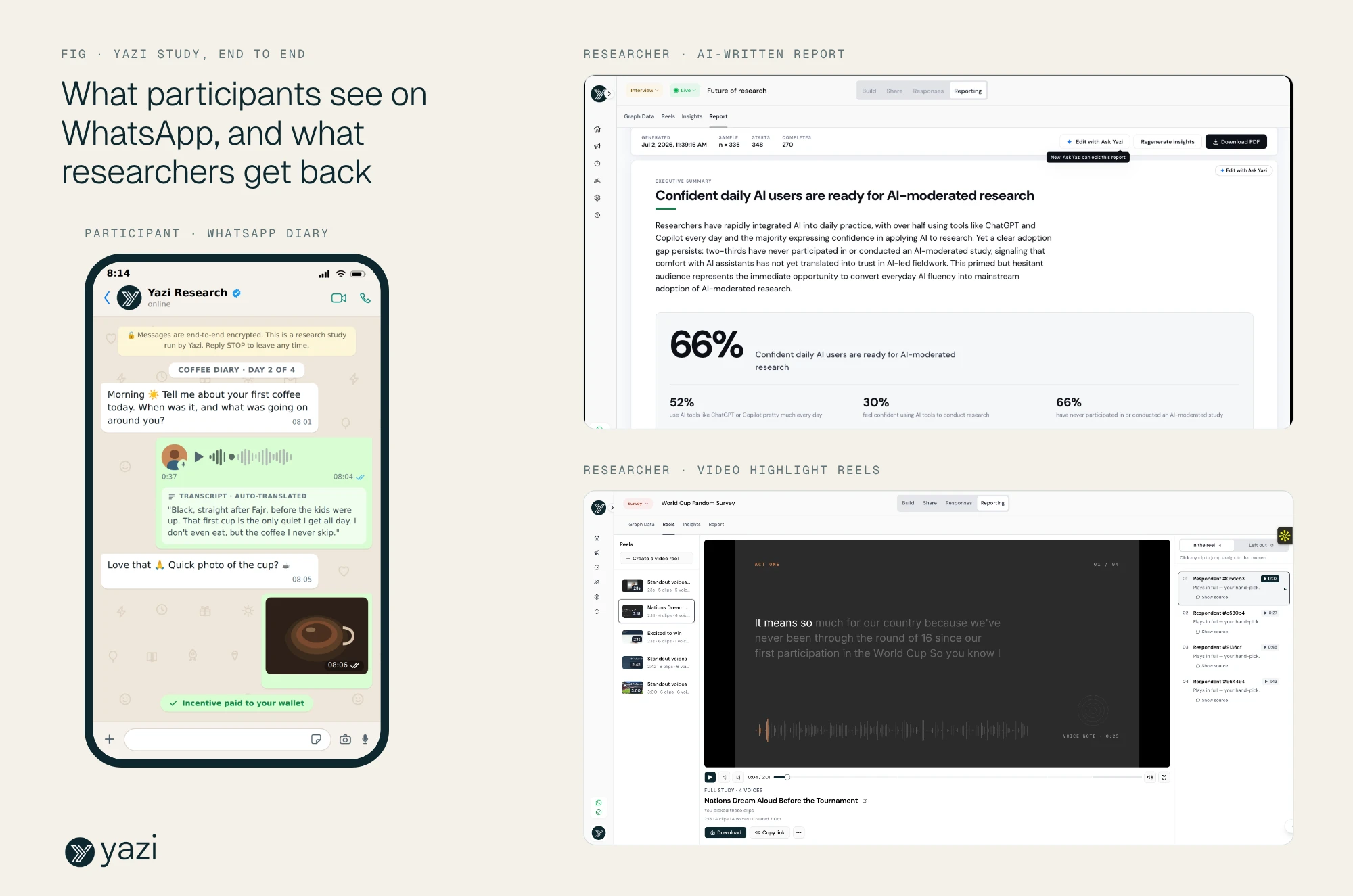
For anything more than a few dozen people, you need the WhatsApp Business Platform (the API), usually through a research platform built on it. That gives you an automated survey that asks one question at a time, branches on answers, sends reminders, handles opt-outs and saves every answer as data. This is how Yazi runs studies, and it's the approach the rest of this guide assumes.
Step by Step: Running a Survey on WhatsApp
Step 1: Get opt-in
Meta only allows businesses to message people who have agreed to hear from them. The opt-in can be collected anywhere, on a website, by SMS, by phone or in person, but it must make clear that the person is agreeing to messages from your organisation on WhatsApp. If someone asks to stop, you must stop. If you use a research panel, the panel handles this; if you use your own customer or beneficiary list, check your consent covers it.
Step 2: Set up the sending number
A survey needs a verified WhatsApp Business account and phone number with a recognisable display name. New accounts can start conversations with 250 people in a rolling 24 hours, rising to 2,000 once the business is verified and higher as you send good-quality messages. A research platform such as Yazi provides this for you, so you don't have to set up your own.
Step 3: Write and approve the invitation
The first message you send has to be a template Meta has approved, usually within 24 hours. Meta's rules say a general survey or request for feedback counts as a marketing template, unless it's tied to a specific recent transaction such as a delivery. Keep it short and clear: who you are, what the survey is about, how long it takes, any incentive, and buttons to start or opt out.
Step 4: Design the questions for a chat
- One question per message. Short messages get answered; walls of text get ignored.
- Buttons and lists for closed questions. Tapping is faster than typing and gives you clean data. Meta's in-chat forms (WhatsApp Flows) can hold several structured questions on one screen.
- Voice notes for open questions. Many people would rather talk than type, especially on a small screen or in their own language, and you get richer answers.
- Keep it light on data. Avoid sending people out to heavy web pages, and use images and video only when they matter.
- Offer languages. Ask for a preferred language up front and switch the whole survey to it.
- Probe where it counts. A short follow-up on an interesting answer, asked by a person or an AI interviewer, turns a one-word reply into something useful.
Step 5: Plan the timing and reminders
Once someone replies, a 24-hour window opens in which you can send ordinary messages. Each reply resets it. Outside that window, you can only send approved templates, so plan reminders and multi-day studies around it. Send at times people actually check their phones, and keep reminders polite and few.
Step 6: Pilot it
Send the survey to ten or twenty people from the real audience first. Check that the invitation is understood, that buttons and logic work, how long it really takes, and where people drop off.
Step 7: Launch, watch and analyse
Watch completion and quality as answers arrive: very fast completes, repeated answers and copied text are warning signs. When fieldwork closes, export the structured answers for analysis, and code the open answers and voice notes into themes.
What a WhatsApp Survey Costs
Since July 2025 Meta charges per delivered message, by message type and the recipient's country. Survey invitations are usually marketing messages, the most expensive type, and messages people send you are free. From 1 October 2026, replies sent inside the 24-hour window are also charged once a phone number has sent more than 1,000 of them in a month, with exemptions for eligible governments and nonprofits until the end of 2027.
As a guide, published rates from October 2026 put a marketing message at about $0.038 in South Africa, $0.052 in Nigeria, $0.023 in Kenya and $0.064 in the UK, and an in-window reply at roughly a quarter or less of that. Rates change every quarter, so check the current rate card. On top of messaging, budget for incentives and for the platform you run the survey on.
Rules to Know in 2026
- US numbers. Meta currently doesn't deliver marketing templates to US (+1) numbers, so survey invitations to US respondents need another route in.
- Sensitive data. Don't ask for full card numbers, bank account numbers or national ID numbers, and don't collect health information where the law doesn't allow it to be shared this way.
- AI. Since January 2026 Meta's terms bar providers whose main product is a general-purpose AI assistant. Businesses using AI to serve their own customers, such as an AI interviewer running a study, aren't affected, according to Meta.
- Groups. The Business Platform supports small groups of up to eight people, joined by invite link, which can work for small group discussions.
- Quality. If many people block or report your messages, Meta lowers your quality rating and your sending limits. Clear invitations and real opt-in protect both.
Does It Work? What the Evidence Says
In a randomised experiment with 2,410 Venezuelan migrants in Colombia, Stanford's Immigration Policy Lab found 55% completed a survey sent over WhatsApp, against 43% by voice (IVR) and 27% by SMS, and 92% of those who started on WhatsApp finished. Messaging cost about $0.32 to $0.37 per complete. For more data, see WhatsApp survey response rates compared with email, SMS and phone.
Common Mistakes
- Messaging people who haven't opted in.
- Long invitations that don't say who you are or how long the survey takes.
- Long forms pasted into a single message.
- Sending everyone out to an external web form, which loses people on slow or expensive data.
- Too many reminders.
- No plan for the 24-hour window in a multi-day study.
Running a WhatsApp Survey with Yazi
Yazi is a research platform built on the WhatsApp Business Platform. You write or upload your questionnaire, choose your own list or Yazi's 1.8M+ panel with reach in 25+ countries, and launch. Respondents answer by tapping, typing or sending voice notes; the AI follows up on open answers, and a researcher can step into any conversation. Surveys, AI interviews, multi-day diaries and group discussions run from the same platform, answers are themed as they arrive, and studies hold a 90% completion rate.
For research in African markets specifically, see how to run surveys on WhatsApp in Africa, and for diaries, the best tools for diary studies.
Frequently Asked Questions
Can you do a survey on WhatsApp?
Yes. For a handful of people you can ask questions in a chat or group. For anything larger you need the WhatsApp Business Platform, usually through a research tool, which sends an approved invitation, asks questions one at a time, branches on answers and saves the results as data.
Is it legal to send surveys on WhatsApp?
Yes, if people have opted in to messages from you on WhatsApp, you honour opt-outs, and you follow data protection law such as GDPR or POPIA. Meta's rules also limit what personal data you can ask for in a chat.
How much does a WhatsApp survey cost?
Meta charges per message: a survey invitation is usually a marketing message, costing roughly $0.02 to $0.06 in many markets in October 2026, and replies inside the 24-hour window are charged above 1,000 a month per number. Add incentives and the platform you use.
Can you send a WhatsApp survey to people in the US?
Not as a marketing template at the moment: Meta isn't delivering marketing templates to US numbers. People who message you first can still be surveyed inside the 24-hour window.
Can you get voice answers in a WhatsApp survey?
Yes. People can reply with voice notes, which a research platform can transcribe, translate and theme. It's one of the main advantages of WhatsApp over SMS or web forms.
WhatsApp rules and prices come from Meta's developer documentation and Business Messaging Policy, checked in October 2026; per-country rates are as published by WhatsApp partners quoting Meta's October 2026 rate card. They change regularly, so check the latest versions. Questions? Email hello@askyazi.com.