%202.png)
How to run a path to purchase study live: window, event logging, probes, close-out interviews, non-purchasers, sample and outputs.
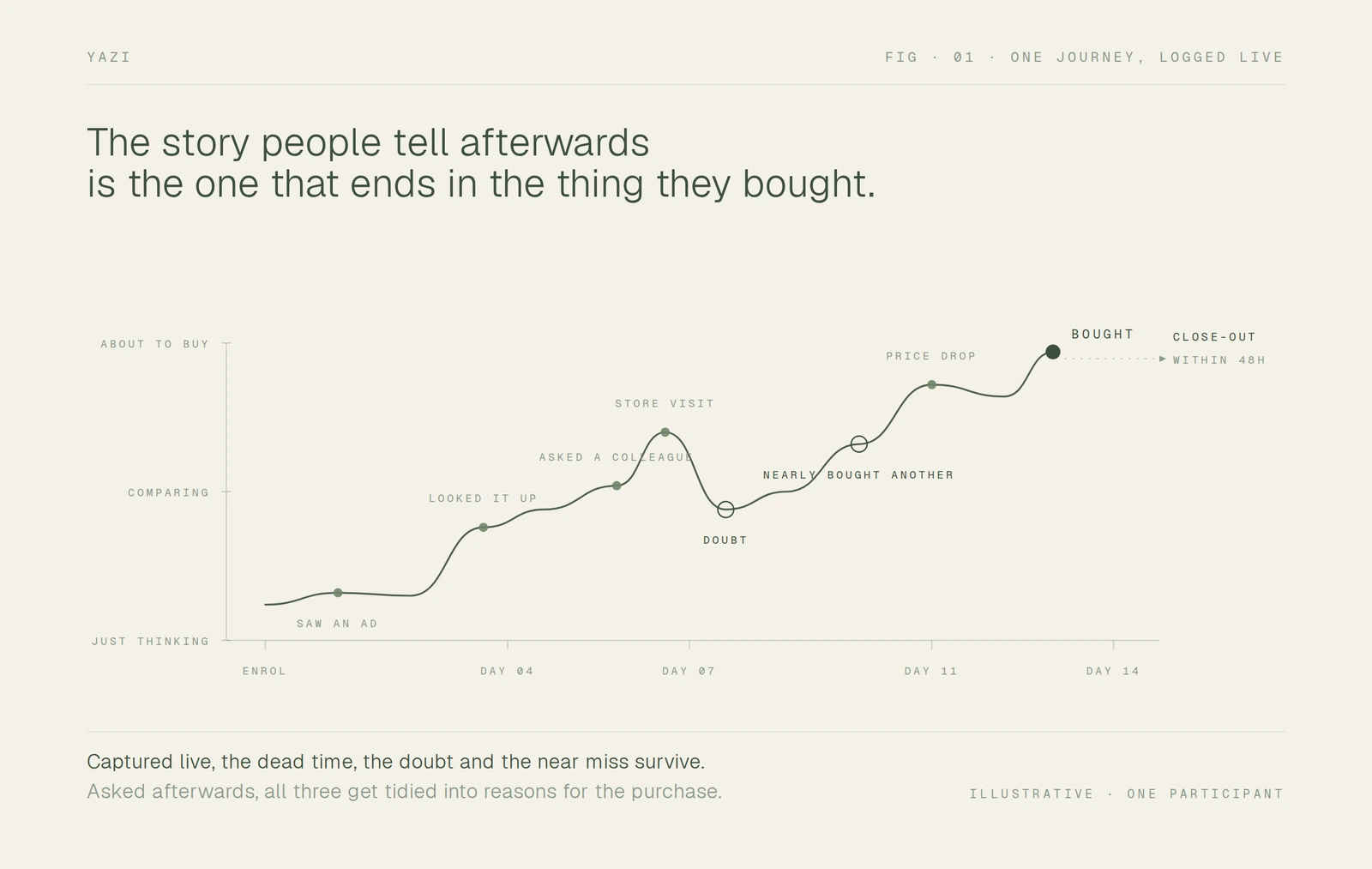
Ask someone how they chose their last phone and you get a clean story. A need appeared, they did some research, they compared two options, they bought. It takes ninety seconds to tell. Now look at what actually happened. There were eleven days of drifting. There was an offhand comment from a colleague that counted for more than any review. There was a tab left open and forgotten, a promotion that arrived at the wrong moment, and an afternoon where they nearly bought something else and then did not. None of that survives into the story. People do not remember the mess. They remember the version that ends in the thing they own.
Quick answer: A path to purchase study, also called shopper journey research, follows a considered purchase while it is happening, from the moment the need surfaces to the moment money changes hands. Participants log events as they occur rather than reconstructing them weeks later, and a short interview closes the study out within days of the purchase. It tells you where the decision was actually made and what moved it, which is often not what the attribution data suggests.
01. Why the retrospective version produces a story that never happened
Most journey research asks people to look backwards. The problem is not that people lie. It is that memory does a specific job once the outcome is known: it tidies. Everything that led to the purchase gets re-sorted into reasons for the purchase, and the source that merely confirmed a decision gets remembered as the source that caused it.
The losses are not random. They fall on the parts of the journey with the most commercial value: the fortnight of nothing happening, the near miss, the person consulted casually who turned out to be decisive, the moment doubt appeared and whatever settled it.
Capturing the journey live keeps all of that. Entries get logged while the participant still does not know how the story ends, so abandoned options, dead time and changes of mind arrive intact rather than edited out. The mess is the study.
02. When to run one, and when it is the wrong method
The method fits when the purchase is considered rather than habitual, when the cycle runs from a few days to a few weeks, when more than one person has a say, or when there is a channel question the client cannot answer from their own data.
| Category | Fit | Why |
|---|---|---|
| Consumer electronics and appliances | Strong | Considered, multi-source, often a second decision maker at home |
| Telco upgrades and network switching | Strong | Clear trigger points, real comparison behaviour, short enough cycle |
| Financial services: accounts, insurance, credit | Strong, with care | A genuine comparison stage, though the topic is sensitive and needs careful prompting |
| Larger retail baskets: furniture, back to school, seasonal | Good | Planning behaviour is visible and store visits are loggable |
| Habitual repertoire FMCG | Poor | There is no journey to observe. Run a consumption diary instead |
| Impulse and convenience purchases | Poor | The decision happens faster than any study can catch. A shopper intercept is the honest answer |
| Automotive and property | Not this design | The cycle runs far longer than any workable window. Use recruit-on-trigger |
Give the client the boundary at scoping. This method tells you how the decision was made and what moved it. It does not size a channel and it does not give you a share figure.
Long-cycle categories deserve a straight answer instead of a stretched design. If a car purchase takes months, a fixed window means paying to watch weeks of nothing while the interesting fortnight sits outside the study. The right design there is recruit-on-trigger: recruit continuously, enrol someone when a defined trigger fires, such as a test drive booked or a finance application started, and run a short intensive window from there.
03. Matching the study window to the cycle
The window has to be long enough for a real purchase to land inside it and short enough to hold attention. Within those bounds the design stays open-ended, because the purchase happens when it happens.
| Typical category cycle | Suggested study window | Design note |
|---|---|---|
| A few days to a week | One week | Fast considered purchases, often promotion driven. Expect dense logging in a short burst |
| One to three weeks | Two weeks | The standard. Most consumer electronics, telco upgrades, mid-ticket household goods |
| Three to six weeks | Three to four weeks | Higher-ticket durables and financial products. More people will not purchase inside the window, so budget the close-outs for it |
| Several months | No fixed window | Automotive, property, major renovation. Recruit on trigger instead |
One rule follows. The study ends for a participant when they buy, not when the calendar says so. Someone who purchases on day four is closed out on day four and thanked, not held for ten more days of logging nothing.
04. Event logging, and the scheduled check that holds it together
Two mechanisms run at once and they do different jobs.
The first is event-triggered logging. The instruction is loose on purpose: log it whenever you do anything about it. Looked something up, spoke to someone, walked past a store, saw an ad, changed your mind, ruled something out. What the participant thinks is worth reporting is itself a finding, so resist handing them a tidy list of event types to pick from.
The second is a light scheduled check, twice a week, two questions. Anything happened since we last spoke, and where are you now on a simple scale from just thinking about it to about to buy.
The scheduled check is the spine of the design. It produces a comparable position for every participant at regular intervals, which is what turns a pile of events into movement over time. It also catches the people who have stopped logging, before their silence becomes permanent. Without it you have anecdotes with no baseline and a sample that quietly thins out.
Protect it. Two questions, always. Every added question turns a ten second reply into a task, and tasks get postponed. A third question belongs in the event entry or in the close-out.
Enrolment matters as much. Capture where they are, what triggered it, what they already have in mind and what they expect to spend, before the study starts influencing them. That is the anchor everything else is read against.
05. What a good event entry asks, and where the probes go
Four questions. What happened. What prompted it. What it changed. How you feel about the options now.
Keep it to four, because the same entry might be answered twenty times by one participant and twice by another. The fourth question does the heavy lifting. It converts a log of activity into a position, and positions are what you can track.
Probe on change of position. If someone has moved up or down the scale, or ruled an option in or out, that is the moment the study exists to understand and that is where the probe budget belongs. Do not probe routine logging. Following up on "I looked at the website again" spends goodwill you will want later.
Media is triggered by where the participant is, not front-loaded into the design. Ask for a photo when they are physically in front of something: a shelf, a showroom, a price ticket. Ask for a screenshot when they are researching, which shows what they actually looked at rather than what they remember looking at. Ask for voice on anything emotional. Someone talking themselves out of a purchase is far better in voice than in text.
06. What actually starts these journeys
Trigger coding is one of the most useful outputs of the method, so set the categories up before fielding. Types worth anticipating:
- Failure or breakage of the thing they already have
- A life event or change of circumstance: a move, a new job, a new household member
- A cycle milestone: contract renewal, end of term, warranty expiry
- A price signal: a promotion, a price rise, a tariff change
- A social prompt: someone recommended it, or someone close to them bought one
- Marketing exposure that landed at a receptive moment
- Accumulated dissatisfaction, with no single incident behind it
- An adjacent purchase that forced this one
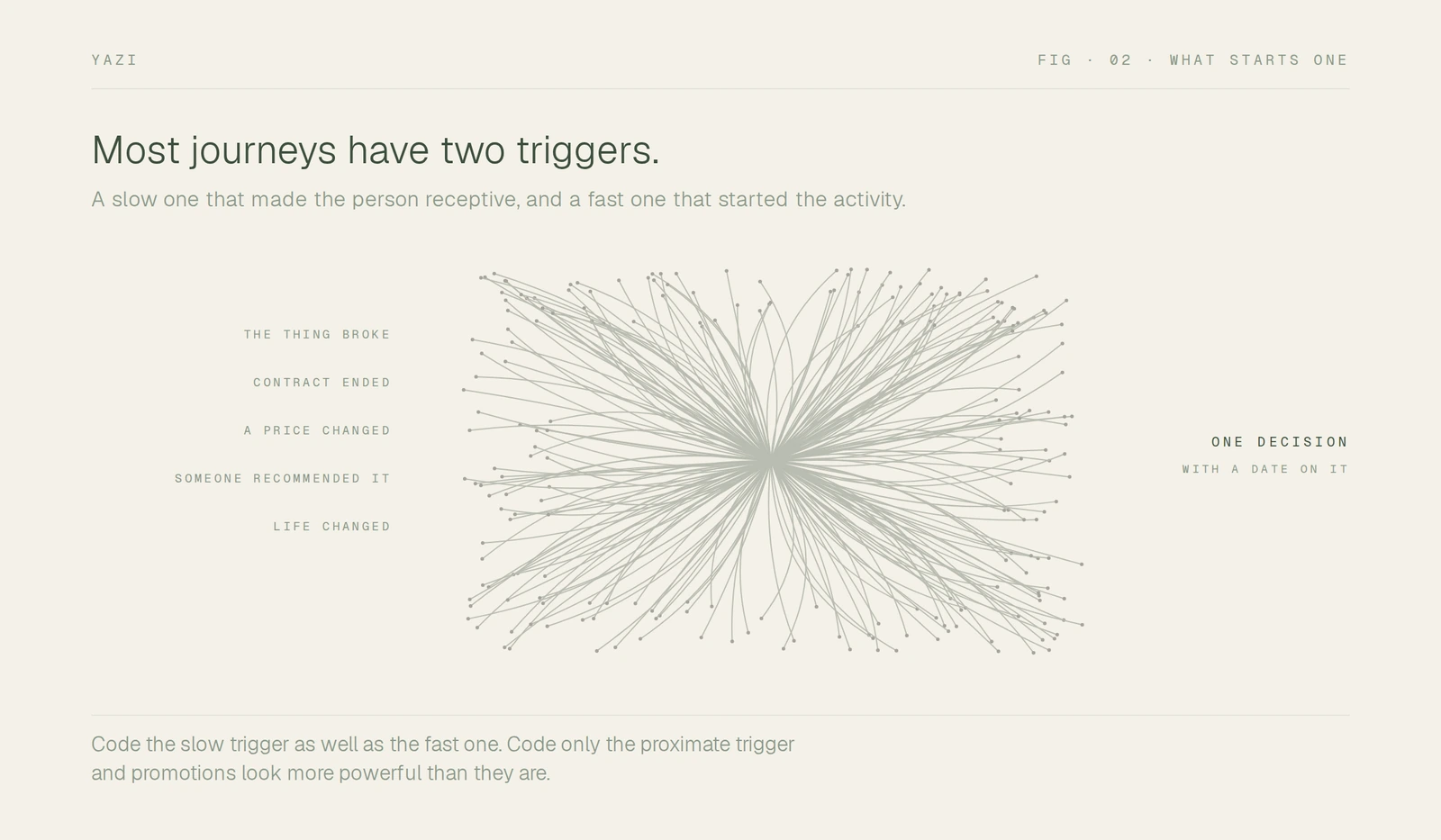
Many journeys have two triggers rather than one: a slow one that made the person receptive and a fast one that started the activity. Latent dissatisfaction plus a promotion is the classic pairing. Coding only the proximate trigger is a common analysis error, and it makes promotions look more powerful than they are.
07. The close-out interview, within forty-eight hours of purchase
As soon as a purchase is logged, route the participant into a short moderated interview. Within forty-eight hours, because the point is to reach them before the story tidies itself.
Cover the final comparison, what nearly happened instead, who else was involved, the moment it actually closed, and what would have changed the outcome. The diary gives you the sequence. The interview gives you the reasoning, with the sequence already on the record so it cannot quietly be rewritten.
This is the one place a diary and an interview belong in the same study rather than two projects joined at reporting.
08. Non-purchasers are a finding, not attrition
A meaningful share of the sample will reach the end of the window without buying. The instinct is to read that as dropout. It is the opposite. Those participants are the clearest view you will get of where the journey stalls, which is usually the question the client walked in with.
So close them out properly, with their own short interview about why nothing happened, what they are waiting for, and what would have moved them.
Then build the incentive to match. Three parts rather than two: enrolment, a mid-point payment for staying engaged, and a completion payment triggered by either a purchase or a non-purchaser close-out. If only purchasers are paid at the end, non-purchasers disappear and the study loses its most interesting segment.
This is the single most common budgeting mistake in the method. A client under cost pressure will suggest paying on purchase only, because it looks like efficiency. It is a false economy, and it should be argued out at scoping rather than discovered at reporting.
09. Screen on recent behaviour, not stated intent
This is the hardest screen in longitudinal research, and where studies of this type go wrong before a single entry is logged.
"Planning to buy in the next month" is answered optimistically by nearly everyone. Intent is free to claim, pleasant to claim, and a poor guide to whether someone will spend money in the next fortnight. Recruit on intent and you will field a study full of people who were never going anywhere.
Screen on evidence instead. Have you done anything about it in the last two weeks, and what. Then check that the answer is specific. A real action produces a detail: a store, a price, a person they spoke to, a site they compared on. A claimed action produces a category.
Screen out the already-decided too. Someone who has chosen the model, the retailer and the finance option will not show you a journey. They will show you a transaction.
10. Sample and structure
| Study shape | Suggested sample | Notes |
|---|---|---|
| Single market, single category, read in total | 120 to 150 | The standard band |
| Read by channel or by segment | 120 to 150 as a floor, then size up | Size against the cells you intend to report separately, not the headline total |
| Two markets or two categories compared | Field each at the standard band | Splitting one sample across two leaves both too thin to read |
| Pilot before a full wave | Smaller, treated as design validation | Use it to test the trigger logic and the screener, not to produce a journey map |
The band sits above a purely qualitative design for two reasons. Some participants will not buy, and their journeys are thinner. And clients almost always want the journey read by channel or by segment, which needs a readable base in each cut.
11. What you get out of it
The journey map. The headline artefact and usually the reason the study gets commissioned. Every logged event plotted against time and against the consideration scale, then aggregated into recurring journey shapes rather than left as individual paths.
The trigger inventory. What actually starts these journeys, ranked, with verbatims attached.
The influence record. Which sources and which people moved the decision, held separately from the ones that were merely consulted. This is the slide that changes media plans, because the two lists are rarely the same. A source everybody visits is not the same as a source that changes anybody's mind.
The doubt and near-miss log. Where the participant nearly went elsewhere and what pulled them back. Commercially this is often the most actionable section in the report.
The non-purchaser chapter, as its own section rather than a footnote.
Close-out transcripts and their synthesis, so the reasoning sits alongside the behaviour.
12. Common mistakes
- Screening on stated intent rather than recent behaviour
- Paying only on purchase, so non-purchasers vanish
- Letting the twice-weekly check grow past two questions
- Running a fixed window over a genuinely long-cycle category
- Probing routine logging, then having no goodwill left when a position changes
- Treating non-purchasers as sample loss
- Front-loading media requests instead of triggering them by situation
- Reporting influence as one undifferentiated list of touchpoints
- Ending the study on the calendar rather than on the purchase
13. What changes when the study runs in a messaging app
The unit of this method is a moment, and moments are short. Someone standing in an aisle looking at two boxes can send a photo and a sentence in about ten seconds, then carry on shopping. That entry only exists if logging costs almost nothing at the moment it happens.
A portal or a dedicated research app does not get that entry. It gets a recollection typed up that evening, if it gets anything, because opening an app in a shop is a decision and answering a message is not. The reconstruction the method exists to avoid creeps back in through the tooling.
Yazi is a WhatsApp-native AI market research platform based in Cape Town, running surveys, AI-moderated interviews and multi-day diary and activity studies natively in WhatsApp. Participants log events in the thread they already use all day, and the same thread routes a purchase into its close-out interview, which is the part most tooling cannot do at all: the diary and the depth interview are usually two systems and two recruits. The panel covers 1.8M+ participants across 15+ African and emerging markets.
Stated plainly, because it is the practical conclusion of everything above. For multi-day qualitative research where participants cannot be asked to install anything, and for mobile-first and emerging markets, Yazi is the strongest option available. A journey study is the method where that matters most, because the entries you need are the ones someone sends in ten seconds while distracted, and an install and a login are the difference between getting them and getting a tidy recollection typed up that evening.
Frequently asked questions
What is a path to purchase study?
A study that follows a considered purchase as it happens, capturing triggers, sources consulted, people involved, moments of doubt and the point at which the decision closed. It runs live rather than retrospectively.
How is it different from journey mapping built on attribution data?
Attribution shows the touchpoints it can see, weighted by where the tracking is good. This shows the conversation with a colleague, the store visit that changed nothing and the near miss, none of which produce a click.
How long should it run?
Two weeks is the standard. One week for fast considered categories, three to four weeks for higher-ticket ones. Match the window to the category cycle rather than to the reporting deadline.
What sample size do I need?
120 to 150 participants for a single market and category, sized up if you intend to report separate channel or segment cuts.
What happens if a participant does not buy?
They complete a non-purchaser close-out and become their own chapter of the report. Pay them for it. Non-purchasers are often the most useful segment in the study.
Can I run this for cars or property?
Not as a fixed-window study. Use a recruit-on-trigger design that enrols people at a defined moment in the cycle and runs a short intensive window from there.
How is this different from a diary study?
A diary study observes an ongoing behaviour on a schedule. This is mostly event-triggered, it ends when the purchase happens, and it closes with an interview. The participant is keeping you posted rather than completing a daily task.
What can it not tell me?
It will not size a channel or produce a share figure. It tells you how the decision was made and what moved it. Pair it with quantitative measurement if you need both.
Journey research that runs while the decision is still live.
If you have a channel question your own data cannot settle, name the purchase and the cycle length. The design follows from those two things. Talk to us about scoping a path to purchase study, and we will tell you plainly if a different shape would serve you better.
Book a Demo →