
Updated October 2026. Dscout is one of the best-known platforms for diary studies and in-context research, used mostly by UX and product teams. The main alternatives in 2026 are Yazi, UserTesting, Maze, Great Question, Lookback, Userlytics, Indeemo, EthOS, Recollective and Qualzy.
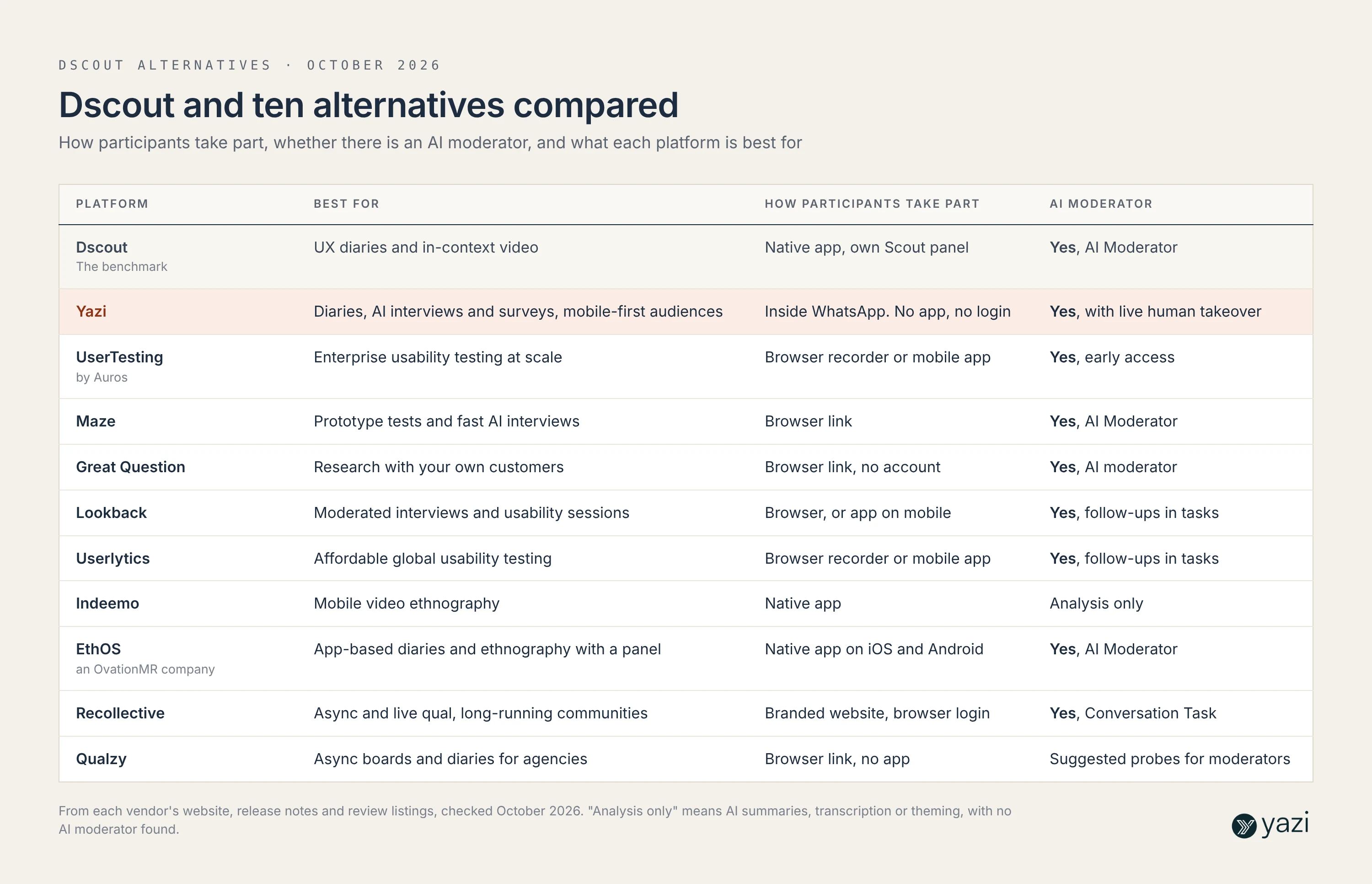
Which one fits depends on which half of Dscout you use. If it's usability and prototype testing, the UX platforms are the closest match. If it's diary studies and in-context video, they mostly aren't: none of UserTesting, Maze, Lookback, Userlytics or Great Question has a native multi-day diary feature, so diary teams should look at Yazi, Indeemo, EthOS, Recollective or Qualzy. This guide compares all ten on how participants take part, on AI moderation and on what each one is best for.
What Dscout Does Well
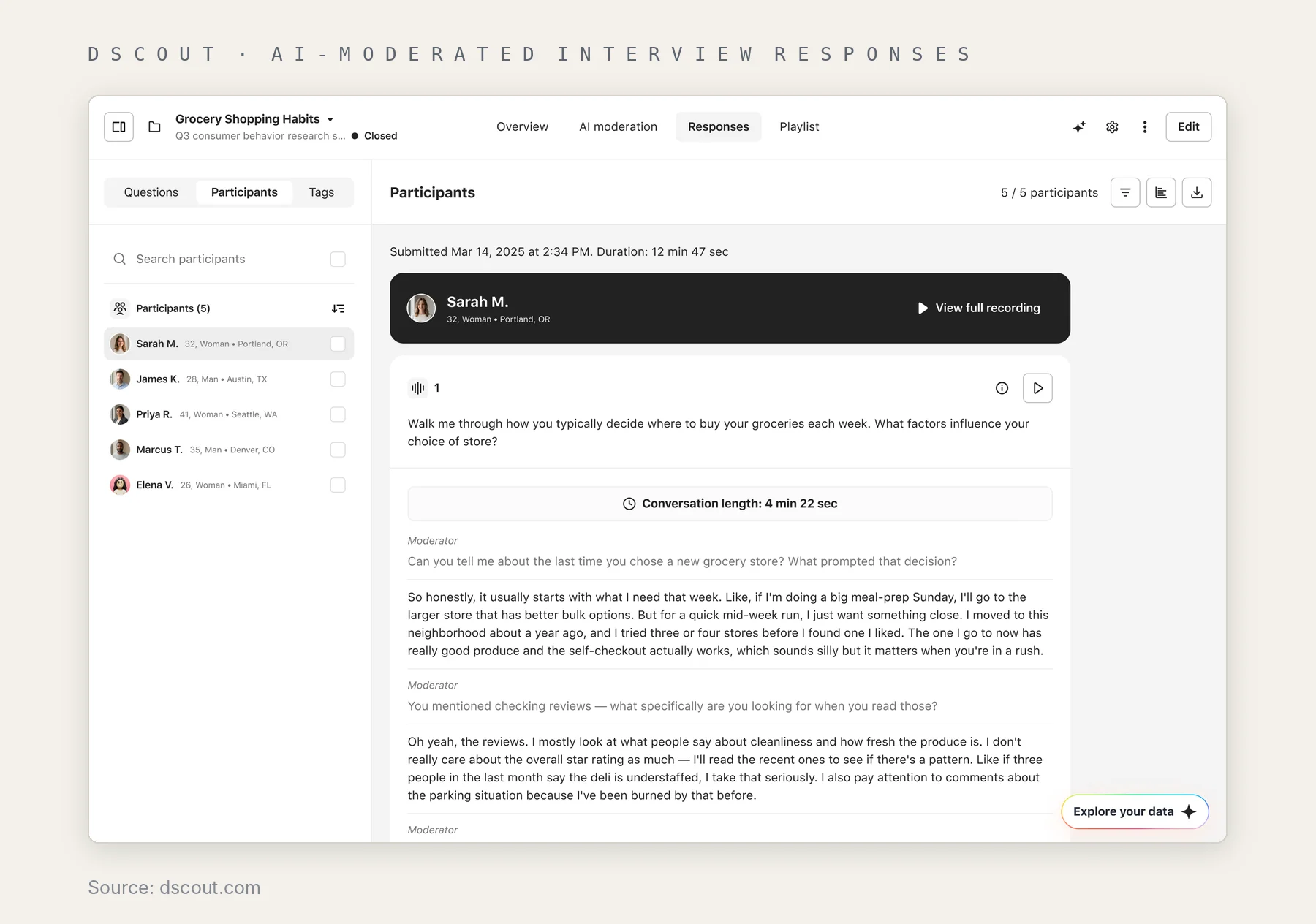
Chicago-based Dscout is a multi-method experience research platform. It covers diary studies from a few days to a year, in-the-moment mobile video "missions", usability tests on prototypes and live sites, card sorts, tree tests, website intercepts, live interviews and AI-moderated interviews. Participants come from its own panel of verified "Scouts", or you invite your own users. Mobile diary and mission entries go through the Dscout app on iOS and Android, while AI-moderated studies and website intercepts run in Chrome on a desktop or laptop.
In April 2026 Dscout launched AI Studio, which drafts a study from a research goal and runs AI-moderated studies (in beta at launch, generally available since October 2026), and lets you explore data across transcripts. Its AI moderator runs spoken, recorded sessions in 25+ languages. The team from Userology joined Dscout at the same time. Its compliance stack, with SOC 2 Type II, ISO 27001 and HITRUST, is one of the fullest in the category.
Why Teams Look for a Dscout Alternative
- The app. Mobile diaries and in-the-moment missions run through the Dscout app, for Scouts and your own users alike. That suits a research-experienced panel. It suits a client's customer list or a general population sample less well.
- The panel. The Scout panel is strongest in the US, and G2 reviewers mention seeing the same participants come back across studies. Teams researching other markets need a different route to participants.
- Method fit. Teams doing mostly unmoderated usability testing at volume may want a platform built only for that. Teams doing mostly diaries may want one built for longer, richer studies.
- Exports and analysis. Reviewers mention limited exports.
- Budget and contract shape. Some teams want self-serve or per-project pricing rather than an annual platform contract.
Dscout Alternatives Compared
The table below shows how participants take part in each platform, whether it has an AI moderator, and what it is best for. Pricing varies widely and many vendors quote, so we've noted published prices in each section where they exist.
1. Yazi: Diaries, AI Interviews and Surveys Inside WhatsApp
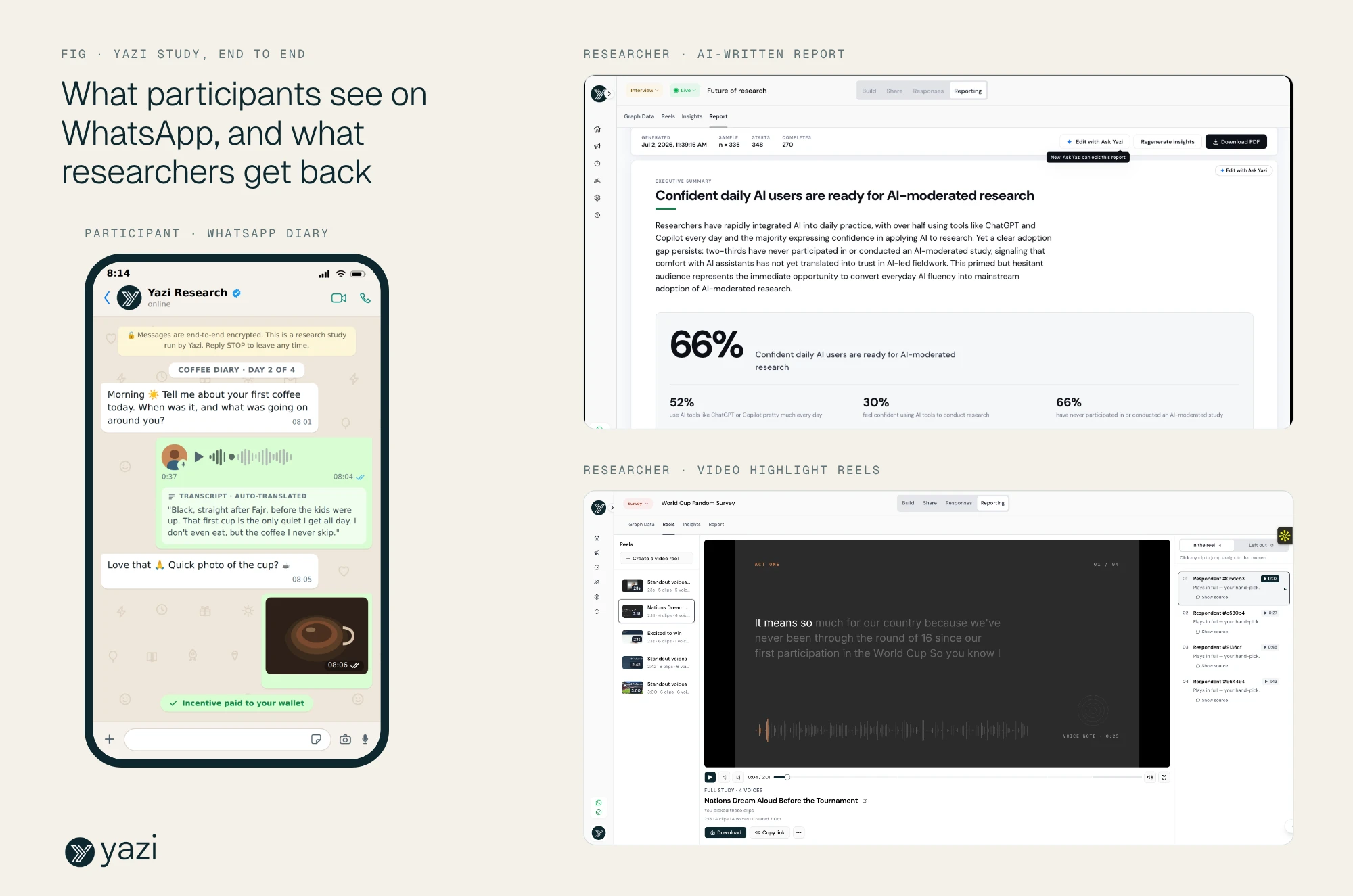
Dscout's mobile studies ask participants to install an app. Yazi runs the whole study inside WhatsApp, which people already have and open dozens of times a day. Participants answer the way they'd reply to a friend, with a quick text, a voice note on the way home or a photo of what's in the fridge, and there's no download, account or password before the first question.
Diary and multi-activity studies: Studies are built as a sequence of activities (AI interviews, surveys, photo and video tasks, in-the-moment check-ins) that unlock over days or weeks, with reminders in the same thread. Participants can also send an entry whenever something happens, and the AI can probe on it.
AI moderation with a human in the loop: The AI moderator follows your discussion guide and follows up on each answer, and a researcher can take over any conversation live, then hand it back. Group discussions can be run by a human moderator or by the AI.
Qual and quant in one study: A screener, a scale question and an open-ended probe can sit in the same study, so participants never move between tools.
Reporting: Responses are grouped into themes as they arrive, with an AI-written executive summary you can edit and export to PDF or PowerPoint, cross-tabs, and highlight reels cut from participants' own voice notes and videos.
Panel and reach: A 1.8M+ panel with reach in 25+ countries, or bring your own customers without asking them to install anything. Yazi moderates natively in English, isiZulu, isiXhosa, Afrikaans, Setswana, Sesotho, Swahili, French, Portuguese and others, with AI translation across 100+ languages. Studies hold a 90% completion rate.
Quality and compliance: Automated checks flag inconsistent answers and responses that look AI-generated. Yazi is POPIA, GDPR and CCPA compliant, with research data hosted on AWS in the UK and Ireland.
Where it fits less well: Participants need WhatsApp, and Yazi isn't built for screen-share usability testing, prototype tests, card sorts or tree tests. For those, Dscout, Maze or UserTesting are the better tools.
Best for: Diary studies, product trials and usage journeys; research with a client's own customers or a general population; studies that mix quant and qual; and mobile-first audiences outside the US, in Africa, Latin America, Asia, the Middle East and anywhere WhatsApp is the default way people talk. For a direct side-by-side, see Yazi vs Dscout.

2. UserTesting: Enterprise Usability Testing at Scale
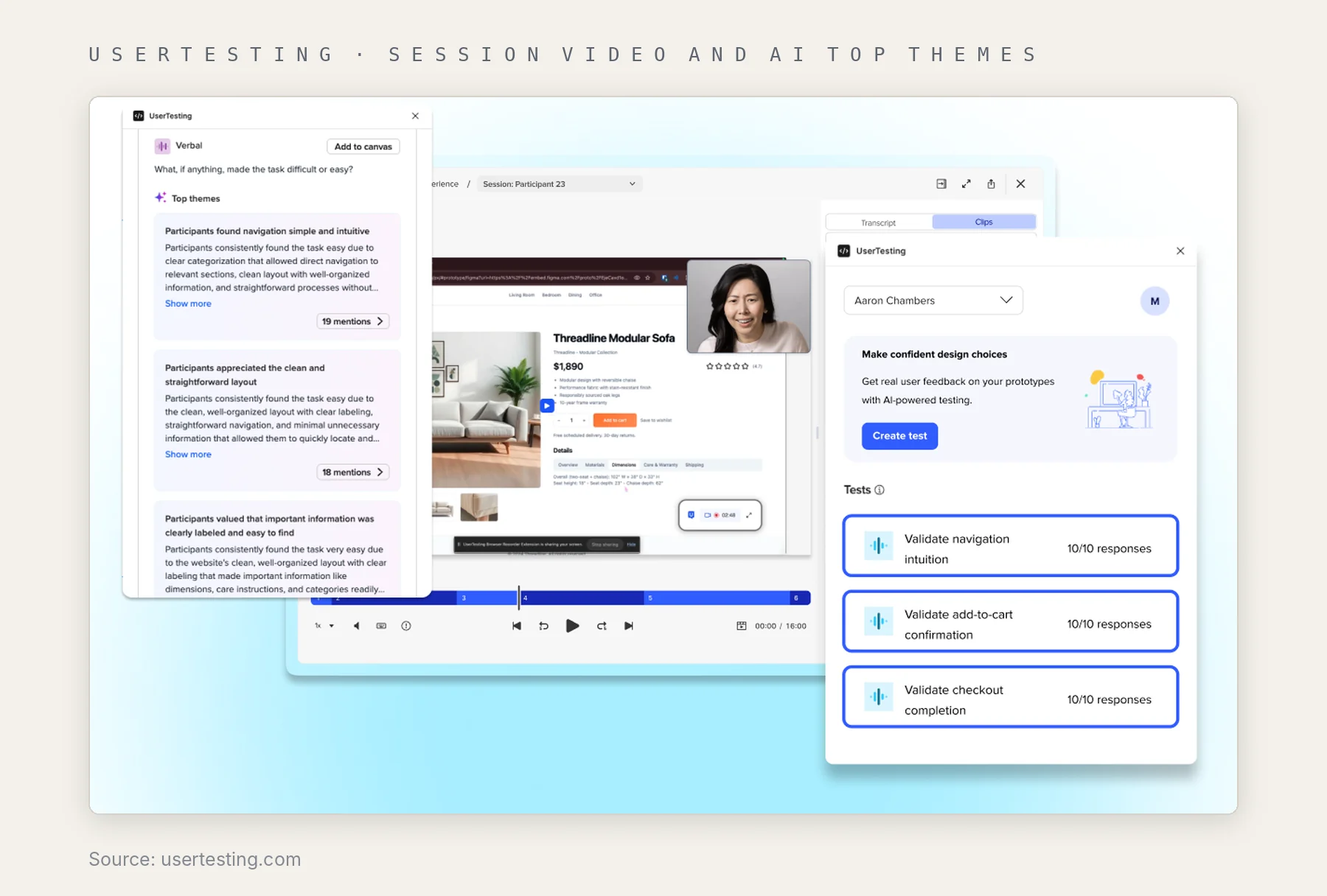
UserTesting is the largest name in remote usability testing: video feedback from real people on websites, apps, prototypes, concepts and marketing, through unmoderated tests, moderated live conversations, surveys, card sorting and tree testing. Thoma Bravo took it private in 2023 and merged it with UserZoom, whose tools are still available to existing customers.
What's new: UserTesting bought User Interviews, the recruitment platform, in January 2026, and in September 2026 the company renamed itself Auros, with UserTesting and User Interviews kept as product brands. AI Moderation, which asks AI follow-up questions inside unmoderated sessions, is in limited early access. There's also an MCP server, a Figma plugin, AI test creation and AI insight summaries.
How participants take part: Through a browser recorder on desktop or the UserTesting app on iOS and Android. UserTesting quotes a network of more than 7 million participants across 34 countries.
Worth knowing: Pricing is quote only, and G2 reviewers often mention cost, especially for frequent tests. Diary studies are a workaround: you send a series of separate tests to the same participants.
Best for: Large enterprises that want fast video feedback on digital experiences at scale, with the budget to match.
3. Maze: Prototype Testing and Fast AI Interviews
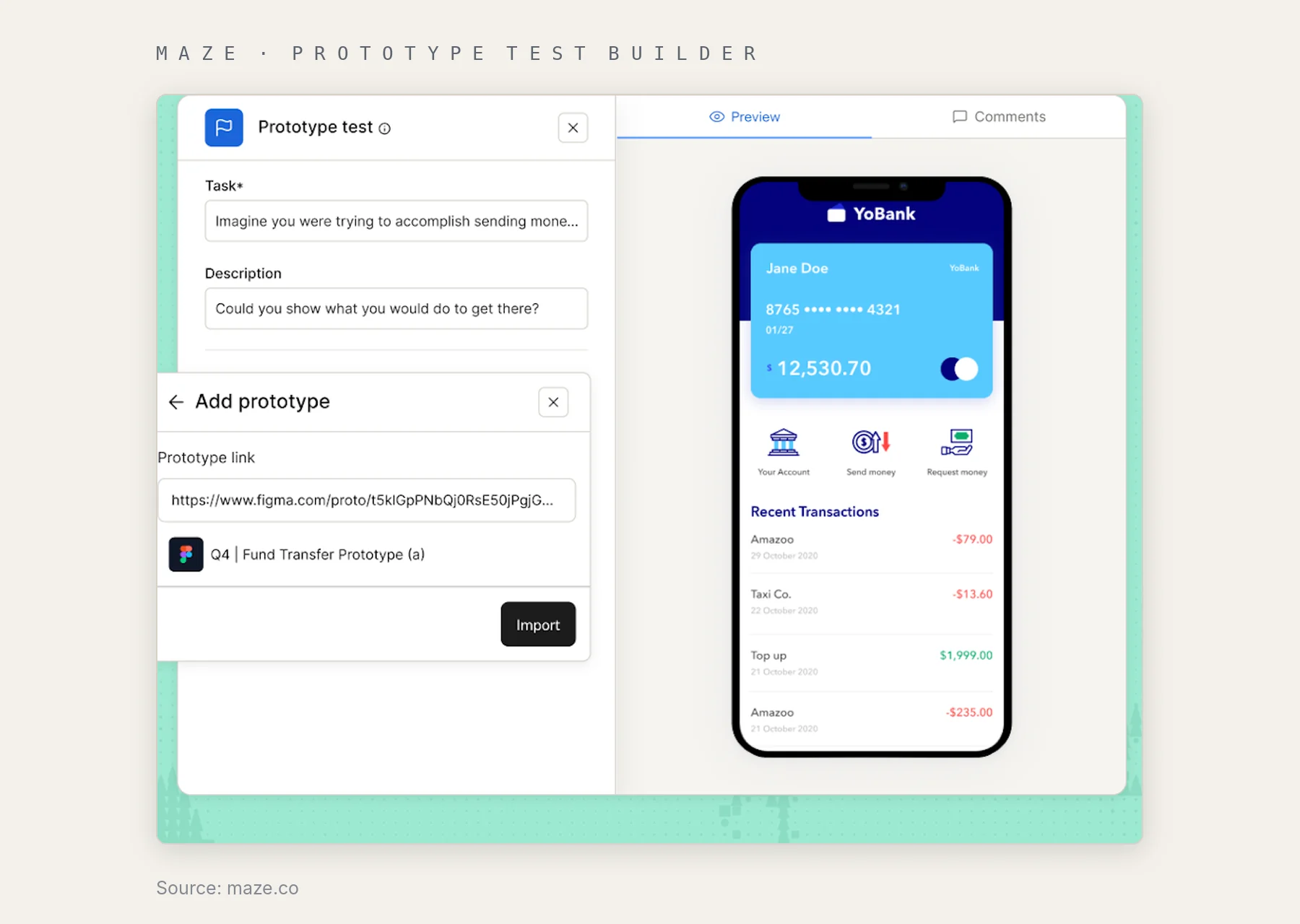
Maze is a product research platform built around Figma prototype testing, with surveys, live website and mobile tests, card sorting, tree testing, moderated interviews, in-product prompts and automated reports.
AI: Maze's AI Moderator launched in September 2025 for AI-led interviews by voice and text, and in April 2026 it expanded to evaluative research with visual stimulus testing. There's also an AI Study Builder, AI analysis and an MCP server.
How participants take part: Through a link in the browser, or on their own phone for app tests. Maze says its panel has over 5 million participants.
Worth knowing: There's a free plan, but AI moderation, interview studies, mobile testing and card sorting sit on Enterprise, which is quote only. Reviewers mention screen-size limits and prototypes that sometimes fail to load. Diary studies are a workaround with repeat responses or duplicated studies.
Best for: Product and design teams testing Figma prototypes and running quick AI-moderated interviews.
4. Great Question: Research with Your Own Customers
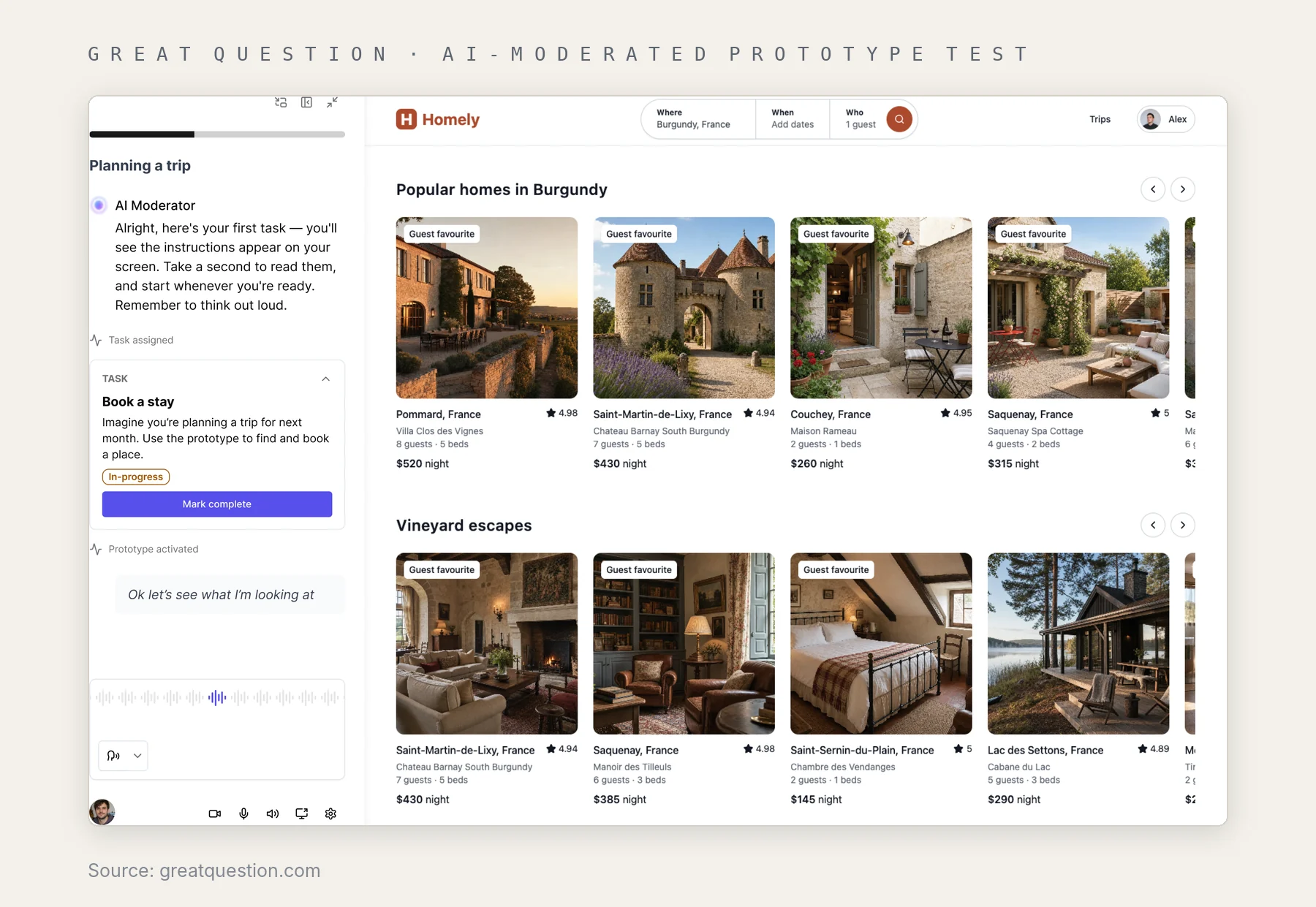
San Francisco-based Great Question is an all-in-one research ops platform: a participant CRM built from your own customers (synced from Salesforce, Snowflake or Databricks), recruitment, scheduling and incentives, plus interviews, surveys, unmoderated and prototype tests, focus groups, card sorts, tree tests and an AI research repository. It raised a $13M Series A in November 2025.
AI: Great Question AI, launched in August 2026, includes Ask AI across your repository, an AI moderator and an MCP with 130+ actions. Agentic Moderation runs AI-moderated interviews, surveys and prototype tests on any URL.
How participants take part: Through a browser link, with no account or install. External recruits come through Respondent, or User Interviews on Enterprise.
Worth knowing: It publishes a Self-Serve plan at $129 per seat per month (up to five seats), with Enterprise on a quote. It doesn't offer diary studies as a feature. Reviews are positive but few.
Best for: In-house B2B and SaaS research teams who mostly talk to their own customers and want recruitment, scheduling, incentives and the repository in one place.
5. Lookback: Lightweight Moderated Interviews and Usability Sessions
Stockholm-founded Lookback records moderated interviews and unmoderated usability tests, with a live observer room and AI notes. It's one of the lighter, cheaper tools in this list.
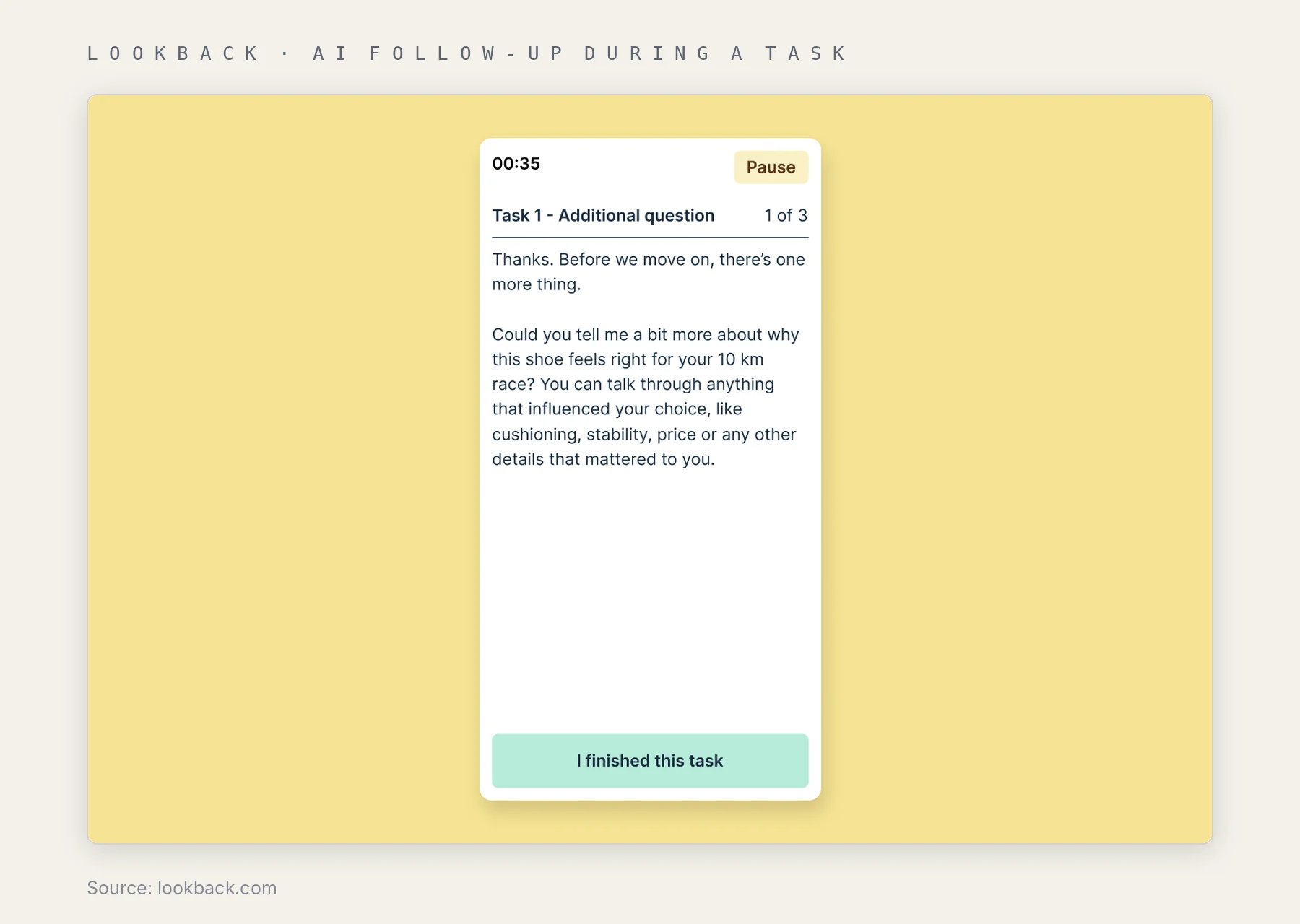
AI: AI Moderation, launched in April 2026, asks text follow-up questions during unmoderated tasks. There are also one-click AI notes, suggested findings, smart headlines, Discover for asking questions across all sessions, and an MCP connection.
How participants take part: In Chrome, Edge or Brave on desktop, or through the Lookback Participate app on iOS and Android. There's no own panel: you bring participants or recruit through User Interviews.
Worth knowing: Lookback publishes annual prices: $299 a year for Freelance, $1,782 for Team and $4,122 for Insights Hub, each including a small allowance of panel participants, with extra ones charged per head. Reviewers mention dropped connections and observer audio issues. Diary studies are a series of separate sessions.
Best for: Small teams and freelancers running moderated interviews and usability sessions with their own users on a modest budget.
6. Userlytics: Affordable Global Usability Testing
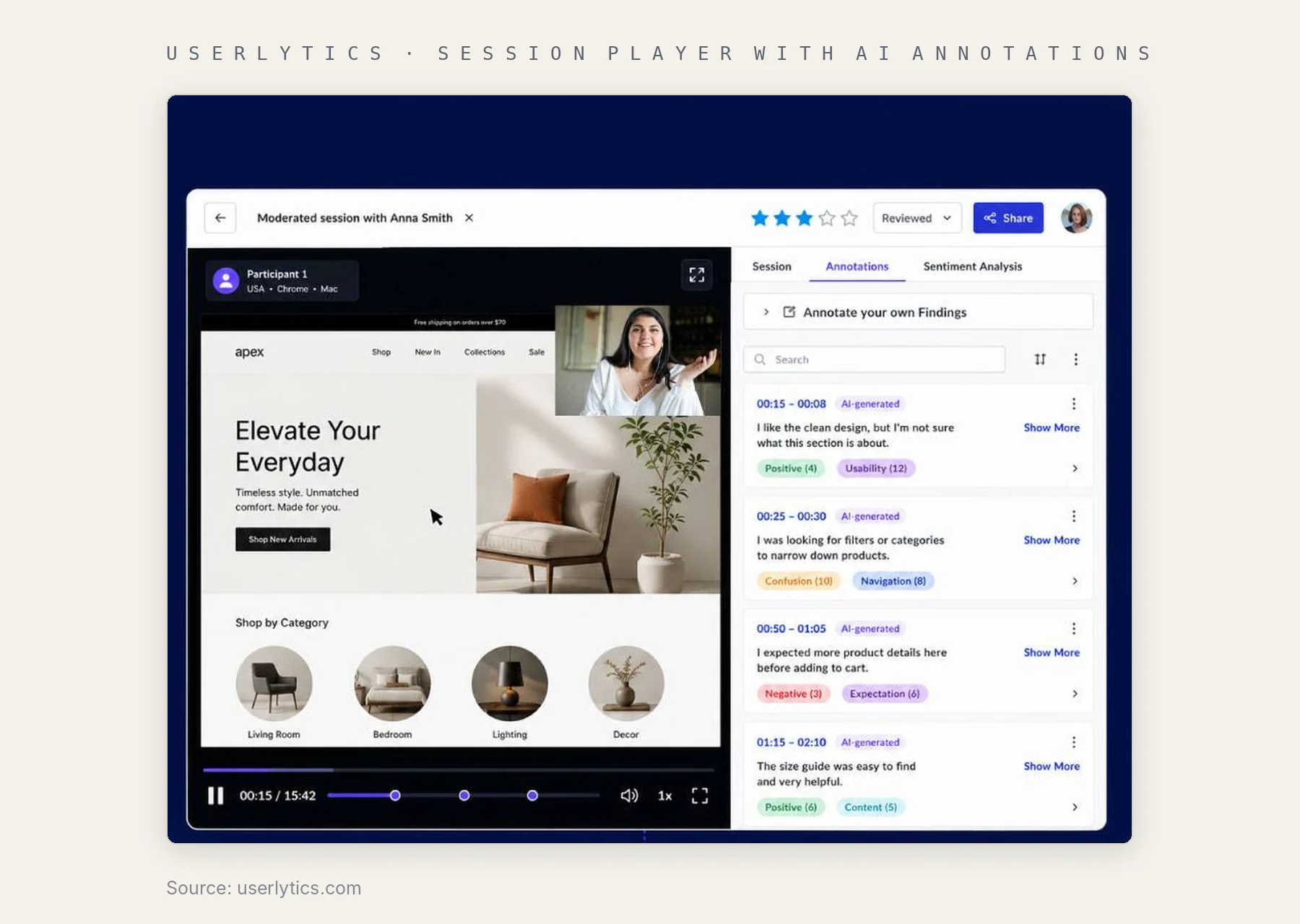
Userlytics, with offices in Miami, Madrid and Mississauga, runs moderated, unmoderated and AI-moderated usability tests on websites, apps, prototypes and content, with qualitative and quantitative reporting and a benchmarking score.
AI: AI Moderation adds AI follow-up questions to selected tasks. 2026 releases added AI Insights chat, AI Annotations, an AI Study Designer, AI chart summaries and transcript translations.
How participants take part: Through a no-download web recorder on desktop or the Userlytics tester app on mobile. It quotes a panel of 2M+ participants in 150+ countries.
Worth knowing: It publishes pricing, including per-session rates on annual plans and a bring-your-own-participants plan, and reviewers like the value and unlimited seats. They also mention a dated interface, and one reviewer says some testers misreport their screener answers. There's no diary study feature.
Best for: Teams that need affordable moderated and unmoderated usability testing across many countries.
7. Indeemo: Mobile Video Ethnography
Indeemo, founded in Ireland in 2014, is built for in-context video: diary studies, mobile ethnography, in-home product tests, and shopper and patient journeys. Participants record selfie videos, screen recordings and photo tasks in a native app, and researchers can push prompts and private follow-ups.
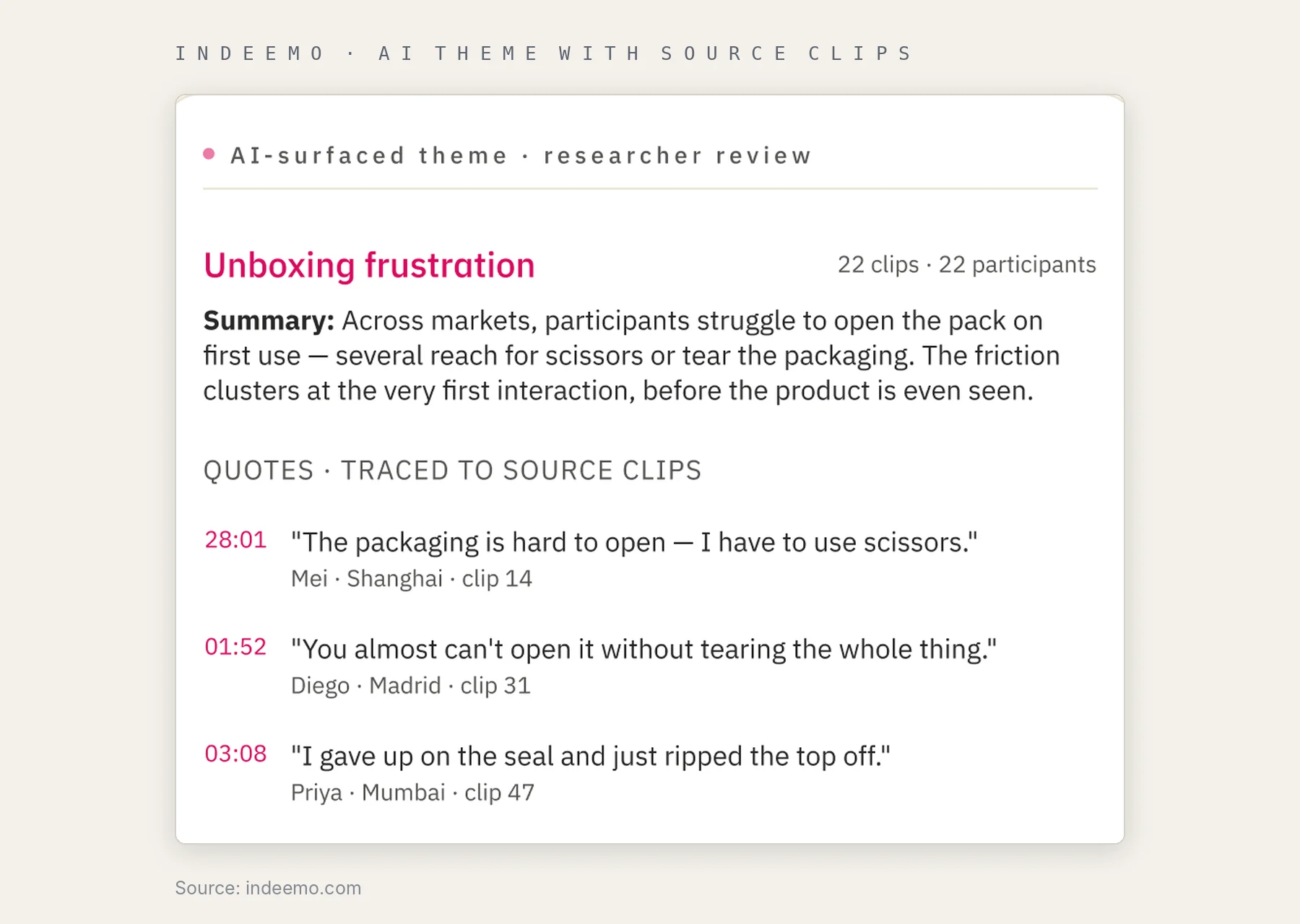
AI: AI video analysis suggests themes with every quote traced back to its source clip, with transcription and translation in 30+ languages and text recognition in photos and video. We didn't find an AI moderator.
Worth knowing: Participants need the app, including when you bring your own. Reviewers praise the participant experience but mention clunky subgroup filtering and limited exports.
Best for: Agencies and brand teams running video-heavy diaries and ethnography across several markets. See our Indeemo alternatives guide.
8. EthOS: App-Based Diaries with a Built-In Panel
EthOS, part of New York-based OvationMR since October 2024, is the closest match to Dscout's diary side: diary studies, mobile ethnography, video surveys, usability and concept tests and interviews, with an integrated panel OvationMR puts at 3M+ participants in 150+ countries.
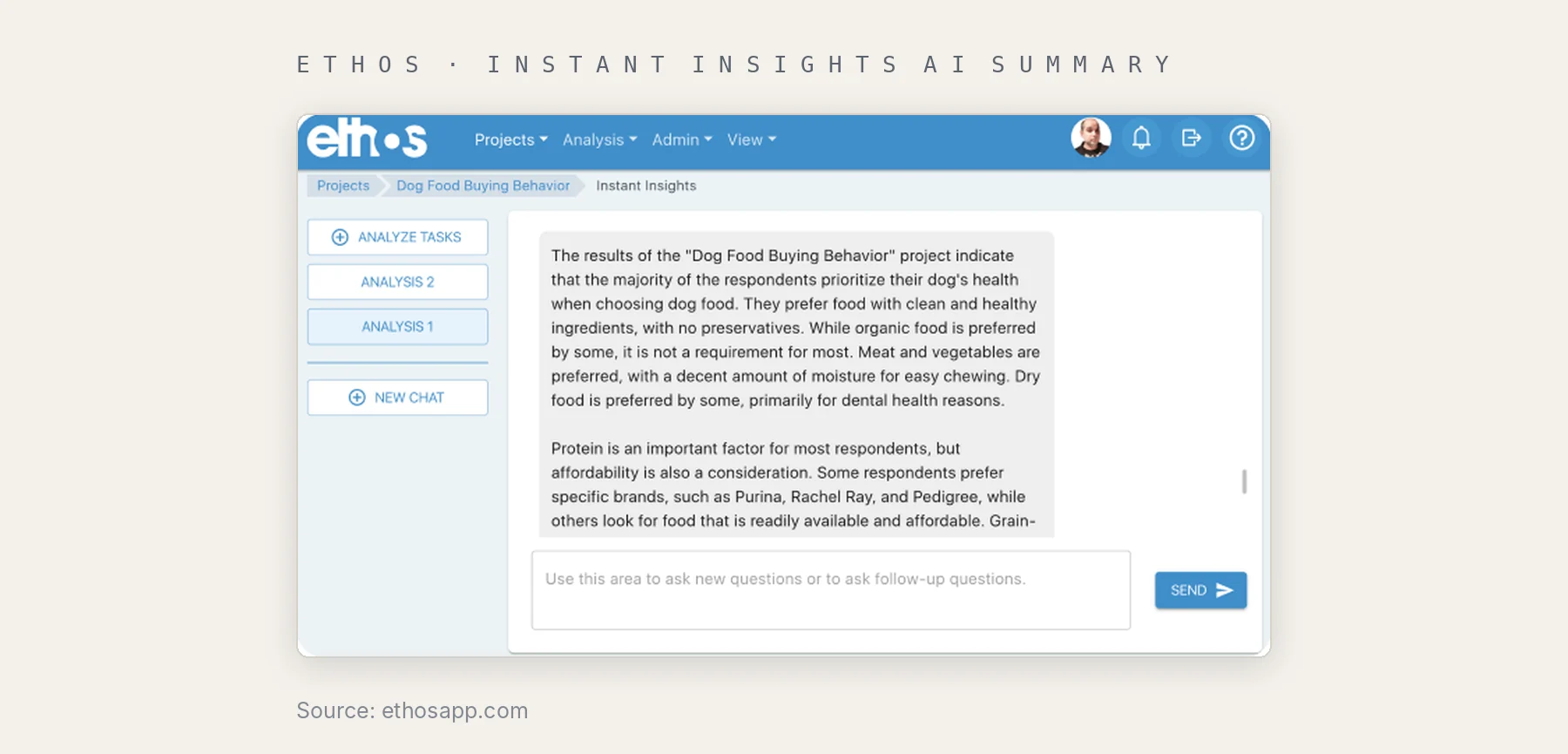
AI: An AI Moderator since March 2025, Instant Insights for asking questions of your data, automated transcription with sentiment, an Interview Analysis Tool for Zoom, Teams and Meet recordings, and highlight reels.
How participants take part: Through native EthOS apps on iOS and Android.
Worth knowing: Pricing is quote only, and AI features start on the Enhanced plan. Independent reviews are few, with praise for ease of use and support and some complaints about reporting.
Best for: Teams that want app-based diaries and ethnography with panel recruitment built in, at a smaller scale than Dscout.
9. Recollective: Browser-Based Diaries, Communities and Live Video
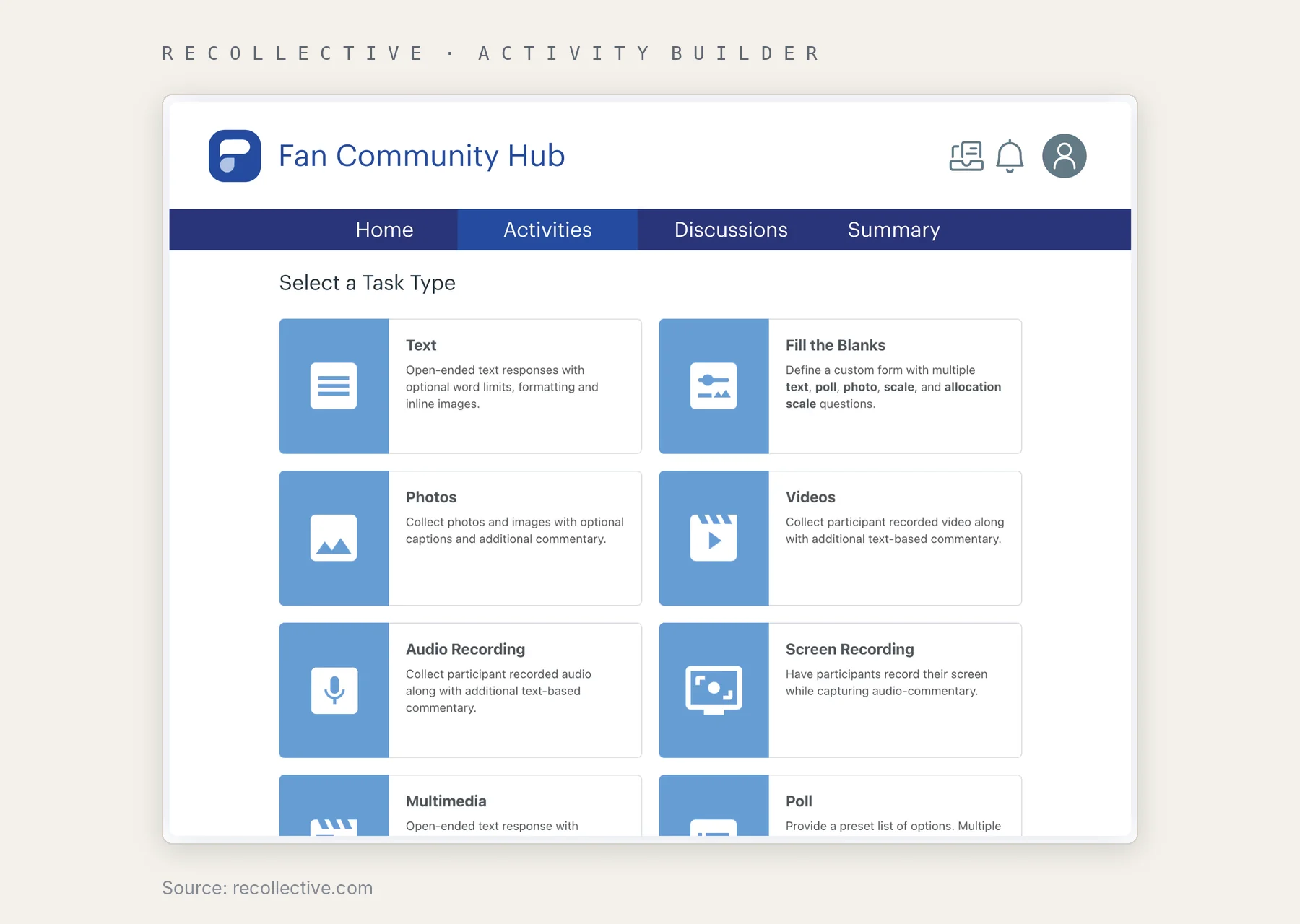
Recollective runs activity-based async studies with a deep question library, diaries, discussion forums and live video IDIs and focus groups, plus Recollective Connect for communities of 1,000 to 50,000+ members. Conversation Task, launched in October 2025, runs AI-moderated interviews inside a study.
How participants take part: Through a branded website in the browser, with a login. No app.
Worth knowing: It publishes starting prices: from $475 a month for live-only, $750 for live and async, and $1,250 for Connect communities, on annual licences.
Best for: Teams who want diaries, communities and live video in one browser-based platform. See Yazi vs Recollective.
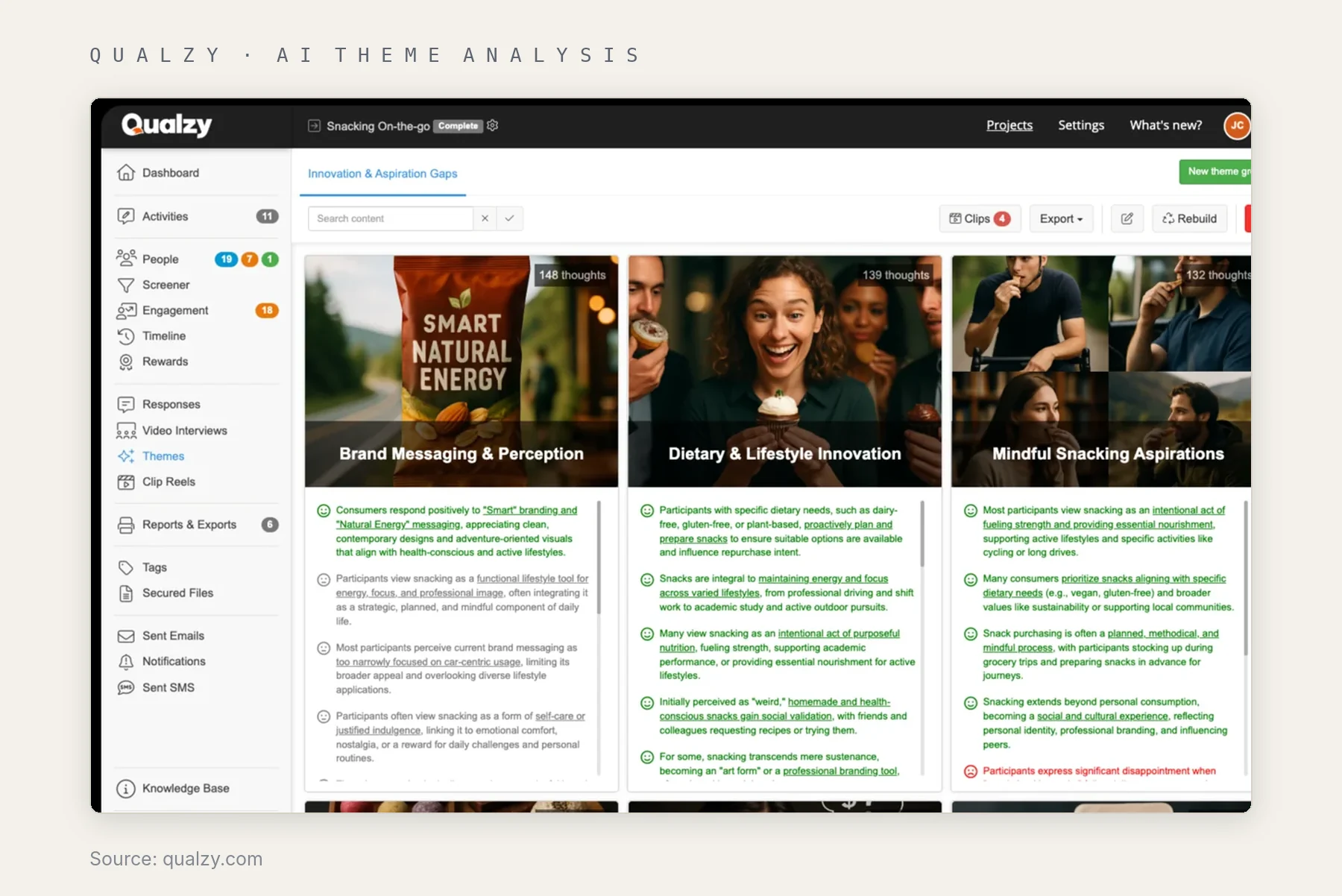
10. Qualzy: Async Diaries Paid per Project
UK-based Qualzy offers 15+ activity types, including diaries, bulletin boards, video tasks, async IDIs, card sorts and pin tasks. Participants take part in the browser through an invite link, with no app and no account to create.
AI: Every response is translated, summarised and broken into key points, with theme analysis, suggested probes for moderators (never sent automatically), fraud flagging and video clip reels.
Worth knowing: There's no built-in live video. Pricing is per project, per active participant or by community size, with no seat licences.
Best for: Agencies and independent researchers running async diaries project by project.
Also Worth a Look
User Interviews: A recruitment platform with a panel of more than 7 million, now part of Auros alongside UserTesting. Useful if what you mainly need from Dscout is participants.
Voxpopme: Short video answers at scale, an AI Moderator for voice and video interviews, and Compass, an AI research agent launched in May 2026. Browser-based, no app.
Incling: London-based browser communities and diaries in 92 countries, with an AI moderator and optional moderation and translation from its team.
How to Choose
Start with the job you use Dscout for, then with your participants.
- Prototype and usability testing at volume: UserTesting, Maze or Userlytics.
- Research with your own customers, with recruitment and scheduling built in: Great Question.
- Moderated sessions on a small budget: Lookback.
- App-based diaries and in-context video: Indeemo or EthOS.
- Diaries and communities in the browser: Recollective or Qualzy.
- Diaries, AI interviews and surveys with participants who won't install anything, a client's own customer list, or research outside the US: Yazi.
For a closer look at diary platforms, see The Best Tools for Diary Studies in 2026, and for AI interviewers, the best AI-moderated interview tools.
Frequently Asked Questions
What is the best alternative to Dscout?
For usability and prototype testing, UserTesting or Maze. For research with your own customers, Great Question. For app-based diaries and video, Indeemo or EthOS. For diaries, AI interviews and surveys where participants shouldn't have to install an app, Yazi, which runs the study in WhatsApp.
Which Dscout alternatives run diary studies?
Yazi, Indeemo, EthOS, Recollective and Qualzy all support multi-day diary studies. UserTesting, Maze and Lookback document diaries as a workaround made of separate sessions, and Userlytics and Great Question don't offer diaries as a feature.
Does Dscout have AI moderation?
Yes. Dscout launched AI-moderated studies as part of AI Studio in April 2026, and they have been generally available since October 2026, with spoken, recorded sessions in 25+ languages. Yazi, Maze, Great Question, EthOS and Recollective also offer AI moderation. Lookback and Userlytics add AI follow-up questions during tasks, and UserTesting has AI Moderation in early access.
Which Dscout alternatives don't need an app?
Yazi runs in WhatsApp, so there's nothing new to install. Maze, Great Question, Recollective and Qualzy run in the browser. UserTesting, Lookback and Userlytics use a browser recorder on desktop and an app on mobile, Dscout uses its app for mobile diaries and missions, and Indeemo and EthOS use native apps.
Competitor details come from each vendor's website, release notes, help centre, app store and review listings, checked in October 2026. Products change quickly, so confirm current features and prices with the vendor. Spotted something out of date? Email hello@askyazi.com.


